Author: Harlan Marriott

  • Vehicle-Related FBT – How To Manage What You’re Providing

    Vehicle-Related FBT – How To Manage What You’re Providing

    As an employer, when you provide vehicles like sedans, station wagons, or passenger vans for your employees’ private use, you might be offering a car fringe benefit.

    This applies to the employee behind the wheel and applies if their family members or associates use the vehicle. Understanding the implications of this can be crucial, as it triggers Fringe Benefits Tax (FBT).

    Knowing how FBT applies can help you manage these benefits effectively, whether it’s a compact SUV, an ute, or a company-owned sedan.

    Vehicle Type – What Is a ‘Car’?
    Determine if the vehicle qualifies as a “car” under FBT rules, including sedans, utes, and certain passenger vehicles. Vehicles like motorbikes or those with high carrying capacity might instead be classified under residual fringe benefits.

    • Private Use: A car fringe benefit arises if the vehicle is used for private purposes, including being garaged at an employee’s home or used for commuting.

    • Exemptions: Certain vehicles, like eligible electric cars, may be exempt from FBT, provided they meet specific criteria.


    Calculating The FBT
    FBT can be calculated using two methods: the statutory formula method and the operating cost method. The records you need to keep depend on which method you use to calculate the taxable value of the benefit you provide. You need to have records to support any claims or calculations you make.

    Statutory Formula Method:
    This applies a fixed percentage (20%) to the car’s base value.
    To use the statutory formula method, you must have the following records:
    • normal purchase records
    • invoices
    • receipts
    • journal entries
    • bills of sale
    • lease documents
    • employee records/declaration


    Operating Cost Method:
    This considers actual operating costs and the percentage of private versus business use.
    To use the operating cost method, you must have the following records:
    • actual costs repairs
    • maintenance
    • fuel registration and insurance leasing costs
    • deemed costs
    • depreciation
    • Interest


    When Might A Car Be Exempt From FBT?
    Electric cars are exempt from FBT under specific conditions. Certain vehicles, such as taxis and utes, might also be exempt if their private use is minimal.

    How To Remain Compliant
    You need to:

    1. work out the taxable value of the car fringe benefit
    2. calculate how much FBT to pay
    3. lodge your FBT return
    4. pay the FBT amount
    5. check if you should report the fringe benefit through Single Touch Payroll (or on your employee’s payment summary).
      Once the FBT year ends (on 31 March), use your records to calculate your FBT. If you have an FBT liability, you must lodge a return and pay any FBT you owe. FBT returns and payments are due by 21 May if you prepare your return yourself or your tax practitioner lodges it by paper on 25 June if your tax practitioner lodges it electronically.

    Navigating car fringe benefits can be complex, but understanding these key aspects will help ensure that your business remains compliant while providing vehicles to your employees.

    Need assistance with determining FBT? Why not speak to your trusted Leenane Templeton tax advisor?

    Disclaimer
    The information contained in this publication is for general information purposes only, professional advice should be obtained before acting on any information contained herein. Neither the publishers nor the distributors can accept any responsibility for loss occasioned to any person as a result of action taken or refrained from in consequence of the contents of this publication.

  • Side Hustle Culture: Having Your Own Business On The Side

    Side Hustle Culture: Having Your Own Business On The Side

    Starting a side hustle has become increasingly popular in Australia as more people seek additional income streams, personal fulfilment, or a way to test business ideas while maintaining their full-time jobs.

    While there are numerous benefits to having a side hustle, there are also challenges to consider. Let’s examine the pros and cons of starting a side hustle in Australia.

    Pros of Starting a Side Hustle

    1. Additional Income
      One of the most significant advantages of starting a side hustle is the extra income it can bring in. Whether saving for a house, paying off debt, or simply looking to boost your financial security, a side hustle can provide that much-needed financial buffer. In today’s gig economy, freelancing, tutoring, and ridesharing can help generate consistent earnings outside your main job.
    2. Flexibility
      A side hustle often comes with greater flexibility than a traditional job. You can choose when and how much you want to work, which allows you to balance other commitments like family, study, or your main job. This flexibility makes pursuing a passion project or building a business around your existing schedule easier.
    3. Skill Development
      Running a side hustle can help you develop new skills that may benefit your career in the long term. Whether it’s improving your marketing, sales, or time management abilities, working on a side project encourages you to wear multiple hats. These transferable skills can enhance your employability or even lead to promotions in your full-time role.
    4. Turning Passion into Profit
      For many, a side hustle is an opportunity to explore a passion outside of their regular job. Whether crafting, photography, writing, or tutoring, turning a hobby into a source of income can be incredibly rewarding. Over time, a successful side hustle might grow into a full-time business over time.

    Cons of Starting a Side Hustle

    1. Time Commitment
      A side hustle requires a significant time investment, which can affect your work-life balance. Balancing a full-time job with a side business can lead to long hours, which can result in burnout if not managed carefully. Setting boundaries is crucial to prevent your side hustle from overtaking other aspects of your life.
    2. Tax Implications
      In Australia, earning additional income through a side hustle means managing extra tax obligations. You’ll need to declare your side hustle income on your tax return, which could push you into a higher tax bracket. Additionally, you may have to register for GST if your side hustle earnings exceed $75,000 per year, increasing your tax responsibilities.
    3. Initial Costs
      Starting a side hustle may require an upfront financial investment. These expenses can add up, whether it’s purchasing equipment, setting up a website, or marketing your business. Without careful planning, you may spend more than you’re earning in the initial stages.
    4. Risk of Failure
      Not all side hustles succeed. You may find that your idea doesn’t generate as much income as expected or that competition is fiercer than anticipated. There’s always a risk that the time and effort invested won’t result in substantial rewards.

    Setting Up A Side Hustle
    Once you have considered the pros and cons of establishing your side hustle venture, you may decide to set yours up. To set up a side hustle in Australia, you’ll need a few key steps to get started:

    1. Choose a Business Idea: Identify a service or product you’re passionate about that has market demand.
    2. Register an ABN (Australian Business Number): If you’re earning money independently, you’ll need to register for an ABN. This helps with tax reporting and ensures your business is recognised legally.
    3. Understand Your Tax Obligations: Any income from your side hustle must be declared on your tax return. If your turnover exceeds $75,000, you must register for GST.
    4. Set Up Business Finances: It’s wise to have a separate bank account for your side hustle to track income and expenses easily.
    5. Marketing: Establish an online presence through a website or social media to attract customers.
      You can effectively set up and manage your side hustle by following these steps.

    Starting a side hustle in Australia can be a great way to earn extra income, develop new skills, and pursue personal passions.

    However, weighing the time commitment, financial costs, and tax implications is essential before jumping in. With careful planning and a clear understanding of the pros and cons, a side hustle can be a fulfilling and profitable venture. Looking to set up a business, book an advice session with one of LT’s accountants and business advisors.

    Disclaimer
    The information contained in this publication is for general information purposes only, professional advice should be obtained before acting on any information contained herein. Neither the publishers nor the distributors can accept any responsibility for loss occasioned to any person as a result of action taken or refrained from in consequence of the contents of this publication.

  • What Is The Small Business Superannuation Clearing House?

    What Is The Small Business Superannuation Clearing House?

    For small businesses in Australia, managing superannuation payments for employees can be a time-consuming and complex task.

    Super guarantee payments must be made quarterly.

    However, the Australian Taxation Office (ATO) offers a solution in the form of the Small Business Superannuation Clearing House (SBSCH).

    This online service simplifies paying super contributions for employees, providing small businesses a convenient and efficient way to meet their super obligations.

    Let’s explore the SBSCH’s features and benefits and how small businesses can use this tool to streamline their super payments.

    What is the Small Business Superannuation Clearing House (SBSCH)?
    The Small Business Superannuation Clearing House is a free online service the ATO provides to help small businesses meet their superannuation obligations.

    It allows employers to pay super contributions for their employees in one transaction, regardless of the number of funds they contribute to.

    The SBSCH acts as a central hub where employers can lodge their super payments, which are then distributed to the respective employees’ super funds.

    You’re eligible to use the Small Business Superannuation Clearing House (clearing house) service if your business has either:
    • 19 or fewer employees, or
    • annual aggregated turnover of less than $10 million.

    You must meet one of these eligibility criteria each time you use the service.

    Features and Benefits of the SBSCH:
    • Consolidated Payments: Employers can consolidate all their super contributions into a single transaction through the SBSCH instead of making separate payments to multiple super funds. This simplifies the payment process and reduces administrative burden for small businesses.
    • Accessibility: The SBSCH is accessible 24/7 through the ATO’s online services portal. Employers can log in to the portal anytime to submit their super payments, providing flexibility and convenience.
    • Secure and Confidential: The SBSCH employs strict security measures to ensure the confidentiality and integrity of employers’ financial information. All transactions are encrypted and protected by robust security protocols, giving employers peace of mind when making super payments.
    • Compatibility with Different Payment Methods: When using the SBSCH, employers can choose from various payment methods, including electronic funds transfer (EFT), BPAY, and direct debit. This flexibility allows businesses to select the best payment method for their needs and preferences.
    • Integration with Business Accounting Software: The SBSCH is compatible with most business accounting software, making it easy for employers to integrate super payments into their existing financial workflows. This seamless integration reduces manual data entry and streamlines the payment process for businesses.

    How to Use the SBSCH

    Using the Small Business Superannuation Clearing House is straightforward and user-friendly.

    Employers can follow these simple steps to make super contributions for their employees:

    1. Register: Employers need to register for the SBSCH through the ATO’s online services portal. Registration is free and only takes a few minutes to complete.
    2. Log In: Once registered, employers can log in to the SBSCH portal using their unique credentials.
    3. Enter Payment Details: Employers need to enter the payment details, including employee information, contribution amounts, and payment method.
    4. Submit Payment: After verifying the payment details, employers can submit the super contribution payment through the SBSCH portal.
    5. Receive Confirmation: Upon successful submission, employers will receive a confirmation receipt confirming that the super contributions have been lodged with the SBSCH.

    The Small Business Superannuation Clearing House (SBSCH) is a valuable resource for small businesses in Australia. It offers a simple and efficient way to manage employee super contributions.

    By leveraging the SBSCH’s features and benefits, businesses can streamline their super payment process, reduce administrative burden, and ensure compliance with their superannuation obligations.

    For small business owners looking to simplify their superannuation management, the SBSCH is a practical and accessible solution provided by the ATO. Need further assistance with meeting your superannuation guarantee payment dates and submitting? Speak with a trusted advisor.

    Disclaimer
    The information contained in this publication is for general information purposes only, professional advice should be obtained before acting on any information contained herein. Neither the publishers nor the distributors can accept any responsibility for loss occasioned to any person as a result of action taken or refrained from in consequence of the contents of this publication.

  • Superannuation, The Self-Employed & Contractors

    Superannuation, The Self-Employed & Contractors

    If you’re a contractor, freelancer, or self-employed, you’re probably already juggling multiple responsibilities, from managing clients to keeping track of your income.

    One area that often gets overlooked is superannuation, but it’s crucial to think about your future.

    Even though you may not have an employer making regular super contributions on your behalf, you can still take control of your super to ensure you’re building a nest egg for retirement.

    1 – Understanding Your Super Obligations
    As a contractor, you’re generally responsible for managing your superannuation contributions. Unlike employees with super contributions from their employers, contractors must take the initiative to contribute to their own super fund.

    However, if you’re working under a contract primarily for your labour, the business you’re contracting for may be required to make super contributions for you, just like they would for an employee. This is something to clarify when setting up your contracts.

    2 – Setting Up Your Super Fund
    The first step is to choose a super fund if you don’t already have one. Look for a fund that suits your needs, considering factors like fees, investment options, and performance.

    Many contractors opt for a low-fee, high-performance fund to maximise their savings over time.

    Once you’ve set up your fund, keeping your details updated and regularly reviewing your account to ensure it’s growing as expected is essential.

    3 – Making Contributions
    As a contractor, you can decide how much and how often you contribute to your super. One option is to set up regular contributions, which can help you stay on track without having to think about it too much. You can do this by setting up an automatic transfer from your bank account into your super fund. Even small, consistent contributions can add up significantly over time, thanks to the power of compound interest.

    Another option is to make lump-sum contributions whenever you have a good month or receive a large payment. The key is to make contributing to your super a priority, just like paying any other bill.

    4 – Take Advantage of Tax Benefits
    Contributing to your super as a contractor comes with some great tax benefits. For example, contributions you make to your super fund may be tax-deductible, which can help reduce your taxable income.
    This is a big advantage, especially if you have a higher income year. Additionally, by building your super, you’re setting yourself up for a more secure retirement, which is a reward in itself.

    5 – Super Co-Contributions
    If you’re earning within a low or middle income bracket, you might be eligible for the government’s super co-contribution scheme. This means that if you make a personal (after-tax) contribution to your super, the government will also contribute up to a certain amount to boost your savings. It’s a great incentive to put a little extra into your super and take advantage of free money from the government.

    6 – Keep an Eye on Your Super
    It’s important to stay engaged with your super fund. Regularly review your statements, check your investments’ performance, and make adjustments as needed.

    As your income and financial situation change, you might want to increase your contributions or change your investment options to suit your goals better.

    Superannuation might not be at the top of your to-do list as a contractor, but it’s an important part of securing your financial future.

    By understanding your super obligations, setting up a solid fund, and making regular contributions, you can build a comfortable nest egg for your retirement. Consult a licensed professional or your super fund if you need additional guidance tailored to your situation.

    Remember, even small contributions can make a big difference over time. So, take the time to invest in your future — you’ll thank yourself later! Speak with our LT Specialists.

    Disclaimer
    The information contained in this publication is for general information purposes only, professional advice should be obtained before acting on any information contained herein. Neither the publishers nor the distributors can accept any responsibility for loss occasioned to any person as a result of action taken or refrained from in consequence of the contents of this publication.

  • Understanding Closely-Held Employees & Small Business STP Reporting

    Understanding Closely-Held Employees & Small Business STP Reporting

    Small businesses, especially family-run ones, require careful attention to payroll for closely held employees, such as family members, directors, and shareholders.

    The Australian Tax Office (ATO) mandates that all employers adhere to Single Touch Payroll (STP) reporting requirements regardless of the employee’s relationship to the business.

    However, small businesses with fewer than 19 employees have some flexibility in how they meet these obligations. In many cases, small businesses may also have closely-held employees

    Understanding Closely-Held Employees
    Closely held employees are individuals directly related to the business entity from which they receive payments. This category typically includes:
    • Family members working in a family business
    • Directors or shareholders of a company
    • Beneficiaries of a trust
    For small businesses, closely held employees are part of the team, but how you manage their payroll might differ from that of other employees.

    STP Reporting Obligations
    STP reporting is mandatory for all employees, including closely held payees. The main difference lies in the flexibility small businesses offer in reporting this information. You can choose to report the pay of closely held employees in one of two ways:

    1. With Each Pay Period: Just as you would for regular (arm’s length) employees, you can report the payroll information for closely held employees on or before each payday.
    2. Quarterly Reporting: You can also opt to report this information quarterly. This option might be more convenient for small businesses that prefer a less frequent reporting schedule.
      However, for arm’s length employees – those who are not closely related to the business owner – STP reporting must be done on or before each payday without exception.

    Deciding the Best Approach for Your Business
    Choosing between quarterly and regular reporting depends on what works best for your business.
    Quarterly reporting might be a practical solution if your closely held employees have irregular pay schedules or if managing weekly or fortnightly reports feels burdensome.

    On the other hand, some businesses may prefer to keep all payroll processes uniform, opting to report both closely held and arm’s length employees together during regular pay periods.

    Regardless of the chosen approach, it’s essential to maintain accurate records and ensure that all reporting is timely. This not only helps in staying compliant with ATO requirements but also avoids potential penalties.

    Other Payroll Obligations

    While STP reporting is a significant part of payroll management, don’t overlook other obligations.
    For example, businesses must avoid pay secrecy practices and ensure transparency in how wages are determined and reported.

    Additionally, maintaining up-to-date records and ensuring fair pay practices are vital responsibilities that all employers should uphold.

    While managing payroll for closely held employees in a small business comes with specific requirements, the flexibility in reporting can be adapted to suit your business needs.

    By understanding your obligations and choosing the best reporting method, you can ensure smooth and compliant payroll management for your closely held employees.

    Speak with your tax adviser to ensure you are meeting your obligations, maintaining compliance standards, and are prepared for a smoother journey with your small business.

    Disclaimer
    The information contained in this publication is for general information purposes only, professional advice should be obtained before acting on any information contained herein. Neither the publishers nor the distributors can accept any responsibility for loss occasioned to any person as a result of action taken or refrained from in consequence of the contents of this publication.

  • Overcoming Business Challenges: Effective Strategies for Australian Businesses

    Overcoming Business Challenges: Effective Strategies for Australian Businesses

    Starting and running a business is an exhilarating journey filled with opportunities for growth and success. However, along the way, entrepreneurs inevitably encounter trials and tribulations that test their resilience and determination. From economic downturns to unexpected setbacks, here are some common challenges businesses face and strategies for overcoming them:

    Economic Uncertainty:
    • Economic downturns, market fluctuations, and global crises can significantly impact businesses of all sizes. During times of uncertainty, it’s crucial for businesses to reassess their strategies, streamline operations, and prioritize financial stability. Diversifying revenue streams, reducing unnecessary expenses, and maintaining open communication with stakeholders can help businesses weather economic storms.

    Competition:
    • In today’s competitive business landscape, standing out from the crowd is essential for success. Businesses must continuously innovate, differentiate their offerings, and deliver exceptional customer value. Conducting thorough market research, understanding competitors’ strengths and weaknesses, and leveraging unique selling propositions are key strategies for staying ahead.

    Cash Flow Management:
    • Cash flow challenges are a common concern for businesses, particularly startups and small enterprises. Poor cash flow management can lead to liquidity issues, missed opportunities, and even business failure. Implementing effective cash flow forecasting, establishing clear payment terms with customers and suppliers, and exploring financing options such as lines of credit or business loans can help businesses maintain healthy cash flow.

    Talent Acquisition and Retention:
    • Recruiting and retaining top talent is critical for business growth and success. However, finding and keeping skilled employees engaged can be daunting. Offering competitive salaries and benefits, providing opportunities for professional development and career advancement, and fostering a positive work culture are essential for attracting and retaining talent. Implementing robust recruitment and onboarding processes can help businesses identify and onboard the right candidates.

    Technology Disruption:
    • Rapid advancements in technology have transformed industries and disrupted traditional business models. Businesses that fail to adapt to technological changes risk falling behind their competitors. Embracing digital transformation, investing in innovative technologies, and leveraging data analytics to drive decision-making are essential for staying competitive in today’s digital age. Fostering a culture of innovation and agility within the organization can help businesses adapt to evolving technological trends.

    Regulatory Compliance:
    • Navigating complex regulatory requirements and compliance standards can pose significant challenges for businesses, particularly in highly regulated industries. Failure to comply with regulations can result in fines, legal consequences, and damage to reputation. Establishing robust compliance processes, staying informed about relevant laws and regulations, and seeking professional guidance when needed are essential for ensuring regulatory compliance.

    Customer Satisfaction:
    • Satisfying customers and building long-term relationships is crucial for business success. However, meeting customer expectations can be challenging, especially in today’s competitive marketplace. Businesses must prioritize customer satisfaction, actively listen to feedback, and continuously improve products and services to meet evolving customer needs. Building strong customer relationships, delivering personalized experiences, and providing exceptional customer service are key strategies for fostering loyalty and driving business growth.

    While businesses inevitably encounter trials and tribulations on their journey to success, with perseverance, resilience, and strategic planning, they can overcome these challenges and emerge stronger than ever.

    Businesses can navigate obstacles and achieve their goals by addressing challenges proactively, staying agile and adaptable, and seeking support when needed. Remember, every challenge presents an opportunity for growth and learning, and with the right mindset and approach, businesses can turn adversity into an advantage.

    Speak with your LT business accountant and advisor about your business challenges.

    Disclaimer
    The information contained in this publication is for general information purposes only, professional advice should be obtained before acting on any information contained herein. Neither the publishers nor the distributors can accept any responsibility for loss occasioned to any person as a result of action taken or refrained from in consequence of the contents of this publication.

  • Have More Than One Job? Here’s What You Need To Know About The Tax-Free Threshold

    Have More Than One Job? Here’s What You Need To Know About The Tax-Free Threshold

    It’s important to be aware of how the tax-free threshold works, especially if you’re earning income from more than one job.

    Many people mistakenly claim the tax-free threshold from multiple employers, which can lead to an unexpected tax bill.

    This guide will help you understand how to manage the tax-free threshold while juggling multiple sources of income, so you can keep your finances in check.

    Getting to Know the Tax-Free Threshold
    The tax-free threshold allows you to earn up to $18,200 each year without paying any tax. It’s a great benefit for Australian residents, especially for those on lower incomes. Understanding how this threshold works is key to making sure you’re not caught off guard when tax time rolls around.

    Which Incomes Count Toward the Tax-Free Threshold?
    It’s important to remember that the tax-free threshold applies to your total income, not just what you earn from one job. This includes:
    • Salaries and wages from your employers
    • Payments from government agencies
    • Income from work done under an Australian Business Number (ABN)

    How to Claim the Tax-Free Threshold
    You can only claim the tax-free threshold from one employer at a time. When you start a new job, your employer will ask if you want to claim the tax-free threshold. If you’re already claiming it from another job, you should let them know by answering “no.” This will help you avoid any tax-related issues later on.

    What Happens If You Claim the Tax-Free Threshold from Multiple Employers?
    If you mistakenly claim the tax-free threshold from more than one employer, you might not have enough tax withheld from your total income. This can happen if:
    • Your combined income from all employers exceeds $18,200, and
    • You’ve claimed the tax-free threshold from more than one job
    When this happens, you could end up with a tax bill that needs to be paid as a lump sum at the end of the financial year. No one likes surprises like that, so it’s best to get it right from the start.

    How to Avoid an Unexpected Tax Bill
    To steer clear of any tax surprises at the end of the financial year, here’s what you can do:
    • Claim the Tax-Free Threshold from Just One Employer: Choose the employer who pays you the most.
    • Notify Your Other Employers: If you need to stop claiming the tax-free threshold from one of your jobs, simply fill out a Withholding Declaration form and give it to your employer.
    • Keep an Eye on Your Income: Make sure you’re aware of how much you’re earning from all sources so you don’t exceed the threshold without enough tax being withheld.

    Managing Study or Training Support Loans with Multiple Employers
    If you have a study or training support loan, like a HECS-HELP or SFSS loan, it’s important to let each of your employers know. You’ll need to make compulsory repayments if:
    • You still have a study loan when you lodge your tax return, and
    • Your repayment income is above the minimum threshold

    Steps to Take
    • Inform Your Employers: Make sure all your employers know about your study loan so they can withhold enough for your compulsory repayments.
    • Adjust Withholding Amounts: You can use a Withholding Declaration form to ensure your employers are withholding the right amount to cover your loan repayments.

    Making Voluntary Repayments
    You’re always welcome to make voluntary repayments to reduce your study loan balance. But remember, if your repayment income is above the threshold, you’ll still need to make compulsory repayments even if you’ve made voluntary ones.

    Managing Tax If You’re a Sole Trader or Earn Through Online Platforms
    If you earn income as an employee and also as a sole trader or through online platforms, managing your tax is crucial to avoid surprises.

    Prepaying Tax on Business Income
    As an employee, your employer takes care of withholding tax from your pay. But as a self-employed individual, you’re responsible for the tax on your business income. To avoid a big tax bill at the end of the year:
    • Pay As You Go (PAYG) Instalments: You can prepay tax on your business income throughout the year using PAYG instalments. This spreads out your tax liability, making it easier to manage than paying a large sum at tax time.
    Understanding and managing the tax-free threshold is key to staying on top of your finances, especially if you have multiple sources of income.

    By claiming the tax-free threshold from only one employer and carefully managing any study loans or additional incomes, you can avoid unexpected tax bills and keep your financial situation under control. If you’re ever unsure about your tax situation, don’t hesitate to seek advice from a Leenane Templeton tax professional. Contact us today.

    Disclaimer
    The information contained in this publication is for general information purposes only, professional advice should be obtained before acting on any information contained herein. Neither the publishers nor the distributors can accept any responsibility for loss occasioned to any person as a result of action taken or refrained from in consequence of the contents of this publication.

  • Claiming Motor Vehicle Expenses

    Claiming Motor Vehicle Expenses

    Making the most of available tax deductions for your business can be an important aspect of starting the new financial year. It’s why planning and strategising with your tax advisor could lead to different and new perspectives regarding tax in areas of your business.

    One area where you can significantly benefit is through claiming motor vehicle expenses.
    Here’s how to navigate the process and ensure you claim the maximum allowable deductions.

    What Can You Claim?
    As a business owner, you can claim a tax deduction for several business-related motor vehicle expenses.

    These include:
    • Fuel and oil
    • Repairs and servicing
    • Interest on the motor vehicle loan
    • Lease payments
    • Insurance cover premiums
    • Registration
    • Depreciation of the vehicle
    However, the method you use to claim these expenses will depend on the type of vehicle you have and your business structure.

    Choosing the Best Method for Your Business
    If you operate your business as a sole trader or partnership, you have two primary methods to claim motor vehicle expenses: the cents per kilometre method and the logbook method. Let’s explore both to determine which might work best for you.

    1. Cents Per Kilometre Method
    Using the cents per kilometre method allows you to claim a set rate for each kilometre travelled for business purposes. You can claim up to 5,000 business kilometres per year using this method. It’s a straightforward option if you have a lower amount of business travel and prefer simplicity in record-keeping.

      2. Logbook Method
      The logbook method requires more detailed records but can be more beneficial if you use your vehicle extensively for business. You need to keep a logbook or diary for a continuous 12-week period, documenting every trip and the purpose of each journey. This logbook will help you determine the percentage of time you use your vehicle for business purposes. Based on this percentage, you can then claim the relevant proportion of all your vehicle expenses.

        Important Considerations
        When deciding which method to use, consider the following:

        • Ease of Record-Keeping: The cents per kilometre method is simpler but may limit the amount you can claim if you travel extensively for business.

        • Potential Deductions: The logbook method, though more time-consuming, can potentially yield higher deductions if you use your vehicle heavily for business purposes.

        Private Use of Your Vehicle
        Remember, you cannot claim any motor vehicle expenses related to the private use of your vehicle. This includes commuting from home to work unless your home is your primary place of business.

        Record-Keeping Requirements
        Knowing what records to keep and for how long is crucial. Most records need to be kept for five years, and they should be stored in a safe place. Ensure that all records are written in English or easily convertible to English. Keeping accurate and detailed records will make it easier for you to lodge your tax returns and defend any claims if audited.

        Final Tips
        • Stay Organised: Implement a good record-keeping system. This could be digital or physical, but ensure it’s reliable and easily accessible.

        • Plan Ahead: If you choose the logbook method, start your 12-week logbook period at a time representing your typical business vehicle use.

        • Consult a Professional: If you’re unsure which method is best for you or need help setting up a record-keeping system, don’t hesitate to consult a tax professional.

        By carefully considering your options and maintaining meticulous records, you can maximise your tax deductions for motor vehicle expenses and ensure compliance with tax regulations.

        If you have any questions or need further assistance, please reach out to the Leenane Templeton tax team. We’re here to help you make the most of your business deductions.

        Disclaimer
        The information contained in this publication is for general information purposes only, professional advice should be obtained before acting on any information contained herein. Neither the publishers nor the distributors can accept any responsibility for loss occasioned to any person as a result of action taken or refrained from in consequence of the contents of this publication.

      1. Superannuation for Young Professionals: Start Early, Retire Comfortably

        Superannuation for Young Professionals: Start Early, Retire Comfortably

        As a young professional, planning for retirement is a distant priority.

        However, starting early with your superannuation contributions can significantly impact your financial future.

        Prioritising superannuation now sets the foundation for a more comfortable retirement.

        Benefits of Early Contributions

        1. Maximising Compound Interest
          One of the most compelling reasons to start contributing to your superannuation early is the power of compound interest. Compound interest means earning returns on your initial contributions and the interest accumulating over time. The earlier you start, the more time your money has to grow. For example, contributing $5,000 annually from age 25 could result in a substantially larger super balance at retirement than starting the same contributions at age 35.
        2. Taking Advantage of Employer Contributions
          In Australia, employers must make superannuation contributions on your behalf, known as the Superannuation Guarantee (SG).
          Starting your contributions early ensures you maximise these employer contributions throughout your career. Additionally, you can boost your super by making voluntary contributions, further enhancing your retirement savings.
        3. Tax Benefits
          Superannuation contributions are generally taxed at a lower rate than regular income, providing significant tax advantages.
          Concessional (before-tax) contributions, including salary sacrifice arrangements, are taxed at 15%, which is often lower than most individuals’ marginal tax rates.
          This tax efficiency helps your super grow faster.

        The Power of Compound Interest
        Compound interest can significantly increase your superannuation balance over time. The longer your money is invested, the more interest you earn on both your contributions and the accumulated interest.
        For instance, if you start with a $10,000 balance and earn a 7% annual return, your balance could grow to over $76,000 in 30 years, assuming no additional contributions. This exponential growth underscores the importance of starting early.

        Smart Investment Choices

        1. Understanding Investment Options
          Most superannuation funds offer various investment options, ranging from conservative to high-growth portfolios. As a young professional, you have a longer investment horizon, allowing you to potentially take on more risk for higher returns. Growth or high-growth investment options typically invest more in equities, which, while more volatile, have historically provided higher returns over the long term.
        2. Reviewing and Adjusting Your Investments
          Regularly reviewing your investment choices and adjusting them as needed is crucial. Life circumstances, risk tolerance, and market conditions can change, and your superannuation strategy should adapt accordingly. Many super funds offer tools and advice to help you make informed investment decisions.

        Integrating Superannuation into Your Financial Plan

        1. Setting Financial Goals
          Incorporating superannuation into your broader financial plan involves setting clear retirement goals. Determine how much you aim to have in your super by the time you retire and develop a strategy to achieve that target. Use online calculators and tools provided by super funds to estimate your future super balance based on different contribution levels.
        2. Regular Contributions and Budgeting
          Consistently contributing to your super is key to building a substantial retirement fund. Consider setting up a budget that includes regular voluntary super contributions. Even small, consistent contributions can make a significant difference over time.
        3. Seeking Professional Advice
          Consulting with a financial advisor can provide personalised guidance tailored to your financial situation.

        They can help you develop a comprehensive retirement plan, optimise your super contributions, and make informed investment decisions.

        Starting early with your superannuation contributions could set you on the path to a more secure retirement. The benefits of compound interest, tax advantages, and strategic investment choices make it a smart financial move for young professionals.

        By integrating superannuation into your overall financial planning and making regular contributions, you can maximise your retirement savings and enjoy financial peace of mind in your later years.

        Prioritise your superannuation today, and watch your wealth grow for a prosperous future.

        Disclaimer
        The information contained in this publication is for general information purposes only, professional advice should be obtained before acting on any information contained herein. Neither the publishers nor the distributors can accept any responsibility for loss occasioned to any person as a result of action taken or refrained from in consequence of the contents of this publication.

      2. Turning Business Ideas into Reality: A Practical Guide

        Turning Business Ideas into Reality: A Practical Guide

        Every successful business starts with a simple idea. The journey from concept to a thriving enterprise, however, is fraught with challenges.

        For aspiring entrepreneurs, the key is not just having an innovative idea but acting on it effectively. Here’s a comprehensive guide to help you transform your business ideas into reality.

        1. Ideation: The Birth of a Concept

        The first step is to generate and refine your idea. Creativity and inspiration can come from various sources:

        •        Identify Problems: Look for gaps in the market or issues people face regularly. A solution to a common problem can be a lucrative business idea.

        •        Passion Projects: Consider what you’re passionate about. Building a business around something you love can be incredibly motivating.

        •        Market Research: Study industry trends, consumer behavior, and emerging technologies. This research can reveal opportunities ripe for innovation.

        2. Research and Validation: Testing the Waters

        Before diving in, ensure your idea has potential:

        •        Market Research: Analyze your target audience, competitors, and industry trends. Use surveys, focus groups, and interviews to gather insights.

        •        SWOT Analysis: Assess the strengths, weaknesses, opportunities, and threats related to your idea.

        •        Minimum Viable Product (MVP): Develop a simple version of your product or service to test with early adopters. Use their feedback to refine your offering.

        3. Planning: Building a Roadmap

        A solid business plan serves as your roadmap:

        •        Executive Summary: Provide a snapshot of your business idea, goals, and the value proposition.

        •        Market Analysis: Detail your research on the industry, market size, and competitive landscape.

        •        Organisation and Management: Outline your business structure and team roles.

        •        Marketing and Sales Strategy: Plan how you’ll attract and retain customers.

        •        Financial Projections: Include income statements, cash flow projections, and funding requirements.

        4. Funding: Securing Capital

        Money is essential to bring your idea to life:

        •        Self-Funding: Use personal savings or assets to finance your startup.

        •        Investors: Seek venture capitalists or angel investors who believe in your idea.

        •        Loans and Grants: Explore small business loans, grants, and other funding options.

        •        Crowdfunding: Platforms like Kickstarter or Indiegogo can help you raise funds from the public.

        5. Execution: Bringing Your Idea to Life

        This phase involves transforming your plan into action:

        •        Build Your Team: Hire talented individuals who share your vision and can contribute to your success.

        •        Develop Your Product: Use feedback from your MVP to finalize your product or service.

        •        Launch: Introduce your business to the market with a strategic launch plan. Utilize marketing channels like social media, PR, and advertising to generate buzz.

        6. Growth: Scaling Your Business

        Once your business is up and running, focus on growth:

        •        Customer Feedback: Continuously gather and act on customer feedback to improve your offerings.

        •        Expansion: Explore new markets, product lines, or services to expand your reach.

        •        Automation: Implement systems and technologies to streamline operations and improve efficiency.

        •        Networking: Build relationships with other entrepreneurs, industry leaders, and potential partners.

        7. Resilience: Overcoming Challenges

        Entrepreneurship is not without its hurdles:

        •        Adaptability: Be prepared to pivot or adjust your strategy based on market conditions and feedback.

        •        Persistence: Stay committed to your vision, even when faced with setbacks.

        •        Learning: Continuously seek knowledge and stay updated with industry trends and best practices.

        Turning a business idea into reality requires more than inspiration; it demands research, planning, funding, and relentless execution.

        By following these steps and maintaining a resilient mindset, you can navigate the entrepreneurial journey and build a successful business.

        Remember, the difference between a dreamer and a doer is action, so take that first step today.

        Please note that this is a general guide only, and that your individual circumstances may require specific tailoring. Speak with a Leenane Templeton business advisor before making any decisions. Contact our team today

        Disclaimer

        The information contained in this publication is for general information purposes only, professional advice should be obtained before acting on any information contained herein. Neither the publishers nor the distributors can accept any responsibility for loss occasioned to any person as a result of action taken

      3. Spousal Contributions: A Guide To Voluntarily Boosting Super

        Spousal Contributions: A Guide To Voluntarily Boosting Super

        Superannuation is a vital aspect of retirement planning in Australia, ensuring individuals have sufficient savings for their later years. One effective strategy to enhance your family’s overall superannuation balance is through spouse contributions. 

        Spouse contributions involve one partner making voluntary superannuation contributions to their spouse’s super fund. This can be particularly beneficial if one spouse has a low income or is not working, helping to balance the superannuation savings between both partners.

        Benefits of Spouse Contributions

        1. Tax Offset: If your spouse earns a low income or is not working, you may be eligible for a tax offset when you contribute to their super fund. As of 2024, you can claim an 18% tax offset on super contributions of up to $3,000 made on behalf of a spouse who earns $37,000 or less. The maximum offset of $540 gradually reduces and phases out when your spouse’s income reaches $40,000.
        2. Boost Retirement Savings: Spouse contributions help increase the total superannuation savings for the family unit. This is especially important if one partner has taken time off work or works part-time, resulting in lower superannuation balances.
        3. Even Out Super Balances: By contributing to a spouse’s super, you can help even out the superannuation balances between both partners. This can be beneficial for tax planning and ensuring both partners have adequate funds for retirement.
        4. Enhance Financial Security: Increasing the superannuation balance of a low-income-earning or non-working spouse enhances their financial security, ensuring both partners have access to sufficient funds in retirement.

        How to Make Spouse Contributions

        1. Eligibility To be eligible for the tax offset, both you and your spouse must meet certain conditions:
          • You must be married or in a de facto relationship.
          • Both you and your spouse must be Australian residents.
          • The receiving spouse must be under the age of 75.
          • Contributions must be made to a complying superannuation fund.
        2. Making the Contribution Making a spouse contribution is straightforward. You can:
          • Directly transfer funds from your bank account to your spouse’s super fund.
          • Use your online banking platform or the super fund’s online portal to make the transfer.
        3. Informing the Super Fund When making a spouse contribution, it’s essential to inform the super fund that the contribution is being made on behalf of your spouse. This ensures the fund records it correctly and you can claim the tax offset.

        Considerations and Tips

        • Check the Contribution Caps There are caps on the amount you can contribute to superannuation each financial year. For spouse contributions, these are counted towards the receiving spouse’s non-concessional (after-tax) contributions cap. Ensure you stay within these limits to avoid excess contributions tax.
        • Understand the Income Thresholds Be aware of the income thresholds for the tax offset. If your spouse’s income exceeds $40,000, you will not be eligible for the offset, but the contribution can still benefit your spouse’s super balance.
        • Review Regularly Regularly review your and your spouse’s superannuation balances and contribution strategies. Changes in employment, income, or superannuation laws may impact the benefits of spouse contributions.

        Spouse contributions are an effective strategy to boost your family’s overall superannuation savings and provide tax benefits. 

        By understanding the eligibility criteria and benefits, and regularly reviewing your contribution strategy, you can enhance both partners’ financial security in retirement. 

        Always consider seeking advice from a financial advisor to tailor superannuation strategies to your specific circumstances and maximise your retirement outcomes.

        Disclaimer

        The information contained in this publication is for general information purposes only, professional advice should be obtained before acting on any information contained herein. Neither the publishers nor the distributors can accept any responsibility for loss occasioned to any person as a result of action taken or refrained from in consequence of the contents of this publication.

      4. Make your tax cut work for you

        Make your tax cut work for you

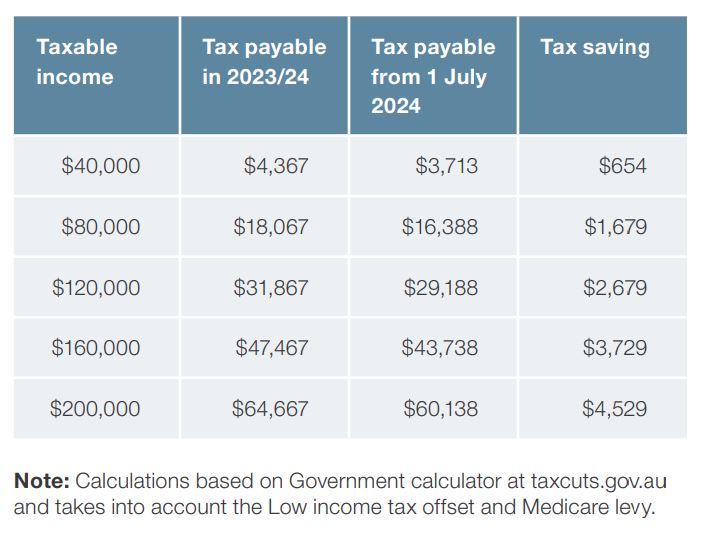
        You may pay less tax with the tax cuts that have taken effect from 1 July. While the tax savings will depend on your circumstances, it’s important to think about the best way to use them.

        For some of us, the savings may be needed to meet regular household expenses and manage cost of living increases. But if you have capacity, there are ways you may be able to use the tax savings to improve your financial position, such as reducing debt, investing or boosting your super.

        The key is to make a conscious decision to put the tax savings to work in a way that suits you.

        Who benefits from the changes?

        The Government estimates approximately 13.6 million Australian taxpayers will pay less tax when the ‘Stage 3 tax cuts’ commenced from 1 July. The table on this page illustrates the potential tax savings at different taxable incomes. To estimate your tax savings, check out the calculator in the taxcuts.gov.au website.

        Smart ways to use your tax savings

        There are many options to consider if you’d like to put your tax savings to work.

        You may want to make additional mortgage repayments, where you can effectively ‘earn’ the loan interest rate tax-free.

        Another option is investing in your own name, such as in term deposits, shares or managed investments. This could suit when planning for certain goals where you may need to access the money before you retire, like children’s education. You could also consider contributing to super, where there may be significant tax and other benefits. For instance:

        • you may be able to arrange for your employer to contribute some of your pre-tax salary into super, via ‘salary sacrifice’ (see the case study)

        • you may be able to claim personal super contributions as a tax deduction

        • if you’re a lower income earner and make personal contributions, you may be eligible for a Government co-contribution of up to $500, and

        • if you contribute on behalf of a low-income spouse, you may be eligible for a tax offset of up to $540.

        But remember, there are caps on how much you can contribute to super and additional tax and penalties may apply if you exceed the caps. Also, you can’t access the money until you retire or meet other conditions.


        Case Study

        Using your tax cut to boost your super with salary sacrifice

        Horace, aged 55, earns a taxable income of $120,000 and his tax savings in 2024/25 will be $2,679. He wants to boost his retirement savings using super.

        His financial adviser works out that even though his tax savings will be $2,679 after tax, he could salary sacrifice as much as $3,940 before tax and still receive the same after-tax income in 2024/25. This is because salary sacrifice contributions are made with pre-tax dollars.

        His super fund will deduct 15% tax from the amount he salary sacrifices, which will reduce the contribution to $3,349. But this is still $670 more than the tax saving of $2,679 he would have received as additional take-home pay if he didn’t salary sacrifice.


        How you can benefit?

        We can help you work out how you could beneficially use your tax cut from 1 July to achieve your short, medium and longer term goals.

        Contact Your LT Advisor Today.

      5. Common EOFY Mistakes Made That Can Be Fixed Before 30 June

        Common EOFY Mistakes Made That Can Be Fixed Before 30 June


        Finding yourself increasingly more busy as the EOFY approaches, particularly with meeting your tax obligations? It’s coming on tax time, so it’s time to ensure you’re prepared for your tax returns.

        This period can be stressful and complicated, leading to common mistakes that can result in financial penalties or missed opportunities for tax savings.

        Here’s a guide on avoiding common EOFY tax mistakes to ensure a smooth and efficient tax lodgement.

        1. Errors in Claiming Deductions
        Mistake: Many taxpayers either overclaim or underclaim deductions, which can lead to audits or missing out on tax savings.

        Solution:
        • Understand What You Can Claim: Familiarise yourself with deductible expenses related to work, such as home office expenses, work-related travel, and self-education costs. Use the Australian Taxation Office (ATO) website as a resource.
        • Keep Accurate Records: Maintain detailed and accurate records of all deductible expenses throughout the year. Use apps or digital tools to track receipts and expenses.
        • Avoid Personal Expenses: Ensure that personal expenses are not claimed as work-related deductions. Mixing these can lead to disallowed claims and potential penalties.

        2. Incorrect Reporting of Income
        Mistake: Failing to report all sources of income, including side gigs, investments, or rental income, can lead to discrepancies and potential audits.

        Solution:
        • Comprehensive Income Tracking: Track all income sources, including salaries, freelance work, investments, and rental income. Use a financial management tool to consolidate this information.
        • Cross-Check Statements: Compare your records with the income statements provided by employers, banks, and investment platforms to ensure accuracy.
        • Report All Income: Even small amounts of income must be reported. The ATO cross-checks data with other financial institutions, so transparency is crucial.

        3. Missing Deadlines
        Mistake: Missing the tax return filing deadline can result in penalties and interest charges.

        Solution:
        • Mark Your Calendar: Set reminders for key dates, including the 30 June EOFY and the 31 October tax return deadline for individuals.
        • Early Preparation: Start gathering necessary documents and information early. Don’t wait until the last minute to file your return.
        • Use Online Lodgement: Use the ATO’s myTax platform for online lodgement, which is efficient and provides guidance throughout the process. Alternatively, speak with your tax agent – they can assist with this

        4. Incomplete or Inaccurate Documentation
        Mistake: Submitting incomplete or inaccurate documentation can delay your return processing and potentially trigger an audit.

        Solution:
        • Create a Checklist: Make a checklist of all necessary documents, including income statements, receipts, and records of deductions.
        • Review Before Submission: Double-check all information for accuracy before submitting your return. Ensure all figures match your records and are correctly entered.
        • Seek Professional Help: If you’re unsure about the documentation, consider consulting a tax professional to review your return before submission.

        5. Overlooking Superannuation Contributions
        Mistake: Neglecting to make superannuation contributions or misunderstanding the rules can lead to missed tax benefits.
        Solution:
        • Maximise Contributions: Understand the contribution limits for concessional and non-concessional contributions and make additional contributions before the EOFY if financially viable.
        • Keep Records: Maintain records of all contributions to avoid exceeding the caps, which can result in excess contribution taxes.
        • Super Co-contribution: Check eligibility for the government co-contribution and ensure you meet the criteria to receive this benefit.

        6. Ignoring Tax Offsets and Rebates
        Mistake: Not claiming eligible tax offsets and rebates can lead to higher tax liabilities than necessary.

        Solution:
        • Research Eligibility: Review available tax offsets and rebates, either by yourself or with our assistance.
        • Claim Correctly: Ensure you meet the eligibility criteria and claim these offsets correctly on your tax return.

        7. Failing to Review Past Returns
        Mistake: Overlooking errors or missed claims from previous years can result in lost refunds or uncorrected mistakes.

        Solution:
        • Amend Past Returns: Review past tax returns for any missed deductions or errors. The ATO allows amendments to previous returns within a certain period.
        • Carry Forward Losses: Ensure you properly carry forward any capital or business losses to offset future gains.

        Avoiding common EOFY tax mistakes requires careful preparation, accurate record-keeping, and timely action.

        By understanding deductible expenses, accurately reporting all income, meeting deadlines, maintaining comprehensive documentation, maximising superannuation contributions, claiming eligible offsets, and reviewing past returns, you can ensure a smoother, more efficient tax filing process.

        If in doubt, consulting with a tax professional like us can provide peace of mind and help optimise your tax situation. Read more at Newcastle Tax Specialists.

        Disclaimer
        The information contained in this publication is for general information purposes only, professional advice should be obtained before acting on any information contained herein. Neither the publishers nor the distributors can accept any responsibility for loss occasioned to any person as a result of action taken or refrained from in consequence of the contents of this publication.

      6. Your End Of Financial Year Checklist

        Your End Of Financial Year Checklist

        As the end of the financial year approaches, businesses need to review their financial affairs and ensure compliance with regulatory requirements.

        Whether you’re a newly established business, an existing one, or simply needing a reminder, this EOFY checklist will help you navigate the necessary tasks to wrap up the financial year effectively.

        For Newly Established Businesses:

        • Register for GST (Goods and Services Tax): If your business has reached the GST threshold ($75,000 turnover annually), register for GST with the Australian Taxation Office (ATO) to comply with tax obligations.
        • Set Up Accounting Systems: Implement accounting software or systems to accurately track income, expenses, and GST obligations. Consider seeking professional advice to ensure compliance and efficiency.
        • Organise Financial Records: Maintain organised records of all financial transactions, including invoices, receipts, and bank statements, to facilitate EOFY reporting.
        • Understand Tax Deductions: Familiarise yourself with tax deductions applicable to your business, such as expenses related to operating the business, depreciation on assets, and superannuation contributions.

        For Existing Businesses:

        • Review Financial Performance: Assess your business’s financial performance over the past year, including revenue, expenses, and profitability, to identify areas for improvement and strategic planning.
        • Reconcile Accounts: Reconcile bank accounts, credit cards, and other financial accounts to ensure the accuracy and completeness of financial records.
        • Complete and Lodge BAS (Business Activity Statement): Lodge your BAS for the quarter ending 30 June, reporting GST collected and paid, as well as other relevant tax information.
        • Review and Renew Contracts: Review existing contracts with suppliers, clients, and service providers, and consider renewing or renegotiating terms where necessary.

        For Businesses Needing a Reminder:

        • Superannuation Payments: Ensure all superannuation contributions for employees are paid and reported to the relevant super funds by the due dates.
        • EOFY Reporting Obligations: Complete and lodge annual reports with the ATO, including PAYG withholding summaries for employees and taxable payments reports for contractors. Make sure to check with us if there has been any changes from previous years.
        • Stocktake: Conduct a stocktake to determine the value of your inventory at the end of the financial year, ensuring accurate reporting for tax purposes.
        • Review Insurance Policies: Review business insurance policies, including public liability, professional indemnity, and property insurance, to ensure adequate coverage for the upcoming financial year.
        • Plan for the Next Financial Year: Develop a budget and financial plan for the next year, outlining revenue targets, expense forecasts, and strategic initiatives to drive business growth.

        By following this EOFY checklist, businesses can ensure compliance with regulatory requirements, maintain financial accuracy, and position themselves for success in the upcoming financial year.

        If you fail to plan, you plan to fail.  Ensuring that your business is prepared at the end of the financial year for the following year is critical to ensuring its viability. 

        Remember to seek professional advice from accountants or financial advisors if you have specific questions or concerns regarding your business’s financial affairs.

        Remember, We Are Here To Help

        This checklist is meant to provide a starting point for identifying the areas that might significantly impact your business planning. We’re always glad to consult with you on such matters and advise you in any way we can.

      7. Know Your Super: A Critical Guide To The EOFY

        Know Your Super: A Critical Guide To The EOFY

        National Employment Standards Update

        From 1 January 2024, the NES included a right to superannuation contributions. This means that most employees covered by the NES can take court action under the Fair Work Act to recover unpaid or underpaid superannuation.

        Changes To Caps (Concessional & Non-Concessional)

        From 1 July 2024, the concessional contributions cap will increase from $27,500 to $30,000, allowing you to add more to your super account (if viable for your situation).

        The non-concessional contributions cap will increase from $110,000 per year to $120,000. This change will also affect the bring-forward rule, which will increase to $360,000 depending on your super balance.

        Carrying Forward & Bringing Forward Contributions Rules

        The carry forward rule only applies to before-tax contributions and relates to rolling over portions of unused limits from previous years into this financial year. For example, the 2018-2019 limit was $25,000. If you contributed $5,000, there is still $20,000 that can be carried forward into another year.

        You’re eligible to do this if you:

        • have a total super balance of less than $500,000 on 30 June of the previous financial year
        • have unused concessional contributions cap amounts from up to 5 previous years (but not before 2018–19).

        Unused cap amounts are available for five years and expire after this. For example, a 2018–19 unused cap amount that is not used by the end of 2023–24 will expire.

        On the other hand, the bring forward rule applies to after-tax contributions and brings your future limits forward so that you can use them earlier.

        This allows you to bring forward the equivalent of 1 or 2 years of your annual cap from future years. This means you can contribute up to 2 or 3 times the annual cap amount in the first year of the bring-forward period. Any amount of the bring-forward cap unused in the first year can be used in the remaining 1 or 2 years.

        How much you can bring forward and from when will depend on your super balance, and some limitations will be imposed on you after activating this. For more information and before acting, speak with a licensed professional.

        Transfer Balance Caps

        The transfer balance cap applies from 1 July 2017. It is a limit on the total amount of superannuation that can be transferred into the retirement phase. All your super account balances (regardless of how many you have) will be included to calculate this amount,

        You can make transfers into the retirement phase as long as you remain below the transfer balance cap. For the 2023-24 financial year and the 2024-25 financial year, this is $1,900,000.

        Small Business Super Clearing House Deadlines

        To qualify for a tax deduction for the 2023-24 financial year, Super Guarantee contributions must be paid by 30th June 2024. Some clearing houses can take over a week to submit the payment to the super fund, but the fund must receive the contribution before the deadline. To keep on top, the best practice may be to pay before 20th June (to allow extra time for the clearing houses to process the payment). Payments may take up to 7 business days to be transferred through the ATO and super fund before they reach the employee’s super fund account. Leave enough time for your SG payments to reach the super fund and allow for their processing timeframes.

        Depositing Contributions For Your SMSF

        Any contributions that have been recorded for your SMSF need to be deposited into the fund’s bank account by no later than 30 June. This is especially important when members have reported concessional or non-concessional contributions on their tax returns.  But remember that you can’t claim the tax deduction until you have lodged your notice of intent to claim a tax deduction and have received an acknowledgement back from the fund. No early lodgements if you have made a contribution to super.


      8. Increase To Super Guarantee From 1 July 2024

        Increase To Super Guarantee From 1 July 2024

        In recent years, the superannuation guarantee (SG) has gradually increased by a set percentage.

        This increment is part of a continuous rise toward reaching 12% gradually, predicted to be achieved by 2025. This gradual approach allows businesses ample time to strategise for the future, as they can manage small annual increases rather than facing a sudden jump.

        Currently, employers must contribute the equivalent of 11% of ordinary time earnings for the 2023-24 financial year. This rate is slated to rise to 11.5% from 1 July 2024 for the 2024-25 financial year.

        All full-time, part-time, or casual employees over 18 are eligible for super guarantee contributions (SGC). Additionally, employees under 18 and private domestic workers, such as nannies, who work more than 30 hours a week, are also eligible. In some cases, certain contractors may be considered eligible as well.

        To ensure compliance with regulations and fairness to employees, it’s crucial for businesses to accurately calculate superannuation contributions based on employees’ ordinary time earnings. The best way to avoid a super guarantee charge is to stay in line with the requirements of the super guarantee.

        If you need assistance managing your payroll and staying informed about these changes and others, don’t hesitate to seek guidance from a trusted advisor like us.

        We can provide expert support to help you navigate the complexities of payroll management and regulatory compliance effectively.


      9. Streamlining Year-End Business Record-Keeping: A Vital Guide

        Streamlining Year-End Business Record-Keeping: A Vital Guide

        As the year draws to a close, the significance of meticulous record-keeping cannot be overstated. It serves as the backbone of your year-end procedures, facilitating tax compliance, cash flow management, and informed decision-making for the future of your enterprise.

        Investing effort in organising your business at the fiscal year’s end ensures compliance and sets the stage for smarter operations in the coming year.

        Here’s a breakdown of essential business records that warrant your attention:

        Expense and Purchase Records

        • Keep comprehensive records of all business expenses, encompassing receipts, tax invoices, cheque stubs, credit card vouchers, and diaries for small cash outlays.

        Year-End Records

        • These encompass creditor/debtor lists, depreciating asset calculations, stocktake reports, and capital gains tax documentation.

        Income and Sales Records

        • Maintain meticulous records of income and sales transactions, including tax invoices, receipt logs, cash register tapes, and cash sales records.

        Bank Records

        • Retain documents like bank statements, loan agreements, and deposit records to facilitate tax return preparation.

        Fuel Tax Credits

        • Ensure your records demonstrate fuel acquisition, usage for business purposes, and accurate application of tax credit rates.

        Payments to Employees and Contractors:

        • Maintain records of employee details, tax file numbers, superannuation contributions, wages, and other payments.

        According to statutory requirements, business records must be retained for at least five years for sole traders and individuals and seven years for companies and payroll transactions.

        Records can be stored electronically or in hard copy, in English or a readily convertible format, providing comprehensive explanations of all transactions. Non-compliance with record-keeping regulations may result in penalties from tax authorities.

        Consistent maintenance of records throughout the year, both major and minor, positions your business favourably for the year-end.

        Simplify this process by collaborating with your registered tax agent, ensuring all necessary information is readily available for timely and accurate tax return completion. Why not start your EOFY preparation today with us?

      10. How to Manage Cash Flow and Plan for Growth: A Guide for Small Businesses In The Lead Up To EOFY

        How to Manage Cash Flow and Plan for Growth: A Guide for Small Businesses In The Lead Up To EOFY

        Effective cash flow management is essential for the success and growth of any small business. 

        Proper budgeting, forecasting, and managing finances ensure that your business remains solvent and can seize growth opportunities when they arise. 

        Here are key tips and strategies to help small businesses manage cash flow and plan for sustainable growth.

        1. Understanding Cash Flow

        Cash Flow Basics:

        Cash flow refers to the movement of money in and out of your business. Positive cash flow means more money is coming in than going out, which is essential for covering expenses and investing in growth.

        Negative cash flow, on the other hand, indicates that expenses are exceeding income, which can lead to financial trouble if not addressed.

        Cash Flow Statement:

        A cash flow statement is a financial document that provides a detailed analysis of cash inflows and outflows over a specific period. It is divided into three sections:

        • Operating Activities: Cash generated from day-to-day business operations.
        • Investing Activities: Cash used for investment in assets or received from the sale of assets.
        • Financing Activities: Cash received from or paid to financiers, such as loans and equity investments.

        2. Budgeting

        Creating a Budget:

        A well-planned budget is the cornerstone of effective financial management. It involves estimating your revenue and expenses for a future period, usually a year.

        Steps to Create a Budget:
        • Estimate Revenue: Base your revenue estimates on historical data, market trends, and sales forecasts.
        • Identify Fixed and Variable Costs: Fixed costs remain constant regardless of business activity (e.g., rent, salaries), while variable costs fluctuate with production levels (e.g., materials, utilities).
        • Plan for Contingencies: Include a buffer for unexpected expenses or emergencies.
        • Monitor and Adjust: Regularly compare actual performance against the budget and adjust as needed to stay on track.

        3. Forecasting

        Importance of Forecasting:

        Financial forecasting involves predicting future revenues, expenses, and cash flow. Accurate forecasts help you anticipate financial needs, plan for growth, and make informed business decisions.

        Types of Forecasting:
        • Short-Term Forecasting: Typically covers the next 12 months and focuses on operational cash flow.
        • Long-Term Forecasting: Looks beyond a year, aligning with strategic goals and growth plans.
        Steps to Forecast:
        • Analyse Historical Data: Review past financial performance to identify trends.
        • Consider Market Conditions: Evaluate economic indicators, industry trends, and market demand.
        • Use Financial Models: Employ tools like regression analysis or time series forecasting to project future financial performance.

        4. Managing Finances

        Accounts Receivable and Payable:
        • Optimise Receivables: Implement efficient invoicing processes, offer early payment discounts, and follow up on overdue accounts to ensure timely collections.
        • Manage Payables: Negotiate favourable payment terms with suppliers and prioritise payments to maintain good relationships and credit standing.
        Inventory Management:

        Efficient inventory management prevents excess stock and reduces holding costs. Use inventory management software to track stock levels, forecast demand, and automate reordering.

        Cost Control:

        Regularly review expenses to identify areas for cost savings. Implement cost-control measures such as reducing waste, renegotiating contracts, and improving operational efficiency.

        5. Securing Funding and Investment

        Funding Options:
        • Self-Funding: Using personal savings or reinvesting profits into the business.
        • Loans: Obtaining financing from banks or alternative lenders. Ensure you understand the terms and can meet repayment obligations.
        • Grants: Applying for government or private grants designed to support small businesses.
        • Equity Investment: Selling shares of your business to investors in exchange for capital. This can dilute ownership but provides significant funding without the obligation of repayment.
        Preparing for Investment:
        • Business Plan: Develop a comprehensive business plan that outlines your business model, market analysis, growth strategy, and financial projections.
        • Pitch Deck: Create a compelling pitch deck to present to potential investors, highlighting your business’s value proposition, market opportunity, and financial performance.
        • Financial Statements: Ensure your financial statements are accurate and up-to-date. Investors will scrutinise your balance sheet, income statement, and cash flow statement.
        Building Investor Relationships:
        • Networking: Attend industry events, join business networks, and leverage online platforms to connect with potential investors.
        • Transparency: Maintain open and honest communication with investors, providing regular updates on business performance and growth plans.
        • Showcase Traction: Demonstrate your business’s progress through key metrics such as revenue growth, customer acquisition, and market penetration.

        Managing cash flow and planning for growth require diligent financial management, strategic planning, and an understanding of funding options.

        By creating and monitoring budgets, accurately forecasting financial performance, managing expenses, and securing appropriate funding, small businesses can navigate financial challenges and position themselves for long-term success.

        With careful planning and disciplined execution, you can ensure that your business not only survives but thrives in a competitive marketplace. Need to chat with your LT Accountant call our team today.

        Disclaimer

        The information contained in this publication is for general information purposes only, professional advice should be obtained before acting on any information contained herein. Neither the publishers nor the distributors can accept any responsibility for loss occasioned to any person as a result of action taken or refrained from in consequence of the contents of this publication.

      11. 2024-25 Federal Budget Announcements – 11 Main Points

        2024-25 Federal Budget Announcements – 11 Main Points

        The Federal Budget was handed down on 14 May 2024, and has outlined a number of changes that impact businesses, tax & superannuation.

        Instant Asset Write-Off Extended

        Small businesses with an aggregated annual turnover of less than $10 million will continue to be able to immediately deduct the full cost of eligible assets costing less than $20,000 that are first used or installed ready for use by 30 June 2025.

        The asset threshold applies per asset so small businesses can instantly write off multiple assets.  Assets valued at $20,000 or more (which cannot be immediately deducted) can continue to be placed into the small business simplified depreciation pool and depreciated at 15 per cent in the first income year and 30 per cent each income year thereafter. 

        Stage 3 Tax Cuts

        From 1 July 2024, every taxpayer will receive a tax cut following changes announced by the federal government earlier this year. This means that workers in every tax bracket will pay less income tax.

        The reforms reduce the 19 per cent tax rate to 16 per cent, reduce the 32.5 per cent tax rate to 30 per cent, raise the threshold at which the 37 per cent tax rate applies from $120,000 to $135,000 and raise the threshold at which the highest rate of 45 per cent applies from $180,000 to $190,000.

        Foreign Resident Capital Gains Tax Regime

        The Government will strengthen the foreign resident capital gains tax (CGT) regime to ensure foreign residents pay their fair share of tax in Australia and to provide greater certainty about the operation of the rules.

        The amendments will apply to CGT events commencing on or after 1 July 2025 to:

        • Carify and broaden the types of assets that foreign residents are subject to CGT on 
        • Amend the point-in-time principal asset test to a 365-day testing period 
        • Require foreign residents disposing of shares and other membership interests exceeding $20 million in value to notify the ATO, prior to the transaction being executed. 

        This will bring foreign residents closer in line with Australian resident taxpayers and may include assets such as shares that are currently not taxed (in most instances)

        Enhancement To Commonwealth Government-Funded Paid Parental Leave

        The Government will provide $1.1 billion over five years from 2023–24 (and $0.6 billion per year ongoing) to strengthen Australia’s government-funded Paid Parental Leave (PPL) scheme and improve women’s retirement outcomes.

        Eligible parents will receive an additional payment based on the Superannuation Guarantee (12 per cent of their PPL payments) as a contribution to their superannuation fund for births or adoptions after 1 July  2025. Small business employees will also be provided additional support in administering paid parental leave as part of the measure.

        This measure aims to help normalise parental leave as a workplace entitlement, like annual and sick leave and reduce the impact of parental leave on retirement incomes. 

        Freeze Social Security Deeming Rates

        The government will freeze social security deeming rates at their current levels for a further 12 months until 30 June 2025, to support Age Pensioners and other income support recipients who rely on income from deemed financial investments and their payment to manage cost of living pressures. This measure is estimated to benefit around 876,000 income support recipients, including 450,000 Age Pensioners.

        The Fair Entitlements Guarantee Recovery Program

        The Government will also recalibrate the Fair Entitlements Guarantee Recovery Program to pursue unpaid superannuation entitlements owed by employers in liquidation or bankruptcy from 1 July 2024.

        Energy Bill Relief Fund

        The Energy Bill Relief Fund is set to provide a $300 rebate to households, and a $325 rebate to eligible small business on 2024-25 bills. This measure partly extends the previous Budget’s measure, titled Energy Price Relief Plan.

        Commonwealth Rent Assistance

        The maximum rates of Commonwealth Rent Assistance is set to increase by a further 10% from 20 September 2024, building on the 15% increase in September 2023.

        The current maximum payment for a single person receiving rent assistance is $188.20 a fortnight, and $125.47 for a single person in a share house. That means the payment would increase by about $19 a fortnight for a single person before accounting for indexation.

        HECS Debt Changes

        Pending a legislative change that must be passed through parliament, student debts will grow each year at the rate of either the consumer price index or the wage price index — whichever is lower.

        The Government will backdate this relief to all HELP, VET Student Loan, Australian Apprenticeship Support Loan and other student support loan accounts that existed on 1 June 2023. This means that the loans for that year will grow at the lower wage index rate or 3.2%, instead of the 7.1% inflation rate they were measured at. 

        Increasing the Medicare levy low-income thresholds

        The Government has increased the Medicare levy low-income thresholds for 2023–24, ensuring more than one million low-income taxpayers continue to be exempt from the Medicare levy or pay a reduced levy rate.

        Impact of the Douglas Decision on Social Security Means Testing

        The Government will provide funding to implement a social security means test treatment for the military invalidity payments affected by the Federal Court’s decision in Commissioner of Taxation v Douglas [2020] FCAFC 220.

        This approach ensures the Douglas decision does not affect income support payment rates for veterans who receive an invalidity payment from the Military Superannuation and Benefits Scheme and the Defence Force Retirement and Death Benefits Scheme, compared to the pre-Douglas arrangements.

        To discuss how these changes impact your business or personal tax call your dedicated LT accountant today.

      12. Federal Budget News 2024-25

        Federal Budget News 2024-25

        In the latest federal Budget announcement, the commentary from Phillip Coorey, The Australian’s Political Editor, captures the scene vividly: “Jim Chalmers is like a bloke who successfully dieted for two years but crumbled after someone shoved a bucket of KFC under his nose.”

        This humorous yet sharply insightful remark highlights the shifts and challenges in the current budget strategy, reflecting the delicate balancing act faced by the Treasurer in managing the nation’s finances amid the cost-of-living crisis.

        As we delve deeper into the details of this budget, let us explore how these financial decisions are set to impact Australian businesses and the broader economy:

        Personal Income Tax – Cost of Living – increasing the Medicare levy lowincome thresholds

        The Government has increased the Medicare levy low-income thresholds for singles, families, and seniors and pensioners from 1 July 2023 to provide cost-of-living relief. The increase to the thresholds ensures that low income individuals continue to be exempt from paying the Medicare levy or pay a reduced levy rate.

        The increase to the thresholds accounts for recent annual CPI outcomes and is estimated to decrease receipts by $640 million over the four years to 2026–27.

        The threshold for singles has been increased from $24,276 to $26,000. The family threshold has been increased from $40,939 to $43,846. For single seniors and pensioners, the threshold has been increased from $38,365 to $41,089. The family threshold for seniors and pensioners has been increased from $53,406 to $57,198. The family income thresholds will now increase by $4,027 for each dependent child, up from $3,760.

        This measure has already been provisioned for by the Government.

        Source: Budget Paper No 2, p 12.

        Personal Income Tax – Cost of Living Tax Cuts

        The Government has legislated permanent tax cuts for all 13.6 million Australian taxpayers from 1 July 2024.

        The tax cuts provide cost-of-living relief, return bracket creep, support women and boost labour supply.

        The Government’s tax changes provide bigger tax cuts for more taxpayers, delivering meaningful cost-of-living relief to middle Australia without adding to inflationary pressures.

        Under the Government’s tax cuts, from 2024–25:

        • the 19 per cent tax rate will be reduced to 16 per cent

        • the 32.5 per cent tax rate will be reduced to 30 per cent

        • the income threshold above which the 37 per cent tax rate applies will be increased from $120,000 to $135,000

        • the income threshold above which the 45 per cent tax rate applies will be increased from $180,000 to $190,000.

        This measure is estimated to decrease receipts by $1.3 billion over the 5 years from 2023–24.

        Source: Budget Paper No 2, p 12-13.

        Small Business Support – $20,000 instant asset write-off

        The Government will continue to improve cash flow and reduce compliance costs for small businesses by extending the $20,000 instant asset write-off by 12 months until 30 June 2025.

        Small businesses, with an aggregated annual turnover of less than $10 million, will continue to be able to immediately deduct the full cost of eligible assets costing less than $20,000 that are first used or installed ready for use by 30 June 2025. The asset threshold applies on a per asset basis so small businesses can instantly write off multiple assets.

        Assets valued at $20,000 or more (which cannot be immediately deducted) can continue to be placed into the small business simplified depreciation pool and depreciated at 15 per cent in the first income year and 30 per cent each income year thereafter.

        The provisions that prevent small businesses from re-entering the simplified depreciation regime for five years if they opt-out will continue to be suspended until 30 June 2025.

        Source: Budget Paper No 2, p 14-15.

        Strengthening Tax Compliance – extending the Personal Income Tax Compliance Program

        The Government will extend the ATO Personal Income Tax Compliance Program for one year from 1 July 2027.

        This extension will enable the ATO to continue to deliver a combination of proactive, preventative and corrective activities in key areas of non-compliance, including overclaiming of deductions, incorrect reporting of income and inappropriate tax agent influence. This will enable the ATO to continue its focus on emerging risks to the tax system, such as deductions relating to short-term rental properties.

        Source: Budget Paper No 2, p15.

        Strengthening Tax Compliance – Australian Taxation Office Counter Fraud Strategy

        The Government will provide $187.0 million over four years from 1 July 2024 to the ATO to strengthen its ability to detect, prevent and mitigate fraud against the tax and superannuation systems.

        Funding includes:

        • $78.7 million for upgrades to information and communications technologies to enable the ATO to identify and block suspicious activity in real time

        • $83.5 million for a new compliance taskforce to recover lost revenue and intervene when attempts to obtain fraudulent refunds are made

        • $24.8 million to improve the ATO’s management and governance of its counter-fraud activities, including improving how the ATO assists individuals harmed by fraud.

        The Government will also provide $0.4 million over four years from 1 July 2024 to the Department of Finance to undertake a Gateway Review process over the life of the proposal to ensure independent assurance, oversight and delivery of the measure.

        Further, the Government will strengthen the ATO’s ability to combat fraud by extending the time the ATO has to notify a taxpayer if it intends to retain a business activity statement (BAS) refund for further investigation. The ATO’s mandatory notification period for BAS refund retention will be increased from 14 days to 30 days to align with time limits for non-BAS refunds.

        The extended period will strengthen the ATO’s ability to combat fraud during peak fraud events like the one that triggered Operation Protego. Legitimate refunds will be largely unaffected. Any legitimate refunds retained for over 14 days would result in the ATO paying interest to the taxpayer (as is currently the case). The ATO will publish BAS processing times online.

        This will have effect from the start of the first financial year after Royal Assent of the enabling legislation.

        Source: Budget Paper No 2, p 15-16.

        Strengthening Tax Compliance – extending the Shadow Economy Compliance Program

        The Government will extend the ATO Shadow Economy Compliance Program for two years from 1 July 2026.

        This extension of the Shadow Economy Compliance Program will enable the ATO to continue to reduce shadow economy activity, thereby protecting revenue and preventing non-compliant businesses from undercutting competition.

        Source: Budget Paper No 2, p16.

        Strengthening Tax Compliance – extending the Tax Avoidance Taskforce

        The Government will extend the ATO Tax Avoidance Taskforce for two years from 1 July 2026.

        Extending the Taskforce ensures the ATO continues to be well-resourced to pursue key tax avoidance risks, with a focus on multinationals, large public and private businesses, and high-wealth individuals.

        Source: Budget Paper No 2, p17.

        Strengthening the foreign resident capital gains tax regime

        The Government will strengthen the foreign resident capital gains tax (CGT) regime to ensure foreign residents pay their fair share of tax in Australia and to provide greater certainty about the operation of the rules. The amendments will apply to CGT events commencing on or after 1 July 2025 to:

        • clarify and broaden the types of assets that foreign residents are subject to CGT on

        • amend the point-in-time principal asset test to a 365-day testing period

        • require foreign residents disposing of shares and other membership interests exceeding $20 million in value to notify the ATO, prior to the transaction being executed.

        This measure will ensure that Australia can tax foreign residents on direct and indirect sales of assets with a close economic connection to Australian land, more in line with the tax treatment that already applies to Australian residents. The new ATO notification process will improve oversight and compliance with the foreign resident CGT withholding rules, where a vendor self-assesses their sale is not taxable real property.

        These reforms will also improve certainty for foreign investors by aligning Australia’s tax law for foreign resident capital gains more closely with OECD standards and international best practice.

        The Government will consult on the implementation details of the measure.

        Source: Budget Paper No 2, p 17-18.

        Australian Universities Accord – tertiary education system reforms

        The Government will provide $1.1 billion over five years from 2023–24 (and an additional $2.7 billion from 2028–29 to 2034–35) for the first stage of reforms to Australia’s tertiary education system in response to the Australian Universities Accord Final Report. These reforms will boost equity and access to higher education, progress tertiary harmonisation and will support a target of 80 per cent of the working age population holding a tertiary qualification by 2050.

        Source: Budget Paper No 2, p 62.

        Future Made in Australia – Attracting Investment in Key Industries

        The Government will provide $68.0 million over four years from 2024–25 (and $3.1 million per year ongoing) to attract investment in key industries to support a Future Made in Australia.

        Source: Budget Paper No 2, p 65.

        Future Made in Australia – Investing in Innovation, Science and Digital Capabilities

        The Government will provide $1.7 billion funding over ten years from 2024–25 for investments in innovation, science and digital capabilities to support a Future Made in Australia.

        Source: Budget Paper No 2, p 66.

        Future Made in Australia – Making Australia a Renewable Energy Superpower

        The Government will provide an estimated $19.7 billion over ten years from 2024–25 to accelerate investment in Future Made in Australia priority industries, including renewable hydrogen, green metals, low carbon liquid fuels, refining and processing of critical minerals and manufacturing of clean energy technologies including in solar and battery supply chains. Funding will catalyse clean energy supply chains and support Australia to become a renewable energy superpower.

        Source: Budget Paper No 2, p 67.

        Future Made in Australia – Promoting Sustainable Finance Markets

        The Government will provide $17.3 million over four years from 2024–25 (and $3.1 million per year ongoing) to promote the development of sustainable finance markets in Australia.

        Source: Budget Paper No 2, p 70.

        Future Made in Australia – Strengthening Approvals Processes

        The Government will provide $182.7 million over eight years from 2023–24 (and $4.5 million ongoing from 2031–32) to strengthen approval processes to support the delivery of the Government’s Future Made in Australia agenda, including Australia’s transition to a net zero economy.

        Source: Budget Paper No 2, p 71.

        Future Made in Australia – Workforce and Trade Partnerships for Renewable Energy Superpower Industries

        The Government will provide $218.4 million over eight years from 2023–24 (and $1.3 million per year ongoing) to support a Future Made in Australia through the development of a skilled and diverse workforce and trade partnerships.

        Source: Budget Paper No 2, p 72.

        Housing Support

        The Government will provide additional funding to build more homes for Australians sooner, invest in more housing enabling infrastructure, train more construction workers and support social and affordable housing and homelessness services.

        Funding includes:

        • subject to states and territories signing the new National Agreement on Social Housing and Homelessness:

        – $423.1 million over five years from 2024–25 in additional funding to support the provision of social housing and homelessness services by states and territories under a new National Agreement on Social Housing and Homelessness. The additional funding will increase annual funding under the new agreement to $1.8 billion per year from 2024–25, with over $9.28 billion provided to states and territories over the life of the agreement

        – $1.0 billion in 2023–24 for states and territories to support enabling infrastructure for new housing through a new Housing Support Program – Priority Works Stream

        • supporting more community housing providers to access finance through the Affordable Housing Bond Aggregator by increasing the cap on the Government’s guarantee of Housing Australia’s liabilities by $2.5 billion to $10.0 billion, with an associated increase in the line of credit that supports the Affordable Housing Bond Aggregator of $3.0 billion to $4.0 billion

        • $88.8 million over three years from 2024–25 to support 20,000 new fee-free training places, including increased access to pre-apprenticeship programs, in courses relevant to the construction sector and delivered through TAFEs and industry registered training organisations

        • $19.7 million over six years from 2024–25 to support housing research, fast-track feasibility studies on the release of Commonwealth land to support social and affordable housing and maintain Treasury’s capability to develop, advise on and implement housing policy and programs

        $7.0 million over three years from 2023–24 to provide targeted assistance to residential builders seeking to obtain accreditation under the Work Health and Safety Accreditation Scheme

        • $6.2 million over two years from 2024–25 to support building industry peak employer associations to assist residential builders in obtaining accreditation under the Work Health and Safety Accreditation Scheme

        • $2.0 million over three years from 2024–25 to build the financial capability of community housing providers and Aboriginal and Torres Strait Islander community controlled housing organisations

        • $1.8 million over two years from 2024–25 for the Department of Employment and Workplace Relations to deliver streamlined skills assessments for migrants from comparable countries who wish to work in Australia’s housing construction industry

        • support to increase available rental housing by allowing foreign investors to purchase established Build to Rent properties with a lower foreign investment fee, conditional on the property continuing to be operated as a build to rent development.

        In addition, the Government will:

        • target the $1.0 billion for social housing under the National Housing Infrastructure Facility in the 2023–24 MYEFO towards crisis and transitional accommodation for women and children fleeing domestic violence, and youth, including redistributing the mix of concessional loans and grants to increase the proportion of grants to $700.0 million

        • provide $1.9 billion in concessional finance to support community housing providers to deliver social and affordable housing under the Housing Australia Future Fund and the National Housing Accord.

        Source: Budget Paper No 2, p 74 – 75.

        Child Care Subsidy Reform – further measures for strong and sustainable foundations

        The Government will achieve net savings of $410.7 million over four years from 2024–25 through additional activities to strengthen the payment and accuracy of the Child Care Subsidy program.

        The Government will invest $30.0 million over two years from 2024–25 in IT and payment services to deliver on its commitment to provide funding towards a wage increase for the Early Childhood Education and Care sector. This will support a response to Fair Work Commission processes as they relate to this sector.

        Source: Budget Paper No 2, p 86.

        Closing the Gap – Education

        The Government will provide $110.0 million over four years from 2024–25 (and $11.0 million per year ongoing) to accelerate action against the National Agreement on Closing the Gap Priority Reforms in the Education portfolio and extend programs supporting education outcomes.

        Source: Budget Paper No 2, p 87.

        Inclusion Support Program – additional funding

        The Government will provide $98.4 million in 2024–25 to help child care services increase their capacity to support inclusion of children with additional needs, through tailored support and funding to services.

        Source: Budget Paper No 2, p 88.

        School Education Support

        The Government will provide $70.3 million over five years from 2023–24 to continue support for initiatives to improve education outcomes for students.

        Source: Budget Paper No 2, p 88.

        Australian Apprenticeships Incentive System – further support

        The Government will provide $265.1 million over four years from 2024–25 to adjust previously scheduled Phase Two Incentive System payments to provide further support for apprentices, trainees and their employers in priority occupations, while the Government undertakes the Strategic Review of the Australian Apprenticeships Incentive System.

        Under 2022–23 March Budget arrangements for the Australian Apprenticeships Incentive System, financial support to apprentices, trainees and their employers was scheduled to reduce from 1 July 2024, including for those in priority occupations, through the implementation of Phase Two settings. The measure will increase Phase Two Incentive System payments for apprentices in priority occupations from $3,000 to $5,000 and hiring incentives for priority occupation employers from $4,000 to $5,000 for 12 months from 1 July 2024.

        Source: Budget Paper No 2, p 90.

        Employment Services Reform

        The Government will provide $13.2 million over five years from 2023–24 (and savings of $36.9 million per year ongoing) for improvements to the employment services system and to support future reform.

        Funding includes:

        • $68.6 million over five years from 2023–24 to increase resourcing for the Digital Services Contact Centre to support people using Workforce Australia Online services

        • $32.1 million over four years from 2024–25 for the Real Jobs, Real Wages pilot providing tapered payments to employers to support wages for people at risk of long-term unemployment

        • $21.9 million over five years from 2023–24 to provide paid employment placements through social enterprise and employer partnerships for people with high barriers to work

        • $13.0 million over five years from 2023–24 (and $0.9 million per year ongoing) to strengthen the complaints mechanism for clients of Workforce Australia and introduce further safeguards in relation to payment suspensions or penalties

        $10.9 million over four years from 2024–25 (and $0.8 million per year ongoing) for critical improvements to the Workforce Australia IT system

        • $6.4 million over five years from 2023–24 (and net savings of $0.3 million per year ongoing) to better recognise individuals’ circumstances through more appropriate and consistent application of mutual obligation rules for certain recipients of income support payments.

        Source: Budget Paper No 2, p 91 – 92.

        Further Support for the Vocational Education and Training System

        The Government will provide $26.1 million over four years from 2024–25 for the Skills and Training portfolio to contribute to a strong and effective Vocational Education and Training system, continue structural reforms, and maximise returns on previous skills and training investments and commitments.

        Source: Budget Paper No 2, p 94.

        Promoting TAFE and VET Pathways

        The Government will provide $4.4 million in 2024–25 to drive demand for Vocational Education and Training (VET) in support of delivering the workforce required to meet Australia’s future skills needs. This will include delivering strategic communications to increase the appeal of VET for students, parents and teachers, and extending community awareness of Fee-Free TAFE courses in areas of high skills needs which has ensured strong uptake of Fee-Free TAFE places to date.

        Source: Budget Paper No 2, p 95.

        Health Workforce

        The Government will provide $116.2 million over five years from 2023–24 to strengthen and support the health workforce.

        Source: Budget Paper No 2, p 111

        Improving Aged Care Support

        The Government will provide $2.2 billion over five years from 2023–24 to deliver key aged care reforms and to continue to implement recommendations from the Royal Commission into Aged Care Quality and Safety.

        Source: Budget Paper No 2, p 112.

        Mental Health

        The Government will provide $888.1 million over 8 years from 2024–25 (and $139.8 million per year ongoing) to respond to the Better Access evaluation and to strengthen Australia’s mental health and suicide prevention system.

        Source: Budget Paper No 2, p 116.

        Pharmaceutical Benefits Scheme (PBS) – new and amended listings

        The Government will provide $3.4 billion over five years from 2023–24 for new and amended listings on the Pharmaceutical Benefits Scheme (PBS) and the Repatriation Pharmaceutical Benefits Scheme.

        Source: Budget Paper No 2, p 119.

        Securing Cheaper Medicines

        The Government will provide $480.2 million over five years from 2023–24 to reduce patient costs and improve access to medicines.

        Source: Budget Paper No 2, p 124.

        Strengthening Medicare

        The Government will provide $1.2 billion over five years from 2023–24 ($14.8 million per year ongoing) to strengthen Medicare by supporting earlier discharge from hospital for older Australians, improving access to essential services, modernising Australia’s digital health infrastructure and ensuring the integrity and compliance of Medicare.

        Source: Budget Paper No 2, p 126.

        Strengthening Medicare – Medicare Urgent Care Clinics – additional funding

        The Government will provide $227.0 million over three years from 2023–24 to boost the capacity of Medicare Urgent Care Clinics. This will include a further 29 Medicare Urgent Care Clinics across Australia, which will take the total number of Medicare Urgent Care Clinics to 87. The Government is also providing additional support to clinics in regional and rural Australia.

        Source: Budget Paper No 2, p 128.

        Strengthening Medicare – an effective and clinically appropriate Medicare Benefits Schedule (MBS)

        The Government will provide $895.6 million over four years from 2024–25 to ensure the Medicare Benefits Schedule (MBS) remains clinically appropriate and reflects modern medical practices.

        Source: Budget Paper No 2, p 129.

        Building a Better Future Through Considered Infrastructure Investment

        The Government is committed to delivering the priority road and rail infrastructure projects Australia needs via the over $120.0 billion infrastructure investment pipeline. Building on the Independent Strategic Review of the Infrastructure Investment Program, the Government is taking a more integrated, strategic and sustainable approach to infrastructure investment this Budget.

        Source: Budget Paper No 2, p 144.

        A Higher Rate of JobSeeker Payment for Participants with a Partial Capacity to Work (0-14 hours)

        The Government will provide $41.2 million over five years from 2023–24 (and $7.0 million per year ongoing from 2028–29) to extend eligibility for the existing higher rate of JobSeeker payment to single recipients with a partial capacity to work of zero to 14 hours per week from 20 September 2024.

        The higher JobSeeker payment rate is currently provided to single recipients with dependent children and those aged 55 and over who have been on payment for nine continuous months or more.

        Source: Budget Paper No 2, p 164.

        Carer Payment – increased flexibility

        The Government will provide $18.6 million over five years from 2023–24 (and $3.1 million per year ongoing) to support Carer Payment recipients through increased flexibility to undertake work, study and volunteering activities.

        From 20 March 2025, the existing 25 hour per week participation limit for Carer Payment recipients will be amended to 100 hours over four weeks. The participation limit will no longer capture study, volunteering activities and travel time and will only apply to employment.

        Carer Payment recipients exceeding the participation limit or their allowable temporary cessation of care days will have their payments suspended for up to six months, rather than cancelled. Recipients will also be able to use single temporary cessation of care days where they exceed the participation limit, rather than the current seven day minimum.

        Source: Budget Paper No 2, p 166.

        Commonwealth Government-Funded Paid Parental Leave – enhancement

        The Government will provide $1.1 billion over five years from 2023–24 (and $0.6 billion per year ongoing) to strengthen Australia’s government-funded Paid Parental Leave (PPL) scheme and improve women’s retirement outcomes.

        Source: Budget Paper No 2, p 166.

        Commonwealth Rent Assistance – increase the maximum rates

        The Government will provide $1.9 billion over five years from 2023–24 (and $0.5 billion per year ongoing from 2028–29) to increase all Commonwealth Rent Assistance maximum rates by 10 per cent from 20 September 2024 to help address rental affordability challenges for recipients.

        Source: Budget Paper No 2, p 167.

        Financial Wellbeing and Capability Activity – additional funding

        The Government will provide $138.0 million over five years from 2023–24 (and $35.4 million per year ongoing) to boost support for Australians in financial distress or experiencing financial hardship and to build financial resilience, through additional funding to the Financial Wellbeing and Capability Activity. The activity will also be restructured to operate under two streams of support: Financial Capability and Resilience and Financial Crisis Response and Recovery.

        Source: Budget Paper No 2, p 169.

        Freeze Social Security Deeming Rates

        The Government will freeze social security deeming rates at their current levels for a further 12 months until 30 June 2025, to support Age Pensioners and other income support recipients who rely on income from deemed financial investments, as well as their payment, to manage cost of living pressures.

        Source: Budget Paper No 2, p 170 – 171.

        National Disability Insurance Scheme – getting the NDIS back on track

        The Government is committed to improving outcomes for National Disability Insurance Scheme (NDIS) participants and ensuring every dollar of NDIS funding goes to those who need it most. The Government will provide $468.7 million over five years from 2023–24 (and $37.9 million per year ongoing) to support people with disability and get the NDIS back on track.

        Source: Budget Paper No 2, p 172.

        Services Australia – additional resourcing

        The Government will provide $2.8 billion over five years from 2023–24 (and $144.7 million per year ongoing) to improve the way Services Australia delivers services to the Australian community.

        Source: Budget Paper No 2, p 175.

        The Leaving Violence Program – financial support for victim-survivors of intimate partner violence

        The Government will provide $925.2 million over five years from 2023–24 (and $263.3 million per year ongoing) to make permanent the Leaving Violence Program that will provide financial support, safety assessments and referrals to support services for victim-survivors leaving a violent intimate partner relationship.

        Source: Budget Paper No 2, p 176.

        Energy Bill Relief Fund – extension and expansion

        The Government will provide $3.5 billion over three years from 2023–24 to extend and expand the Energy Bill Relief Fund to provide a $300 rebate to all Australian households and a $325 rebate to eligible small businesses on 2024–25 bills to provide cost of living relief.

        Source: Budget Paper No 2, p 179 – 180.

        Supporting Small Businesses

        The Government will provide $41.7 million over four years from 2024–25 to support small businesses.

        Funding includes:

        • $25.3 million over four years from 2024–25 to support the Payment Times Reporting Regulator to implement reforms recommended by the statutory review of the Payment Times Reporting Act 2020, including increased resourcing for the Regulator and upgrading the Regulator’s ICT infrastructure

        • $10.8 million over two years from 2024–25 to extend the Small Business Debt Helpline and the NewAccess for Small Business Owners program to continue to provide financial counselling and mental health support for small business owners

        • $3.0 million over two years from 2024–25 to implement the Government’s response to the Review of the Franchising Code of Conduct, including by investigating the feasibility of a licensing model and remaking and updating the Franchising Code of Conduct prior to its expiration in April 2025

        • $2.6 million over four years from 2024–25 (and $0.7 million per year ongoing) for the Australian Small Business and Family Enterprise Ombudsman to support unrepresented small businesses to navigate business-to-business disputes through alternative dispute resolution.

        Source: Budget Paper No 2, p 182 – 183.