Author: Harlan Marriott

  • Avoid a home loan headache

    Avoid a home loan headache

    Mortgage holders have just had the ninth consecutive interest rate rise as the Reserve Bank of Australia has announced an 0.25 per cent increase this afternoon to a cash rate of 3.35%. Inflation is just under 8% and its possible we will see more interest rate rises to come. Inflation and interest rates have been rapidly rising in Australia and around the world. This means higher cost of living, higher home loan repayments … and higher mortgage stress for homeowners.

    New research from Roy Morgan (Jan 27 2023) shows an estimated 1.1 million mortgage holders (23.9%) were ‘At Risk’ of ‘mortgage stress’ in the three months to December 2022. This period encompassed three interest rate increases of 0.25% taking official interest rates to 3.1% in early December – the highest official interest rates for a decade since December 2012. 

    These statistics show that many Australians are feeling the financial pressure in the current economic environment, which is why it’s critical for home buyers to make sure they are properly prepared when entering the property market.

    Here’s a few tips on future proofing your home purchase to ensure your ‘Great Australian Dream’ doesn’t turn into a ‘Great Australian Nightmare’ –

    Know your numbers

    When planning to buy a property, it’s important for buyers to have a good understanding of both their current and future cashflow. 

    This should include considering:

    • Changes to income i.e. taking maternity leave
    • Changes to expenses i.e. private school fees
    • Major upcoming expenses i.e. car purchases
    • Increases to cost of living

    When determining affordability, buyers should also ensure they are factoring in a buffer to allow for future interest rate rises.

    A financial adviser can assist with planning and putting together a home purchase and debt management strategy, including forward planning to ensure your home loan is affordable both now and into the future.

    Be smart about your purchase

    Buying a home can be an exciting and emotional time, but it’s best to not let your emotions get the better of you.

    Once you know your numbers, it’s important to stick to them and not get enticed away by homes outside your price range. 

    Get the right loan product (and understand it)

    Fixed vs Variable… Principal & Interest vs Interest Only… Redraw vs Offset…

    There are many different loan providers, products and features available in the loan market. Ensure you are taking the time to thoroughly research and get the right home loan for your personal situation.

    A mortgage broker can assist you with comparing a range of lenders and securing the best home loan structure, including ensuring you get a quality interest rate and suitable product features for your needs.

    Bonus Tip– It’s important to review your home loan on a regular basis, to ensure your product remains competitive in the market.

    What to do if you’re experiencing mortgage stress

    If you’re an existing homeowner who is currently experiencing mortgage stress, there are a number of things you can consider:

    Review your spending

    If you’re having difficulties making ends meet, it might be time to review your spending.

    This could include reviewing your service providers (such as phone/internet, electricity, home/car insurance etc), your memberships and subscription services, as well as your discretionary spending.

    Contact your lender 

    Your lender will be able to discuss different options that might be available to you, when experiencing financial difficulty:

    • Redraw Facility – If your loan has a redraw facility and you’re ahead on your loan repayments, you may be able to access additional repayment amounts.
    • Repayment Holiday – Some loan providers will offer repayment holidays to mortgage holders that are experiencing financial hardship.
    • Renegotiate Interest Rate/Refinance – If your home loan does not have a competitive interest rate or product features, you may be able to renegotiate. Alternatively, you could consider refinancing to another provider.

    Seek additional support

    The National Debt Helpline offers a range of information and resources, including free financial counselling and advice.

    If buying a home is on your financial goal list, reach out to a professional today to make sure you’re in the right position to purchase and your home buying experience is a great one!

    Disclaimer :

    The information contained in this article is for general information purposes only, professional advice should be obtained before acting on any information contained herein. Neither the publishers nor the distributors can accept any responsibility for loss occasioned to any person as a result of action taken or refrained from in consequence of the contents of this publication

  • Have You Made Your Business’s New Year Resolution?

    Have You Made Your Business’s New Year Resolution?

    Coming out of the holiday period is usually a slow time for businesses but there’s never been a better time to get on top of things.

    A new year brings business owners great motivation and opportunities to bring their businesses to greater heights. Whether you want to get on top of your business’ finances, relationships, and policies, or whether you want to finalise your business plan for the year, setting your 2023 business resolutions allows for greater organisation, clarity, and a sense of direction. Many studies show that identifying goals increases the likelihood of achieving them.

    Why not consider adopting the following business resolutions?

    Review Your Supplier Relationships
    While you review your budget for the year, consider if your suppliers are the most competitively priced for their quality of service. Take the time to research alternatives against your performance indicators. If you don’t have any already, establish a system to track and evaluate the performance of your supplier as it is crucial to the efficiency and profitability of your business.

    While it is important to cut underperforming suppliers, it is just as essential to maintaining good relationships with your suppliers to begin with. This includes actively involving your supplier in strategic meetings which involve them to help with any negotiations further down the track.

    Improve Your Branding
    Developing and protecting your brand is essential to differentiate yourself in a competitive market. Start by reviewing your marketing strategy and get to know your market by gathering consumer data and conducting customer surveys.

    Make an effort to consistently improve and update your website regularly and strategically utilise social media channels for a strong digital presence. Consider hiring a marketing consultant that can help guide your brand.

    Take A Look At The Books
    No matter how well your business performed in the past year, there is always room for growth and improvement. Alternatively, if your business didn’t perform as expected, look at where things might be stagnating. Revisit where the business spends money and create strategies to lower these costs.

    For example, if the internet bill for the business is X amount, consider shopping around and looking for a cheaper deal. Small changes in multiple areas could see you make an extra 10 per cent annually without feeling like you are making large sacrifices.

    Revamp Social Media Marketing Strategies
    Technology is ever-evolving, meaning the way it can be used as a business and marketing tool is too. The start of the year is the ideal time to do your research; investigate emerging trends for social media marketing and try to analyse the direction in which these trends are travelling.

    Research may tell you, hypothetically, that successful businesses in your industry are steering away from Facebook and are predominantly using Instagram and Tiktok. In this instance, you should be analysing how you can adapt and transform your current marketing strategy to stay current.

    Professional and Personal Development
    There is always something new to learn; whether that be related directly to your business and the industry it is in, or whether it relates to personal skills that will make you a better business person and a better leader. Take some time to look at the courses available to you, that will fit into your schedule, or that you can adjust your schedule to fit them in.

    There are many organisations online that provide courses in a large array of areas, such as developing your technology-based skills, learning how to use specific software and programs, business refresher courses, etc. You may have wanted to learn a new personal skill, such as yoga, rock climbing or a new language; make that a priority in 2022.

    Developing your personal skills will help you to become a better leader and all-around entrepreneur. Some businesses may implement personal/professional development days for their employees to boost the business as a whole.

    Update Your Business Goals Regularly
    Setting your goals is one matter, but following them through requires commitment. For example, make your goals and plans by the quarter instead of the year.

    By reviewing your business plan, budget, and goals regularly with your team, your goals will be more specific and relevant to the business and will give you greater motivation to achieve them.

    Another tip for staying motivated with your goals is to build an emotional attachment with them. Motivation to ‘make more money’ could be increased when you consider how that will affect your family and loved ones.

    Disclaimer for External Distribution Purposes:

    The information contained in this publication is for general information purposes only, professional advice should be obtained before acting on any information contained herein. Neither the publishers nor the distributors can accept any responsibility for loss occasioned to any person as a result of action taken or refrained from in consequence of the contents of this publication.

  • Investing yourself vs using an adviser

    Investing yourself vs using an adviser

    While Kim Kardashian attracts attention everywhere she goes, she recently caught the eye of the US Securities and Exchange Commission and was fined over $2 million for making one of her popular posts.

    So, what was the offence? Wearing a dress Marilyn Monroe once owned or wearing too much eyeliner? No, her offence was encouraging followers to invest in cryptocurrency without disclosing she had been paid almost $400,000 for doing so.

    The case highlights the problem for people trying to make their own investment decisions and possibly being influenced by a raft of newly emerging so called ‘fin-fluencers’. People who post investment advice online without a licence.

    While it’s tempting to go it alone and not seek out professional advice, research suggests do-it-yourself investors are significantly worse off than those who do take the time to obtain quality advice, tailored to their particular situation.

    According to a study conducted in 2016 by the US-based Vanguard Investments, financial planners have the potential to add up to three percentage points to the net returns they achieve for their clients.

    The study found they did this by embracing various complex strategies including locating lower-cost investments, better managing asset allocations and assisting clients in developing and adhering to financial plans.

    These findings were also supported by research from the Queensland University of Technology. Clients of financial planners were surveyed twice, 15 months apart, to assess the impact of financial advice over time.

    It found clients’ satisfaction with their financial situation grew 12 per cent on average during this period, while clients who had been using a financial planning service for longer than this, believed they were in a much better financial position as a result of this advice.

    So, what are the key advantages of using a financial adviser as opposed to trying to go it alone?

    Financial planners are highly qualified and experienced professionals who spend their professional lives working in and around financial markets, reviewing and evaluating the best options for investing their client’s funds.

    They are not influenced by Kim Kardashian or other would-be influencers, who may or may not know what they are talking about and who certainly don’t know if a certain investment is the best option for a particular client.

    Importantly, financial planners spend time determining exactly what clients are hoping to achieve in managing their finances and they work to develop a strategy that is tailored to each client’s specific needs.

    Financial planners determine just what clients’ attitudes are to risk and how much risk each client might be comfortable in assuming while determining which investments are most appropriate given their level of risk tolerance.

    They bring years of experience and a thorough understanding of how financial markets work in good times and in bad, and so are able to better protect client’s financial positions in the years ahead.

    Advisers support their clients through challenging times when clients may not know exactly what they should be doing with their money or how they should be responding to one off events, such as falling markets or a spike in interest rates.

    Most importantly, in using a financial planner, clients can rely on their advisers to put in the hard yards, investigating and reviewing various investment options, so they don’t have to. They give clients the financial peace of mind to get on and enjoy their lives.

    So, while Kim Kardashian might be a great source of advice next time you want fashion or beauty tips, when it comes to investing your hard earnt savings, its best to rely on the professionals who know what they are doing and have your best interests at heart.

    Disclaimer:

    The information contained in this article is for general information purposes only, professional advice should be obtained before acting on any information contained herein. Neither the publishers nor the distributors can accept any responsibility for loss occasioned to any person as a result of action taken or refrained from in consequence of the contents of this publication.

  • How much interest are you actually paying?

    How much interest are you actually paying?

    This article illustrates the importance of budgeting, saving and structuring loans to work in your favour, rather than purchasing on credit. The examples reiterate the importance of professional advice in early adult life to establish good habits and build financial knowledge. A great article for teens and young adults to demonstrate how much interest you may pay over your lifetime.

    ——————————————————

    At 20 years old Jaxon graduated TAFE and found an administration job with a transport company.

    He immediately applied for a credit card, embracing the convenience of online shopping, streaming subscriptions and tap-and-go facilities, and finally, he could join his friends at concerts, ski weekends and Bali holidays.

    His credit card soon maxed-out at its $5,000 limit. Jaxon was shocked at how quickly his spending had added up. He reluctantly disciplined himself and committed to paying it off. It took two years! 

    While repaying his credit card, he couldn’t save, so when Jaxon bought a car, he borrowed the entire $20,000.

    Jaxon’s loans and credit card meant that his pay was spent before he received it. He began to see interest on borrowings as a fact of life, never considering how much it was costing him.

    Five years later, having repaid his debts, Jaxon upgraded to a brand new car with all the latest gadgets, this time borrowing $40,000.

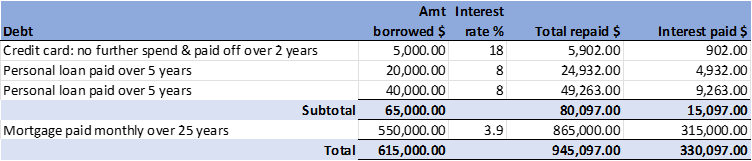
    This chart shows the amount of interest Jaxon had paid before he turned 30.

    In ten years, Jaxon had paid over $15,000 in interest. When eventually he bought his first home, his interest payments really blew out.

    Presumably, Jaxon will buy several cars and another home or two over his lifetime; he could easily end up paying more than a million dollars in interest.

    When buying assets, and creating a lifestyle, interest often can’t be avoided, but it is possible to reduce the amount you pay.

    At 20, when Angela took out a credit card, she insisted on the lowest credit limit possible and ensured she paid the full card balance each month. The low credit limit meant she’d have money for emergency purchases but never more than she could easily repay in a couple of months.

    Her parents introduced her to their financial adviser, who helped Angela create a budget and open a regular savings plan. Angela asked her employer to direct a set amount into it each pay. She didn’t miss the money, and her budget helped her stay on track with card payments and discretionary spending.

    After a year of saving, Angela bought her first car. With her savings, she only needed to borrow half the car’s value. As her repayments were easily managed, she continued saving.

    Again using her savings, Angela eventually upgraded to a new car borrowing only half the value.

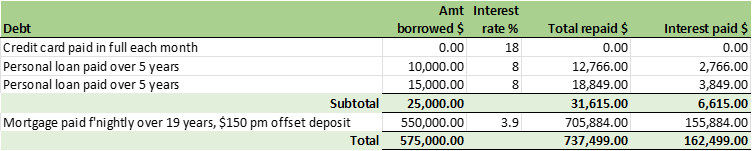
    The chart below shows that over ten years, Angela paid significantly less interest than Jaxon but had made the same purchases.

    When Angela was ready to purchase a house, she opted to make fortnightly repayments instead of monthly, and the money she’d previously deposited into her savings plan now went into a mortgage offset account.

    Mortgage offsets are a great way to reduce the loan period and the interest paid over the course of the loan.

    Consequently, Angela ended up paying considerably less interest than Jaxon. This was no accident.

    Early on, Angela had sought professional advice, she’d budgeted and saved, and structured her loans to work in her favour. Instead of relying on her credit card, Angela lived frugally, saved and paid cash wherever possible.

    Additionally, Angela and her financial adviser regularly reviewed her financial position to ensure her savings and borrowing arrangements continued to meet her needs.

    Few of us purchase big-ticket items without borrowing. Interest is the price we pay for those things that facilitate our chosen lifestyle. But while interest may be a necessary evil, we really can take control of our finances and ensure we don’t pay more than we have to.

    Disclaimer :

    The information contained in this article is for general information purposes only, professional advice should be obtained before acting on any information contained herein. Neither the publishers nor the distributors can accept any responsibility for loss occasioned to any person as a result of action taken or refrained from in consequence of the contents of this publication.

  • New Year Financial Checklist

    New Year Financial Checklist

    As we begin a new year and ponder how fast the last 12 months have come and gone, many of us find ourselves thinking about the coming year and our aspirations for the future.

    Let’s face it, we’ve worked hard throughout the year and now is the time to reflect on what we have achieved; where we want to go; and what we need to get there. These times of reflection are critical to our lives whether we run our own business, are employed or retired.

    A financial checklist is an excellent tool to see how you are progressing towards your goals and to help identify any specific areas you might need to focus on in the immediate future.

    The key issues to consider are:

    Home loan review
    If you’re still making repayments, is it time to revisit your progress? Are you able to increase your payment amounts or frequency to save interest? With interest rates on the move upwards, should you investigate locking in at a fixed rate?

    Other debts
    Review the amount of personal loans, credit card or other debts currently being paid off. If the total of all loans exceeds 10% of household income, you need to implement a plan to reduce them as a matter of priority. Consolidating debts could help control interest costs but take steps to ensure this doesn’t become an excuse to spend more.

    Savings
    How much money did you save this past year? Are you spending first and saving what’s left? If your savings aren’t as healthy as you would have hoped by this time of the year, remember to pay yourself first by allocating up to 10% of your income to a regular savings plan.

    Insurance
    When illness or accidents strike, most people are caught insufficiently protected. It’s important to regularly review your insurance policies to ensure that you and your family have adequate cover. When was the last time you reviewed your insurance cover?

    Superannuation
    What is the current value of your super? If you don’t know, now is a good time to check. Is it working as hard as it should be? Are the fees reasonable? Are you on track to meeting your retirement needs or should you start making extra contributions?

    Your Will
    Making a Will itself is not particularly difficult or even terribly expensive. It is a fact of life that people get married, have children, change relationships, get divorced or establish new interests. Left unaddressed, any of these may result in a Will being legally challenged. Estate planning matters such as Powers of Attorney and Medical Directives should be regularly reviewed in addition to your Will.

    So before you get back into your routine and the year rushes past again, take the time to plan, make some calls and set your goals for the year ahead.

  • Starting A New Business In The New Year?

    Starting A New Business In The New Year?

    The coming new year of 2023 may bring you a fresh start regarding your business adventures. You may even be looking to start your next adventure on your terms.

    Why not make the coming year your year to start a business?

    Understandably, you may have concerns and trepidation about the process (particularly amidst current economic uncertainty). However, a good start to a business should consider strategising, planning and development.

    Starting a successful business requires three things:
    • A good idea,
    • The right amount of capital you’ll need, and
    • Creativity.

    However, with the challenges many businesses faced over the last few years, particularly those who were finding their feet and starting up, having just those three things to face in 2023’s business environment might be a little daunting.
    That’s why having a strategy in place for your business and a plan for its path in the future is of paramount importance.

    Think Through Every Element Of Your Startup (From Top To Bottom)
    Having an idea for your business is a great starting point, but articulating that idea to your investors with a solid foundation behind it is even more critical.

    Think about the questions that your investors might ask you about critical elements of your business, including your target audience, the competition in the field, your company’s goals and your potential marketing strategies, as well as potential questions investors might ask you about each of those aspects of your business.

    Having solid answers in place will give your investors (and you) a better picture of the idea and your potential as a business innovator.

    Draft A Business Plan
    Having a physical business plan that includes all the elements you brought forward to your investors or partners will help you as you move forward on your business trajectory, but it also gives a map of your business goals.

    Creating a business plan should be easy as it simply puts in writing what you have already discussed ahead of time with your investors.
    You may also be able to speak with us about creating business plans at the beginning of your business and throughout your business’s lifetime.

    Put Your Money Into The Resources You Need (Not The Ones You Want)
    It might be tempting to shell out for the best and the flashiest equipment that your business could have a use for all at once, but it’s best to plan out your expenses. Determine your needs upfront and invest in them. Are you planning to have a physical space for your business, or can operations be conducted remotely? Putting the extra money into the critical resources and equipment that your business needs at the start may help you to produce a quality product and earmark your business

    Don’t Skimp On The Marketing
    Marketing is one of the most important business growth strategies but is often neglected or overlooked by new businesses. Use social media, create a website, set up a blog or create email campaigns to bring awareness to your business.

    Hire An Accountant
    An accountant is specially trained to manage your finances and keep them in good order.

    While you might be able to keep track of your finances in the early stages of the business’s growth, we’re equipped to help when things start to pick up speed.

    Start a conversation to find out how we can help your business today.

    Disclaimer:

    The information contained in this publication is for general information purposes only, professional advice should be obtained before acting on any information contained herein. Neither the publishers nor the distributors can accept any responsibility for loss occasioned to any person as a result of action taken or refrained from in consequence of the contents of this publication.

  • Strategising Your Risk Levels Of Super Fund Investments Could Pay Off In The Long Run

    Strategising Your Risk Levels Of Super Fund Investments Could Pay Off In The Long Run

    When it comes to investing, there is always a certain amount of risk involved. The key to a great investment strategy is to discern how much risk you are willing to take.

    The risk profile of your superannuation investment strategy should be determined by combining your financial goals and the time frame in which you want to achieve them.

    As you get closer to retirement, you may care to reduce the risk profile of your investments.
    Younger people, for example, are better positioned to deal with market fluctuations because they have more time to compensate for losses.

    The returns you receive on investments are based on the income those investments can generate and the capital growth that the investments will experience. Investments can be broadly categorised into defensive and growth assets.

    Growth assets typically have a better potential for high returns but carry short-term risks. Shares and property are examples of growth assets. Defensive assets, such as cash and term deposits, generally have a very low level of associated risk but will also yield lower returns.

    By diversifying your superannuation investments between growth and defensive assets, you can fine-tune your portfolio to suit your circumstances.

    Individuals running a self-managed superannuation fund should already have a robust understanding of their risk profile. However, if you are a member of a public fund, it can still be possible to retain a high degree of control over your risk profile.

    Some public funds offer broad investment categories that you can select (usually between five and ten). Others offer members a much higher degree of control over their portfolios, even going so far as to allow you to select specific companies to buy shares from.

    Individuals interested in gaining a higher degree of control over their superannuation risk profile may wish to look at joining one of these more precise funds.

    However, the downside is that these funds usually have much higher fees, potentially eroding the benefits of more control. Involved investors with an active interest in determining their risk profile may wish to investigate self-managed superannuation.

    Before making any major decisions, consulting with a professional is advised.

    Disclaimer:

    The information contained in this publication is for general information purposes only, professional advice should be obtained before acting on any information contained herein. Neither the publishers nor the distributors can accept any responsibility for loss occasioned to any person as a result of action taken or refrained from in consequence of the contents of this publication.

  • Vicarious Liability During Work Events

    Vicarious Liability During Work Events

    The liability of an employer does not start and end at the office door. Employers should understand that their liability extends to outside events affiliated with their staff’s employment (such as employer-sponsored events, training workshops or even office parties).

    Employers can be held legally responsible for acts of discrimination or harassment in the workplace or in connection with a person’s employment.

    This is known as vicarious liability.

    It also means that employers can be liable for acts by their employees that occur at work-related events, such as conferences, training workshops, business trips and workrelated social events, such as Christmas parties.

    For example, in the case of Leslie v Graham [2002] FCA, an employer was found to be vicariously liable for sexual harassment in a situation where the harassment occurred between two employees in the early hours of the morning in a serviced apartment they were sharing, while attending a workrelated conference.

    With workplace events approaching at the end of the year (such as office parties, lunches or even the end-of-year Christmas hurrah), you need to take all reasonable steps to minimise the risk of discrimination or harassment occurring to and by your employees during these events.

    Employers owe a duty of care to their employees and must take reasonable steps to identify and reduce potential risks. The nature of workplace functions and consumption of alcohol heightens the threshold for what is required of employees to take ‘reasonable steps.’

    Failing to take reasonable steps to prevent inappropriate conduct at workplace functions can result in significant liability for the employer.

    To reduce risks at workplace functions, the following reasonable steps can be implemented to minimise employer liability:

    WORKPLACE POLICIES
    • Ensure that policies related to bullying, sexual harassment, discrimination, and work health and safety are up-to-date and accessible. All employees must receive appropriate training regarding these policies.
    • Advise employees that workplace policies could apply to planned and unplanned workplace events.
    • Remind employees that workplace policies will apply to behaviour at these functions even when held off-site.
    • Ensure that workplace policies allow for internal complaints and properly investigate all complaints.

    SET RULES AROUND ALCOHOL & SUBSTANCE ABUSE

    • Remind employees of the dangers of excessive alcohol consumption and drunk driving.
    • Remind employees that workplace policies still apply and that substance usage will not be tolerated.
    • Remind employees that ‘Secret Santa’ gifts must be appropriate. There can be a risk of harassment or discrimination claims if gifts are inappropriate.
    • Responsible service of alcohol must also be taken into account to reduce the risks of sexual harassment, bullying and accidents. Ensure that food and non alcoholic drinks are available. Consider the needs of staff with dietary or cultural requirements.
    • If employees become too intoxicated at a work party, they should be told to stop drinking. If necessary, they should leave the function with safe transport arranged.

    EMPLOYEE SAFETY
    • Ensure that the chosen venue and activities do not present inappropriate risks.
    • Undertake a risk assessment of the venue to identify safety hazards.
    • Set specific start and finish times for workplace functions, and note that parties following after the function are not endorsed by the employer.
    • Ensure that employees can get home safely. You could provide taxi vouchers or organise a shuttle bus.
    • Check your employee insurance policy to see if the function is covered.

  • FBT, The Holiday Season & Your Employees

    FBT, The Holiday Season & Your Employees

    At the end of the year, you may be looking for extrinsic ways to thank your hardworking employees or faithful customers/clients.

    A work Christmas/end-of-year party may be a method employed by many businesses to demonstrate their gratitude towards staff, but the expense can be a deciding factor.

    Christmas/holiday parties are regarded as “entertainment” expenditures, which means they are not tax-deductible. The employer may have to pay FBT if the party costs $300 or more per person.

    It may also be that an end-of-year party might not be feasible for your business this year.
    Instead, it may be a better idea to thank your staff by giving certain items known as “non-entertainment” gifts. These non-entertainment gifts must cost less than $299.99 but are fully tax-deductible and carry no FBT.

    Non-entertainment gifts are usually exempt from FBT when the total cost of the gift is less than $299.99 (inclusive of GST). An employer can also claim tax deductions and GST credits for every non-entertainment gift to staff members.

    These gifts could include beauty or skincare products, flowers, wine, gift vouchers or hampers.

    If you provide a similar gift to the spouse/partner of an employee, the FBT exemption will also be valid. This can be a nice way to say thank you to the hard-working members of your staff while promoting a positive work culture.

    Providing your employees with gifts considered to be “non-entertainment gifts” but costing $300 or more (including GST) is less tax effective. Even though the gift giver can still claim a tax deduction and GST credit, FBT must be paid at 49%.

    You can still give staff members entertainment gifts as a way of saying thank you, though this is a less beneficial and tax-favourable option from an employer’s point of view.

    Examples of entertainment gifts include tickets to a play, sports event, musical, theatre or even providing a holiday.

    These gifts may not be FBT payable if they cost less than $299.99 (including GST) or claimable for a tax deduction or GST credit. However, if they cost more than $300 (including GST), an employer can claim a tax deduction and GST credit, but FBT is payable at 49%.

    Some fringe benefits (such as these gifts) may need to be included in payment summaries. When the value of certain fringe benefits amounts to more than $2,000 in an FBT year, it is your responsibility to record that amount in your payment summary.

    Want to know more about possible FBT exemptions that might apply to gifts you give to your employees this holiday season? Speak with us about how you can make this work for your situation.

    Chat with your accountant at LT

    Disclaimer:

    The information contained in this publication is for general information purposes only, professional advice should be obtained before acting on any information contained herein. Neither the publishers nor the distributors can accept any responsibility for loss occasioned to any person as a result of action taken or refrained from in consequence of the contents of this publication.


  • Binding Death Nominations Are An Important Part Of Your Estate Planning

    Binding Death Nominations Are An Important Part Of Your Estate Planning

    You must make a binding death benefit nomination to maintain control and certainty over who will inherit your superannuation assets after you pass away.

    Contrary to what you may think, your will does not automatically control the payment of your death benefits. If you do not make a binding death benefit nomination, your super trustee will decide who your super passes onto.

    Familiarise yourself with the death benefit nomination rules, so your super assets are paid on your terms after you are gone.

    Binding And Non-Binding Death Benefit Nominations
    You can make a binding or non-binding death benefit nomination depending on your super fund. A binding death benefit nomination provides the greatest certainty as the legal document binds the trustee to pay your death benefits to the beneficiaries you have nominated.

    Some super funds do not offer binding nominations, so individuals make non-binding nominations instead. Non-binding nominations act as a guide to your trustee that they will take into consideration but are not obliged to follow. Your trustee may pay your death benefit to an individual you did not nominate if they feel they are more appropriate.

    Lapsing And Non-Lapsing Nominations
    Understanding your fund’s options for lapsing and non-lapsing nominations will help you keep your nominations up-to-date and binding. Lapsing nominations typically expire after three years and must be renewed. If your binding nomination lapses without renewal, it will be considered a non-binding nomination upon your death. Non-lapsing nominations are permanent unless you change them.

    Changing Death Benefit Nominations
    Life circumstances like divorce, marriage or the death of a nominated individual may trigger you to change your nominations.

    You can amend, cancel or replace your death benefit nomination at any time, provided the nomination is validly concluded. Remember that a power of attorney can renew lapsed binding nominations if you are mentally incapacitated or unable to sign.

    Eligible Beneficiaries
    You cannot pay your superannuation death benefits to just anyone, as there are strict eligibility requirements. You may only nominate your dependents or personal legal representative.

    Dependents are strictly defined by law. According to the legislation, dependents include
    • Your spouse, whom you are legally married to, in a registered relationship with or live with on a genuine domestic basis
    • Your child (including adopted and foster children) or your spouse’s child
    • Anyone in an interdependent relationship with you at the date of your death
    • Other persons who the trustee deems were financially dependent on you at the date of your death
    You can also have your superannuation death benefit paid directly into your estate.

    Validity Requirements
    Whether you are making a new binding death benefit nomination, replacing an old one or cancelling altogether, you must meet these requirements to make your nomination valid:
    • Nominate eligible beneficiaries
    • Clearly allocate your benefits amongst your beneficiaries
    • Allocate 100 per cent of your death benefits
    • Sign and date your nomination in the presence of two witnesses who are legally adults and not nominated to receive your death benefits
    Ensure your witnesses sign and date the notice in your presence.

    Disclaimer:

    The information contained in this publication is for general information purposes only, professional advice should be obtained before acting on any information contained herein. Neither the publishers nor the distributors can accept any responsibility for loss occasioned to any person as a result of action taken or refrained from in consequence of the contents of this publication.

  • Self-Employed Individuals & Super

    Self-Employed Individuals & Super

    Superannuation may not be the first thing that springs to mind as a self-employed individual, but just like how looking after your tax and business expenses benefits you, superannuation is an important subject to consider.

    While you don’t need to pay super to yourself, it might help you feel more secure about your finances during retirement. You can make regular or lump sum payments can usually claim a tax deduction on contributions, and may be able to save tax.

    Contributions you make to your super will only be taxed at 15%. Depending on which tax bracket you fit into, this might be a concession compared to your usual tax rates. Additionally, investing in your super will most likely yield a higher return than if you put your money into a bank savings account.

    You may be able to contribute to your pre-existing super fund after becoming self-employed. All you need to do is provide the fund with your tax file number (TFN) so that your contributions can be added to the fund. Alternatively, you can choose a new fund.

    There are two ways you can contribute to the fund which are dependent on how you receive income:

    • Wage: Make regular transfers to the super fund from your pre-tax income (such as by salary-sacrificing).
    • Income from business revenue: Transfer lump sum amounts when there is sufficient cash flow from your business.

    If you make contributions to the super fund from your pre-tax income, then you can claim tax deductions for them. Your overall taxable income is reduced as well. Ensure you complete a ‘Notice of intent to claim’ to receive this deduction.

    There are limits to the amount of money you can contribute to your super every financial year:
    • Up to $27,500 in concessional contributions (from pre-tax income, so you can claim a deduction)
    • Up to $110,000 in non-concessional contributions (from after-tax income)

    For example, employers contribute a minimum of 10.5% of an employee’s earnings to their super (since July 2022) – if you are not sure how much to contribute, this could be a starting point.

    For Example – How Your Concessional Contribution Can Work

    You claim a tax deduction for your superannuation contribution above what your employer paid, up to the limit (currently $27,500), and will receive a refund of your marginal tax rate. In this example, we’ll say that it’s 34%.

    But, your fund pays 15% tax. So if you put $10,000 into your fund, you should receive a tax refund of $3,400 (34%) cash into your pocket. However, the fund pays $1,500 (15%) in tax, which comes from your contribution.

    This 15% will go up to 30% when your adjusted income is above $250,000, but your savings will be 47% instead of 34%.

    If you are a low to middle-income earner, then you may meet the eligibility criteria to receive government super contributions. The government will determine how much you are entitled to when you lodge your tax return. If you’re eligible, the government will pay the co-contribution directly to your fund.

    Although it may be challenging to make super contributions when self-employed, consider starting off the process so that when you are in your retirement period, you have some financial security.

    Disclaimer:

    The information contained in this publication is for general information purposes only, professional advice should be obtained before acting on any information contained herein. Neither the publishers nor the distributors can accept any responsibility for loss occasioned to any person as a result of action taken or refrained from in consequence of the contents of this publication.

  • Is Your Limit To Claiming A GST Refund Approaching?

    Is Your Limit To Claiming A GST Refund Approaching?

    Small businesses entitled to refunds of GST may not be aware of the four-year time limit on claiming those refunds. Your entitlement to a GST credit ends four years from the due date of the earliest activity statement in which you could have claimed it.

    GST refunds are claimed under the indirect tax concession scheme (ITCS), which also covers luxury car tax (LCT), wine equalization tax (WET) and excise.

    They are a form of “outstanding indirect tax refunds”, which are tax refunds that are entitled to the taxpayer but are yet to be claimed.

    “Outstanding indirect tax refunds” can be claimed in the following cases.

    Refund of a net amount for a tax period:
    This applies to those that have yet to lodge an activity statement for a tax period. Small businesses with GST entitlements that amount to $2,500 (which exceeds the net GST, WET and LCT liabilities for that period $2,000), can claim an outstanding indirect tax refund of $500.

    Refund Of An Overpayment Of A Net Amount:
    Due to a clerical error, a business owner reports and pays $4,600 net GST for a tax period instead of the actual amount of $4,060. The excess amount of $540 is an outstanding indirect tax refund which the business can claim.

    ETP cap: this is indexed each year, so for 2022- 23 the cap is $230 000. This cap is reduced by any earlier ETPs paid in the same income year.


    Whole-of-income cap: this cap is $180 000 (2021-22 tax rate), and is reduced by any other taxable payments given to the employee in the same income year.

    The concessional tax rate is 17% for employees who have reached their preservation age, which is determined by when they were born (if they were born after 30/6/1964, their preservation age is 60).

    For genuine redundancy payments and early retirement scheme payments, there is a tax-free limit depending on the employee’s service amount with the employer. The tax-free amount is not part of the employee’s ETP and is provided as a lump sum in their PAYG payment summary.

    Any amount above this tax-free limit is part of the employee’s ETP.

    The tax-free limit is calculated through the formula: Tax-free limit = base amount + (service amount x years of service).

    The ETP payment summary that reflects the payment amount and any associated withholding must be supplied to the employee within 14 days of the employer making the payment.

    Refund Due To An Underreported Initial Net Refund Entitlement:

    A business claims a net GST refund of $3,000 for the tax period and receives the refund. Afterwards, however, it is realised that the actual refund entitlement was $3,200, the excess $200 represents an outstanding indirect tax refund that can be claimed.

    Refund Of Indirect Tax Relating To An Importation:
    For example, $200 GST is overpaid for an importation. This $200 represents an outstanding indirect tax refund that can be claimed.

    Disclaimer:

    The information contained in this publication is for general information purposes only, professional advice should be obtained before acting on any information contained herein. Neither the publishers nor the distributors can accept any responsibility for loss occasioned to any person as a result of action taken or refrained from in consequence of the contents of this publication.

  • Budget 2022/23: What you need to know

    Budget 2022/23: What you need to know

    We have pleasure in enclosing a summary of the highlights from the Federal Government’s October 2022/23 Budget.

    Australia’s Foreign Investment Framework – increase to fees and penalties

    The Government has increased foreign investment fees and will increase financial penalties for breaches that relate to residential land. Fees doubled on 29 July 2022 for all applications made under the foreign investment framework. The maximum financial penalties that can be applied for breaches in relation to residential land will also double on 1 January 2023.

    Fees ensure Australians do not bear the cost of administering the foreign investment framework, and penalties encourage compliance with these rules.

    This measure is estimated to increase receipts by $457.4 million over the 4 years from 2022–23.

    This measure delivers on the Government’s election commitment as published in the Plan for a Better Future.

    Source: Budget Paper No 2, p 10.

    Depreciation – reverse the measure allowing taxpayers to self-assess the effective life of intangible depreciating assets

    The Government will not proceed with the measure to allow taxpayers to self-assess the effective life of intangible depreciating assets, announced in the 2021–22 Budget.

    Reversing this decision will maintain the status quo – effective lives of intangible depreciating assets will continue to be set by statute. This will avoid the potential integrity concerns with the previously announced measure and contribute to budget repair.

    This measure is estimated to increase receipts by $550.0 million over the 4 years from 2022–23.

    Source: Budget Paper No 2, p 10.

    Digital Currency – clarifying that digital currencies are not taxed as foreign currency

    The Government will introduce legislation to clarify that digital currencies (such as Bitcoin) continue to be excluded from the Australian income tax treatment of foreign currency. This maintains the current tax treatment of digital currencies, including the capital gains tax treatment where they are held as an investment. This measure removes uncertainty following the decision of the Government of El Salvador to adopt Bitcoin as legal tender and will be backdated to income years that include 1 July 2021.

    The exclusion does not apply to digital currencies issued by, or under the authority of, a government agency, which continue to be taxed as foreign currency.

    This measure is estimated to have no impact on receipts over the 4 years from 2022–23.

    Source: Budget Paper No 2, p 11.

    Extend ATO Compliance Programs – Personal Income Taxation Compliance Program

    The Government will provide $80.3 million to the ATO to extend the Personal Income Taxation Compliance Program for 2 years from 1 July 2023.

    This extension will enable the ATO to continue to deliver a combination of proactive, preventative and corrective activities in key areas of non-compliance, including overclaiming of deductions and incorrect reporting of income. The funding will enable the ATO to modernise its guidance products, engage earlier with taxpayers and tax agents and target its compliance activity.

    This measure is estimated to increase receipts by $674.4 million and increase payments by $80.3 million over the 4 years from 2022–23.

    Source: Budget Paper No 2, p 11.

    Extend ATO Compliance Programs – Shadow Economy Program

    The Government will extend the existing ATO Shadow Economy Program for a further 3 years from 1 July 2023.

    The extension of the Shadow Economy Program will enable the ATO to continue a strong and co-ordinated response to target shadow economy activity, protect revenue and level the playing field for those businesses that are following the rules.

    This measure is estimated to increase receipts by $2.1 billion and increase payments by $685.2 million over the 4 years from 2022–23. This includes an increase in GST payments to the States and Territories of $442.3 million.

    This measure delivers on the Government’s election commitment as published in the Plan for a Better Future.

    Source: Budget Paper No 2, p 12.

    Extend ATO Compliance Programs – Tax Avoidance Taskforce

    The Government has boosted funding for the ATO Tax Avoidance Taskforce by around $200 million per year over 4 years from 1 July 2022, in addition to extending this Taskforce for a further year from 1 July 2025.

    The boosting and extension of the Tax Avoidance Taskforce will support the ATO to pursue new priority areas of observed business tax risks, complementing the ongoing focus on multinational enterprises and large public and private businesses.

    This measure is estimated to increase receipts by $2.8 billion and increase payments by $1.1 billion over the 4 years from 2022–23.

    This measure delivers on the Government’s election commitment as published in the Plan for a Better Future.

    Source: Budget Paper No 2, p 12.

    Improving the integrity of off-market share buy-backs

    The Government will improve the integrity of the tax system by aligning the tax treatment of off-market share buy-backs undertaken by listed public companies with the treatment of on-market share buy-backs. This measure will apply from announcement on Budget night (7:30pm AEDT, 25 October 2022).

    This measure is estimated to increase receipts by $550.0 million over the 4 years from 2022–23.

    Source: Budget Paper No 2, p 13.

    Making COVID-19 business grants non-assessable non-exempt

    In response to COVID-19, payments from certain state and territory business grants, made prior to 30 June 2022, can be made non-assessable, non-exempt (NANE) for income tax purposes, subject to eligibility. This tax treatment is only provided in exceptional circumstances, such as the severe economic consequences facing businesses during the COVID-19 pandemic.

    The Government has made the following state and territory COVID-19 grant programs eligible for NANE treatment, which will exempt eligible businesses from paying tax on these grants: Victoria Business Costs Assistance Program Four – Construction, Victoria Licenced Hospitality Venue Fund 2021 – July Extension, Victoria License, Hospitality Venue Fund 2021 – Top Up Payments, Victoria Business Costs Assistance Program Round Two – Top Up, Victoria Business Costs Assistance Program Round Three, Victoria Business Costs Assistance Program Round Four, Victoria Business Costs Assistance Program Round Five, Victoria Impacted Public Events Support Program Round Two, Victoria Live Performance Support Program (Presenters) Round Two, Victoria Live Performance Support Program (Suppliers) Round Two, Victoria Commercial Landlord Hardship Fund 3, Australian Capital Territory HOMEFRONT 3, and Australian Capital Territory Small Business Hardship Scheme.

    This measure is estimated to result in an unquantifiable decrease in receipts over the 4 years from 2022–23.

    Source: Budget Paper No 2, p 14.

    More Competition, Better Prices – increase penalties

    The Government will increase penalties for breaches of competition and consumer law to deter conduct that stifles competition and increases costs to consumers. Maximum penalties for corporations will increase from $10 million to $50 million per breach, and from 10 per cent of annual turnover to 30 per cent of turnover (whichever is greater) during the period the breach took place.

    This measure is estimated to increase receipts by $62.6 million over the 4 years from 2022–23.

    This measure delivers on the Government’s election commitment as published in the Plan for a Better Future.

    Source: Budget Paper No 2, p 15.

    Multinational Tax Integrity Package – amending Australia’s interest limitation (thin capitalisation) rules

    The Government will strengthen Australia’s thin capitalisation rules to address risks to the corporate tax base arising from the use of excessive debt deductions. This measure will apply to income years commencing on or after 1 July 2023.

    The current thin capitalisation regime limits debt deductions up to the maximum of three different tests: a safe harbour (debt to asset ratio) test; an arm’s length debt test; and a worldwide gearing (debt to equity ratio) test. The Government will replace the safe harbour and worldwide gearing tests with earnings-based tests to limit debt deductions in line with an entity’s activities (profits).

    This measure includes changes to:

    • limit an entity’s debt-related deductions to 30 per cent of profits (using EBITDA —earnings before interest, taxes, depreciation, and amortisation – as the measure of profit). This new earnings-based test will replace the safe harbour test

    • allow deductions denied under the entity-level EBITDA test (interest expense amounts exceeding the 30 per cent EBITDA ratio) to be carried forward and claimed in a subsequent income year (up to 15 years)

    • allow an entity in a group to claim debt-related deductions up to the level of the worldwide group’s net interest expense as a share of earnings (which may exceed the 30 per cent EBITDA ratio). This new earnings-based group ratio will replace the worldwide gearing ratio

    • retain an arm’s length debt test as a substitute test which will apply only to an entity’s external (third party) debt, disallowing deductions for related party debt under this test.

    The changes will apply to multinational entities operating in Australia and any inward or outward investor, in line with the existing thin capitalisation regime. Financial entities will continue to be subject to the existing thin capitalisation rules.

    This measure is estimated to increase receipts by $720.0 million and increase payments by $5.4 million over the 4 years from 2022–23.

    This measure delivers on the Government’s election commitment as published in the Plan for a Better Future.

    Source: Budget Paper No 2, p 15-16.

    Multinational Tax Integrity Package – denying deductions for payments relating to intangibles held in low- or no-tax jurisdictions

    The Government will introduce an anti-avoidance rule to prevent significant global entities (entities with global revenue of at least $1 billion) from claiming tax deductions for payments made directly or indirectly to related parties in relation to intangibles held in low- or no-tax jurisdictions. For the purposes of this measure, a low- or no-tax jurisdiction is a jurisdiction with:

    • a tax rate of less than 15 per cent or

    • a tax preferential patent box regime without sufficient economic substance.

    The measure will apply to payments made on or after 1 July 2023.

    This measure is estimated to increase receipts by $250.0 million and increase payments by $6.7 million over the 4 years from 2022–23.

    This measure delivers on the Government’s election commitment as published in the Plan for a Better Future.

    Source: Budget Paper No 2, p 16.

    Multinational Tax Integrity Package – improved tax transparency

    The Government will introduce reporting requirements for relevant companies to enhance the tax information they disclose to the public, for income years commencing from 1 July 2023.

    The Government will require:

    • large multinationals, defined as significant global entities, to prepare for public release of certain tax information on a country by country (CbC) basis and a statement on their approach to taxation, for disclosure by the ATO

    • Australian public companies (listed and unlisted) to disclose information on the number of subsidiaries and their country of tax domicile and

    • tenderers for Australian Government contracts worth more than $200,000 to disclose their country of tax domicile (by supplying their ultimate head entity’s country of tax residence).

    This measure is estimated to have an unquantifiable impact on receipts and to increase payments by $5.1 million over the 4 years from 2022–23.

    This measure delivers on the Government’s election commitment as published in the Plan for a Better Future.

    Source: Budget Paper No 2, p 17.

    Powering Australia – Electric Car Discount

    The Government will cut taxes on electric cars so that more Australians can afford them.

    From 1 July 2022, the measure will exempt battery, hydrogen fuel cell and plug-in hybrid electric cars from fringe benefits tax and import tariffs if they have a first retail price below the luxury car tax threshold for fuel-efficient cars. The car must not have been held or used before 1 July 2022.

    Employers will need to include exempt electric car fringe benefits in an employee’s reportable fringe benefits amount.

    This measure is estimated to decrease receipts by $410.0 million and decrease payments by $65.0 million over the 4 years from 2022–23. The measure will be reviewed after 3 years.

    This measure delivers on the Government’s election commitment as published in the Plan for a Better Future.

    Source: Budget Paper No 2, p 18.

    Providing certainty on unlegislated tax and superannuation measures announced by the previous Government

    The Government has reviewed and will not proceed with the following legacy tax and superannuation measures that were announced but not legislated by the previous Government:

    • The 2013-14 MYEFO measure that proposed to amend the debt/equity tax rules.

    • The 2016–17 Budget measure that proposed changes to the taxation of financial arrangements (TOFA) rules (a delayed start date was announced in 2018–19 Budget).

    • The 2016–17 Budget measure that proposed changes to the taxation of asset-backed financing arrangements.

    • The 2016–17 Budget measure that proposed introducing a new tax and regulatory framework for limited partnership collective investment vehicles.

    • The 2018–19 Budget measure that proposed changing the annual audit requirement for certain self-managed superannuation funds (SMSFs).

    • The 2018–19 Budget measure that proposed introducing a limit of $10,000 for cash payments made to businesses for goods and services (a delayed start date was announced in 2018–19 MYEFO).

    • The 2018–19 Budget measure that proposed introducing a requirement for retirement income product providers to report standardised metrics in product disclosure statements.

    • The 2021–22 MYEFO measure that proposed establishing a deductible gift recipient category for providers of pastoral care and analogous well-being services in schools.

    Further, the Government will defer the start dates of the following legacy tax and superannuation measures to allow sufficient time for policies to be legislated and implemented:

    • The 2019–20 MYEFO measure that proposed introducing a sharing economy reporting regime, from:

     – 1 July 2022 to 1 July 2023 for transactions relating to the supply of ride sourcing and short-term accommodation, and

    – 1 July 2023 to 1 July 2024 for all other reportable transactions (including but not limited to asset sharing, food delivery and tasking-based services).

    • The 2021–22 Budget measure that proposed relaxing residency requirements for SMSFs, from 1 July 2022 to the income year commencing on or after the date of Royal Assent of the enabling legislation.

    • The 2021–22 Budget measure that proposed making technical amendments to the TOFA rules, from 1 July 2022 to the income year commencing on or after the date of Royal Assent of the enabling legislation.

    This measure is estimated to increase receipts by $29.4 million, and decrease GST payments to the States and Territories by $4.1 million over the 4 years from 2022–23.

    Source: Budget Paper No 2, p 18-19.

    Superannuation – expanding eligibility for downsizer contributions

    The Government will allow more people to make downsizer contributions to their superannuation, by reducing the minimum eligibility age from 60 to 55 years of age. The measure will have effect from the start of the first quarter after Royal Assent of the enabling legislation.

    The downsizer contribution allows people to make a one-off post-tax contribution to their superannuation of up to $300,000 per person from the proceeds of selling their home. Both members of a couple can contribute and contributions do not count towards non-concessional contribution caps.

    This measure provides greater flexibility to contribute to superannuation and aims to encourage older Australians to downsize sooner to a home that better suits their needs, thereby increasing the availability of suitable housing for Australian families.

    This measure is estimated to decrease receipts by $20.0 million over the 4 years from 2022–23.

    This measure delivers on the Government’s election commitment as published in the Plan for a Better Future.

    Source: Budget Paper No 2, p 20.

    Tax Practitioners Board – compliance program to enhance tax system integrity

    The Government will provide $30.4 million to the Tax Practitioners Board (TPB) to increase compliance investigations into high-risk tax practitioners and unregistered preparers over 4 years from 1 July 2023.

    The TPB will use new risk engines to better identify tax practitioners who engage in poor and unlawful tax advice, to improve tax compliance and raise industry standards.

    This measure is estimated to increase receipts by $81.9 million, and increase payments by $30.8 million, over the 4 years from 2022–23. This includes an increase in GST payments to the States and Territories of $10.0 million.

    Source: Budget Paper No 2, p 20.

    Energy Efficiency Grants for Small and Medium Sized Enterprises

    The Government will provide $62.6 million over 3 years from 2022–23 to support small to medium enterprises to fund energy efficient equipment upgrades. The funding will support studies, planning, equipment and facility upgrade projects that will improve energy efficiency, reduce emissions or improve the management of power demand.

    Costs of this measure will be partially met within the existing resourcing of the Department of Climate Change, Energy, the Environment and Water.

    This measure delivers on the Government’s election commitment as published in the Plan for a Better Future.

    Source: Budget Paper No 2, p 60.

    Outcomes of the Jobs and Skills Summit

    The Government will provide $76.4 million over 4 years from 2022–23 for outcomes from the Jobs and Skills Summit to help build a bigger, better trained and more productive workforce, boost real wages and living standards, and create more opportunities for more Australians.

    Funding includes:

    • $42.2 million over two years from 2022–23 for the Department of Home Affairs to increase visa processing capacity and raise awareness of opportunities for high-skilled migrants in Australia’s permanent Migration Program

    • $11.5 million over 4 years from 2022–23 to the Australian Public Service Commission to establish an APS Digital Traineeship Program to support early to mid-career transitions into digital roles

    • $8.9 million over 3 years from 2023–24 to establish a Productivity, Education and Training Fund to support employer and union representatives to improve safety, fairness and productivity in workplaces

    • $7.9 million over 4 years from 2022–23 for the Fair Work Commission to support the uptake of enterprise bargaining for small businesses

    • $4.0 million over 4 years from 2022–23 to the Australian Bureau of Statistics to increase the frequency and detail of data measuring the barriers and incentives to participating in the labour market

    • $2.0 million over 3 years from 2022–23 to develop a Carer Friendly Workplace Framework to assist employers to develop and adopt practices to support employees with caring responsibilities to enter and remain in the workforce, with the cost of this component met from within the existing resourcing of the Department of Social Services.

    The Government will also:

    • establish a South Australian Defence Industry Workforce and Skills Taskforce, within the existing resources of the Department of Defence, to support the growth of a skilled defence industry workforce in South Australia

    • extend the relaxation of work restrictions for student visa holders and secondary training visa holders until 30 June 2023.

    In addition, the Government provided $4.7 million over two years from 2022–23 for the Treasury to deliver the Jobs and Skills Summit in September 2022 and to develop the Employment White Paper in 2023.

    This measure delivers on the Government’s election commitment as published in the Plan for a Better Future.

    Source: Budget Paper No 2, p 82-83.

    Plan for Cheaper Child Care

    The Government will provide $4.7 billion over 4 years from 2022–23 (and $1.7 billion per year ongoing) to deliver cheaper child care, easing the cost of living for families and reducing barriers to greater workforce participation. This includes $4.6 billion over 4 years from 2022–23 to:

    • increase the maximum Child Care Subsidy (CCS) rate from 85 per cent to 90 per cent for families for the first child in care and increase the CCS rate for all families earning less than $530,000 in household income

    • maintain current higher CCS rates for families with multiple children aged 5 or under in child care, with higher CCS rates to cease 26 weeks after the older child’s last session of care, or when the child turns 6 years old

    • task the Australian Competition and Consumer Commission to undertake a 12 month inquiry into the cost of child care and the Productivity Commission to conduct a comprehensive review of the child care sector

    • improve the transparency of the child care sector by requiring large providers to publicly report CCS-related revenue and profits.

    The Government will also provide $43.9 million over 4 years from 2022–23 for measures that support the National Agreement on Closing the Gap targets and improve early childhood outcomes for First Nations children.

    Funding includes:

    • $33.7 million over 4 years from 2022–23 to introduce a base entitlement to 36 hours per fortnight of subsidised early childhood education and care for families with First Nations children, regardless of activity hours or income level

    • $10.2 million over 3 years from 2022–23 to establish the Early Childhood Care and Development Policy Partnership with Coalition of Peaks partners and First Nations representatives to develop policies on First Nations early childhood education and care.

    The Government will also provide $9.5 million over two years from 2022–23 to communicate the changes to the CCS system to families and child care providers.

    This measure delivers on the Government’s election commitment as published in the Plan for a Better Future.

    Source: Budget Paper No 2, p 93-94.

    Plan for Cheaper Medicines

    The Government will provide $787.1 million over 4 years from 2022–23 (and $233.4 million per year ongoing) to decrease the general patient co-payment for treatments on the Pharmaceutical Benefits Scheme from $42.50 to $30.00 on 1 January 2023.

    This measure delivers on the Government’s election commitment as published in the Plan for a Better Future.

    Source: Budget Paper No 2, p 135.

    Disaster Support

    The Government will provide $51.5 million in 2022–23 to support communities impacted by natural disasters, including:

    • $24.6 million for Queensland communities impacted by flooding in May 2022

    • $22.6 million for ongoing recovery for communities from the 2019–20 Black Summer bushfires in Victoria

    • $2.8 million towards rebuilding of the Norco Ice Cream Factory in the Northern Rivers region of New South Wales

    • $1.5 million for the National Emergency Management Agency to support work on optimal responses and resilience to natural disasters.

    The support outlined in this measure is in addition to previous assistance provided by the Commonwealth Government in response to flooding in Queensland in March and May 2022, and in New South Wales from February, March and July 2022 through Australian Government Disaster Recovery Payments (AGDRP), Disaster Recovery Allowance (DRA) and other payments made under the Disaster Recovery Funding Arrangements. It is also additional to the assistance announced for Victoria, New South Wales and Tasmania in October 2022.

    The Government is expecting to provide $1.4 billion to individuals impacted by disaster events through the AGDRP and DRA.

    The 2022–23 October Budget includes a provision of $3.0 billion over the forward estimates to account for potential future expenditure on floods or other disaster response payments, including for demand driven payments under the DRFA, and delayed AGDRP and DRA claims.

    Partial funding for this measure has already been provided for by the Government.

    Source: Budget Paper No 2, p 148.

    National Reconstruction Fund – establishment

    The Government will invest $15.0 billion over 7 years from 2023–24 to establish the National Reconstruction Fund (NRF) to support, diversify and transform Australian industry and the economy through targeted co-investments in 7 priority areas: resources; agriculture, forestry and fisheries sectors; transport; medical science; renewables and low emission technologies; defence capability; and enabling capabilities.

    Funding includes:

    • $15.0 billion in targeted co-investments through independently assessed projects

    • $50.0 million over two years from 2022–23 to the Department of Industry, Science and Resources, and the Department of Finance to establish the NRF.

    The NRF is expected to generate revenue from investments, which will be quantified as part of the policy and legislation design of the NRF, following public consultation.

    This measure will redirect $5.2 million from the 2022–23 March Budget measure titled Boosting the Modern Manufacturing Strategy and Addressing Critical Supply Chain Vulnerabilities.

    This measure delivers on the Government’s election commitment as published in the Plan for a Better Future.

    Source: Budget Paper No 2, p 153.

    Improving the NBN

    The Government will provide an equity investment of $2.4 billion to NBN Co over 4 years from 2022–23 to upgrade the National Broadband Network (NBN) to deliver fibre-ready access to a further 1.5 million premises by late 2025.

    The additional investment will support nearly 90 per cent of Australia’s fixed line footprint to have access to world class gigabit speeds by late 2025.

    The Government will also provide $4.7 million over 3 years from 2022–23 to support the delivery of free broadband for up to 30,000 unconnected families with school aged students during the 2023 calendar year.

    This measure includes the Government’s election commitment as published in the Plan for a Better Future.

    Source: Budget Paper No 2, p 162.

    Boosting Parental Leave to Enhance Economic Security, Support and Flexibility for Australia’s Families

    The Government will enhance economic security, improve gender equality, and enhance and provide more flexibility for shared care arrangements at a cost to the budget of $531.6 million over 4 years from 2022–23 (and $619.3 million per year ongoing).

    The Government will introduce reforms from 1 July 2023 to make the Paid Parental Leave Scheme flexible for families so that either parent is able to claim the payment and both birth parents and non-birth parents are allowed to receive the payment if they meet the eligibility criteria. Parents will also be able to claim weeks of the payment concurrently so they can take leave at the same time.

    From 1 July 2024, the Government will start expanding the scheme by two additional weeks a year until it reaches a full 26 weeks from 1 July 2026.

    Both parents will be able to share the leave entitlement, with a proportion maintained on a “use it or lose it” basis, to encourage and facilitate both parents to access the scheme and to share the caring responsibilities more equally. Sole parents will be able to access the full 26 weeks.

    The Women’s Economic Equality Taskforce will assist in the finalisation of the changes to the scheme to ensure that the final model supports women’s economic participation and gender equality, including the period of concurrence and the most appropriate proportion of “use it or lose it” weeks.

    This measure extends the 2022–23 March Budget measure titled Women’s Economic Security Package.

    Source: Budget Paper No 2, p 177.

    Incentivising Pensioners to Downsize

    The Government will provide $73.2 million over 4 years from 2022–23 (and $0.4 million per year ongoing), including:

    • extending the assets test exemption for principal home sale proceeds from 12 months to 24 months for income support recipients

    • changing the income test, to apply only the lower deeming rate (0.25 per cent) to principal home sale proceeds when calculating deemed income for 24 months after the sale of the principal home.

    This measure will reduce the financial impact on pensioners looking to downsize their homes in an effort to minimise the burden on older Australians and free up housing stock for younger families.

    The cost of this measure will be partially met from within the existing resourcing of the Department of Social Services, Services Australia and the Department of Veterans’ Affairs.

    Personal income tax receipts are also expected to increase by $7.0 million over 3 years from 2023–24 as a result of this measure.

    This measure delivers on the Government’s election commitments as published in the Plan for a Better Future.

    Source: Budget Paper No 2, p 180.

    Jobs and Skills Summit – incentivise pensioners into the workforce

    The Government will provide $61.9 million over two years from 2022–23 to provide age and veterans pensioners a once off credit of $4,000 to their Work Bonus income bank.

    The temporary income bank top up will increase the amount pensioners can earn in 2022–23 from $7,800 to $11,800, before their pension is reduced, supporting pensioners who want to work or work more hours to do so without losing their pension.

    Personal income tax receipts are also expected to increase by $15.0 million in 2023–24 as a result of this measure.

    This measure implements an outcome from the Jobs and Skills Summit.

    Source: Budget Paper No 2, p 181.

    Lifting the Income Threshold for the Commonwealth Seniors Health Card

    The Government will provide $69.6 million over 4 years from 2022–23 to increase the income threshold for the Commonwealth Seniors Health Card from $61,284 to $90,000 for singles and from $98,054 to $144,000 (combined) for couples.

    The Government will also freeze social security deeming rates at their current levels for a further two years until 30 June 2024, to support older Australians who rely on income from deemed financial investments, as well as the pension, to deal with the rising cost of living.

    The cost of this measure will be partially met from within the existing resourcing of the Department of Veterans’ Affairs.

    This measure delivers on the Government’s election commitments as published in the Plan for a Better Future.

    Source: Budget Paper No 2, p 181.

    National Housing and Homelessness Plan

    The Government will provide $13.4 million over 4 years from 2022–23 (and $4.2 million per year ongoing) to develop a 10 year National Housing and Homelessness Plan in 2023. The plan will be developed in association with states and territories, industry bodies and not for profit organisations, to support the development of short, medium and long term housing and homelessness policy.

    The Government will also provide a one year extension for the National Housing and Homelessness Agreement to 30 June 2024, to allow for the development of the new arrangement, in consultation with the National Housing Supply and Affordability Council and states and territories. Funding for the extension of the National Housing and Homelessness Agreement has already been provided for by the Government.

    The cost of this measure will be partially met from within the existing resourcing of the Department of Social Services.

    This measure delivers on the Government’s election commitment as published in the Plan for a Better Future.

    See also the related payment measure titled Safer and More Affordable Housing in the Treasury Portfolio.

    Source: Budget Paper No 2, p 183.

    Fighting Online Scams

    The Government will provide $12.6 million over 4 years from 2022–23 to combat scams and online fraud to protect Australians from financial harm.

    Funding includes:

    • $9.9 million over 4 years from 2022–23 to the Australian Competition and Consumer Commission for initial work on the establishment of a National Anti-Scam Centre

    • $2.0 million in 2022–23 to the Department of Home Affairs to expand its arrangement with IDCARE to provide specialist identity support services, including counselling and identity recovery services for victims of identity theft

    • $0.7 million in 2022–23 to the Treasury to raise public awareness of the risk of scams.

    The cost of this measure will be partially met from within the existing resourcing of the Australian Competition and Consumer Commission.

    This measure delivers on the Government’s election commitment as published in the Plan for a Better Future.

    Source: Budget Paper No 2, p 188.

    Housing Accord

    The Australian Government will provide $350.0 million over 5 years from 2024–25 to support funding of an additional 10,000 affordable homes under a Housing Accord with state and territory governments and other key stakeholders.

    The Commonwealth support will include availability payments over the longer term to facilitate institutional investment, including by superannuation funds, in affordable homes.

    This measure complements the Government’s investment in the Housing Australia Future Fund, which will provide a further 30,000 social and affordable homes over 5 years.

    See also the related payments measures titled Safer and More Affordable Housing in the Treasury Portfolio and National Housing and Homelessness Plan in the Social Services Portfolio.

    Source: Budget Paper No 2, p 189.

    Modernising Business Registers – program funding, director ID sustainment and registry stabilisation

    The Government will provide additional funding of $166.2 million over 4 years from 2022–23 to continue delivery of the Modernising Business Registers program that will consolidate over 30 business registers onto a modernised registry platform.

    Funding includes:

    • $80.0 million in 2022–23 for the Australian Taxation Office (ATO) and the Australian Securities and Investments Commission (ASIC) to continue design and delivery of the modernised registry platform

    • $86.2 million over 4 years from 2022–23 ($119.5 million over 6 years from 2022–23 and $15.9 million per year ongoing) for ATO and ASIC to operate and regulate the Director Identification Numbers regime, and maintain ASIC’s registry systems.

    Source: Budget Paper No 2, p 190.

    Safer and More Affordable Housing

    The Government will invest $10 billion in the newly created Housing Australia Future Fund, to be managed by the Future Fund Management Agency, to generate returns to fund the delivery of 30,000 social and affordable homes over 5 years and allocate $330 million for acute housing needs.

    In the first 5 years these investment returns will fund:

    • $200 million for the repair, maintenance and improvements of housing in remote Indigenous communities, where some of the worst housing standards in the world are endured by our First Nations people

    • $100 million for crisis and transitional housing options for women and children fleeing domestic and family violence and older women on low incomes who are at risk of homelessness

    • $30 million to build more housing and fund specialist services for veterans who are experiencing homelessness or are at-risk of homelessness.

    The Government remains committed to ensuring that of the $10 billion fund, the returns from $1.6 billion will be directed to long-term housing for women and children fleeing domestic and family violence, and older women on low incomes who are at risk of homelessness.

    In addition, the Government will provide $348.6 million over 4 years from 2022–23 for a number of further initiatives to deliver more social and affordable housing. Funding includes:

    • $324.6 million over 4 years from 2022–23 to establish the Help to Buy scheme to assist people on low to moderate incomes to purchase a new or existing home with an equity contribution from the Government

    • $15.2 million over 4 years from 2022–23 (and $4.4 million per year ongoing) to establish a National Housing Supply and Affordability Council to support the Australian Government to develop housing supply and affordability policy through research and advice

    • $0.5 million over 4 years from 2022–23 (and $0.1 million per year ongoing) to establish Housing Australia, by renaming and expanding the remit of the National Housing Finance and Investment Corporation, to deliver the Australian Government’s social and affordable housing programs

    • $8.3 million over 4 years from 2022–23 to the Treasury and Housing Australia to administer the Housing Australia Future Fund.

    The Government will also:

    • establish the Regional First Home Buyers Guarantee to support eligible citizens and permanent residents who have lived in a regional location for more than 12 months to purchase their first home in that location with a minimum 5 per cent deposit, with 10,000 places per year to 30 June 2026, by redirecting funding from the Regional Home Guarantee component of the 2022–23 March Budget measure titled Affordable Housing and Home Ownership, with no financial impact

    • broaden the remit of the National Housing Infrastructure Facility to directly support new social and affordable housing in addition to financing critical housing infrastructure, with no financial impact, as announced at the Jobs and Skills Summit.

    This measure implements the Government’s election commitments as published in the Plan for a Better Future.

    See also the related payments measures titled Housing Accord in the Treasury Portfolio and National Housing and Homelessness Plan in the Social Services Portfolio.

    Source: Budget Paper No 2, p 191-192.

    Supporting Small Business Owners

    The Government will provide $15.1 million over two calendar years from 1 January 2023 until 31 December 2024 to extend the Small Business Debt Helpline and the NewAccess for Small Business Owners programs to support the financial and mental wellbeing of small business owners.

    This measure will redirect partial funding from the Australian Small Business and Family Enterprise Ombudsman component of the 2022–23 March Budget measure titled Small Business Support Package, and savings identified as part of the Spending Audit.

    Source: Budget Paper No 2, p 193.

    Want to chat with our accountants? Contact us today

  • Insurance & Your Business – Are You Covered?

    Insurance & Your Business – Are You Covered?

    Providing your business with insurance is like providing a safety net to a trapeze artist. You hope you won’t need it, but having it in place adds security and protection if the worst-case scenario occurs.

    Your business may require certain types of insurance, depending on the circumstances. These may be because it is required by law (such as workers’ compensation insurance) or because people you deal with may require it to provide something to you.

    Other types of insurance are your choice but can be an important way to reduce business risk and protect things like your:
    – business assets (such as equipment, premises and stock)
    – customers
    – employees
    – business owners
    – earnings

    Some forms of insurance are required by law.
    – Workers’ compensation insurance is compulsory if you have employees.  

    If you are an independent contractor, you may require your own insurance.

    If you are a sole trader, you cannot cover yourself as an ‘employee’ with workers’ compensation insurance. So you’ll need to consider your own personal death, illness and disability insurance. You can cover yourself for accident and sickness insurance through a private insurer. This policy will compensate you for the loss of revenue while you recover.

    – Third-party personal injury insurance is compulsory if you own a motor vehicle. This is often part of your vehicle registration fee.

    – Public liability insurance covers you for third-party death or injury and is compulsory for certain types of companies.

    Other forms of insurance may be necessary for your business’s needs to provide you with security in the event of incidents (and keep you from having it taken out of your pocket). Keep in mind the following for your business’s purposes.

    Personal Or Loss Of Income Insurance
    These are personal insurances that cover things that could happen to you. These may include income protection or disability insurance, life insurance, business interruption or loss of profits insurance, or even employee dishonesty.

    Stock Products & Asset Insurance
    If you have important business assets, property, stock or products you can’t afford to lose, these types of insurance provides cover. This may include building and contents, tax audit, transit goods, farm insurance, etc.

    Accident & Liability Insurance
    Liability insurance protects you if you are liable for the damage or injuries sustained to another person or property. This is mostly optional, but it’s highly recommended for your business if the possibility of legal action is high. For some industries, liability or professional indemnity insurance is mandatory.

    Technology & Cybercrime Insurance
    Insurance cover is required to protect against emerging technology risks within businesses. This may include:

    – Electronic equipment insurance will cover your electronic items from theft, destruction or damage.

    – Cyber liability insurance protects your business against cybercrime. This insurance covers the cost of keeping your data secure and the expenses from disrupting your business

    Examine each type of insurance and consider if it’s something your business needs.

    Talk to a licenced insurance broker, business advisor or insurer for advice.


    Disclaimer for External Distribution Purposes:

    The information contained in this publication is for general information purposes only, professional advice should be obtained before acting on any information contained herein. The receiver of this document accepts that this publication may only be distributed for the purposes previously stipulated and agreed upon at subscription. Neither the publishers nor the distributors can accept any responsibility for loss occasioned to any person as a result of action taken or refrained from in consequence of the contents of this publication.

  • 3 Things To Know Tax-Wise Before Buying A Car For Your Business

    3 Things To Know Tax-Wise Before Buying A Car For Your Business

    Regardless of whether or not the owner is a company or an employee, a car purchased for business use can provide tax benefits to the owner.

    However, there are also tax implications that can impact these supposed benefits. Certain advantages and disadvantages to purchasing a car for a business may not necessarily apply to your business or impact your decision, but they can assist in informing it.

    The key question is: should I buy my car under the name of my business?

    When you buy a car under a business name, you can deduct depreciation, minimising your earnings tax liability. Furthermore, the purchase will be a fixed asset for the company that was made with earnings.

    According to the ATO, as a business owner, you can claim a tax deduction for expenses related to motor vehicles — cars and certain other vehicles – used in the operation of your business.

    Depending on your business structure, the way you can claim your deductions and entitlements may change. This may include:

    – How you can claim the business-use percentage of each car expense (for some structures, this may be through a logbook or the cents per kilometre method, or by actual receipts).

    – How you can claim a deduction on the depreciation of a motor vehicle

    Car Expenses
    If you drive a car for both business and personal purposes, you must be able to appropriately identify and justify the percentage you claim as business use. The percentage for personal usage is not claimable. This is an area where mistakes are frequently made.

    Common types of motor vehicle expenses that can be claimed include:
    – Fuel and oil
    – Repairs & servicing
    – Interest on a motor vehicle loan
    – Lease payment
    – Insurance
    – Registrations

    Depreciation Of A Motor Vehicle
    If you work out your deduction for expenses using the logbook method or actual costs, then you can generally claim a deduction for capital costs, such as the purchase price of a motor vehicle, over a period of time. This is known as depreciation.

    If you have an aggregated turnover of less than $10 million, you can use simplified depreciation rules (such as temporary full expensing).

    If you are a sole trader or a partnership, there are specific rules about how you can claim depreciation. If you use:

    – the cents per kilometre method, you cannot make a separate claim for depreciation of the vehicle as this is already taken into account

    – the logbook method, you can only claim depreciation on the business portion of the motor vehicle’s cost.

    Record-Keeping
    Regardless of the method you use, you will need to keep:
    – loan or lease documents
    – details on how you calculated your claim
    – tax invoices
    – registration papers

    If purchasing a car for your business is still on the cards, consult one of our LT professional tax advisors as they can model different tax positions and work out what’s best for you.

    Contact LT today to discuss your business accounting and tax.

    Disclaimer for External Distribution Purposes:

    The information contained in this publication is for general information purposes only, professional advice should be obtained before acting on any information contained herein. The receiver of this document accepts that this publication may only be distributed for the purposes previously stipulated and agreed upon at subscription. Neither the publishers nor the distributors can accept any responsibility for loss occasioned to any person as a result of action taken or refrained from in consequence of the contents of this publication.

  • SG Payments & Your Employees – What You Need To Know

    SG Payments & Your Employees – What You Need To Know

    Superannuation payments need to be made to your employees, otherwise, stringent penalties can be implemented that could be financially more devastating to your business than simply paying their super.  

    Eligible employees must be paid their minimum superannuation of 10.5% of their ordinary time earnings (OTE). By 2025, this is predicted to increase to 12%.

    This compulsory payment is called the super guarantee (SG) and is paid at least quarterly.

    The current super guarantee percentage is the minimum required by law. You may pay super at a higher rate under an award or agreement.

    You must pay the super guarantee charge if you don’t pay the required SG amount by the quarterly due date. This amount will be more than the super you would otherwise have had to pay to your employee and is non-tax-deductible.

    To manually work out how much super to pay for a quarter, multiply your employee’s OTE, based on salary and wages paid in the quarter (before tax), by the SG rate. If you’re paying super at a higher rate, use that rate.

    Employees who started during the quarter need to have their super worked out based on any salary and wages paid in the quarter.

    What Are Ordinary Time Earnings (OTE)?

    Ordinary time earnings (OTE) is the gross amount your employees earn for their ordinary hours of work (before tax). It includes:
    – over-award payments
    – commissions
    – shift loading
    – annual leave
    – loading
    – allowances
    – bonuses

    Ordinary hours are the normal hours that an employee works, unless their hours are specified in an award or agreement.

    In the case of casual employees, where determining the normal hours of work changes per week, the actual hours worked by the employee are their ordinary hours of work.

    For contractors paid mainly for their labour, the SG is calculated based on the labour component of the contract.

    You must pay super on back pay of OTE amounts, even if the employee no longer works for you. You’ll be liable for the super guarantee charge if you don’t.

    Is There A Cap To SG Payments?

    You don’t have to pay SG for your employee’s earnings above a certain limit, which is known as the maximum contribution base. This amount is indexed annually. For the 2022-23 income year, this is currently capped at $60,220 per quarter.

    When Do I Not Have To Pay Employees The SG?
    High-Income Earners Who Opt Out Of Super
    You do not have to pay super for high-income earners working for multiple employers who ask you not to pay the super guarantee to them. If this is requested, you must have an SG employer shortfall exemption certificate for the employee (sent by the ATO after the employee has applied to opt-out).

    International Workers
    You do not have to pay super for:
    – non-resident employees who work outside Australia
    – some foreign executives who hold certain visas or entry permits
    – employees temporarily working in Australia who are covered by a bilateral super agreement – you must keep a copy of the employee’s certificate of coverage to prove the exemption.

    If you’re a non-resident employer, you do not have to pay super for resident employees for work they do outside Australia.

    Self-Employed
    If you’re self-employed as a sole trader or in a partnership, you do not have to pay super guarantee to yourself.

    Disclaimer for External Distribution Purposes:

    The information contained in this publication is for general information purposes only, professional advice should be obtained before acting on any information contained herein. The receiver of this document accepts that this publication may only be distributed for the purposes previously stipulated and agreed upon at subscription. Neither the publishers nor the distributors can accept any responsibility for loss occasioned to any person as a result of action taken or refrained from in consequence of the contents of this publication.

  • Successfully Starting A Business Requires 3 Things (Plus A Great Strategy)

    Successfully Starting A Business Requires 3 Things (Plus A Great Strategy)

    Starting a successful business requires three things:

    – A good idea,
    – The right amount of capital you’ll need,
    – and Creativity.

    However, with the challenges many businesses faced over the last few years (particularly those who were finding their feet and starting up, having just those three things to face the pressures of the business environment might be a little daunting. That’s why having a strategy in place for your business and a plan for its path in the future is of paramount importance.

    Think Through Every Element Of Your Startup (From Top To Bottom)
    Having the idea for your business is a great starting point, but articulating that idea to your investors with a solid foundation behind it is even more important.

    Think about the questions that your investors might ask you about critical elements of your business, including your target audience, the competition in the field, your company’s goals and your potential marketing strategies, as well as potential questions investors might ask you about each of those aspects of your business. Having solid answers in place will give your investors (and you) a better picture of the idea and your potential as a business innovator.

    Draft A Business Plan
    Having a physical business plan that includes all of the elements you brought forward to your investors or partners will help you move forward on your business trajectory and also gives a map of your business goals.

    Creating a business plan should be easy as it simply puts in writing what you have already discussed ahead of time with your investors. You may also be able to speak with us about creating business plans at the beginning of your business and throughout your business’s lifetime.

    Put Your Money Into The Resources You Need (Not The Ones You Want)
    It might be tempting to shell out for the best and the flashiest equipment that your business could have a use for all at once, but it’s best to plan out your expenses. Determine your needs upfront and invest in them. Are you planning a physical space for your business, or can operations be conducted remotely? Putting the extra money into the critical resources and equipment your business needs initially may help you produce a quality product and earmark your business.

    Don’t Skimp On The Marketing
    Marketing is one of the most important business growth strategies but is often neglected or overlooked by new businesses. Use social media, create a website, set up a blog or create email campaigns to bring awareness to your business.

    Hire An Accountant
    An accountant is specially trained to manage your finances and keep them in good order. While you might be able to keep track of your finances in the early stages of the business’s growth, we’re equipped to help when things start to pick up speed. Start a conversation to find out how we can help your business today.

    Contact LT today


    Disclaimer for External Distribution Purposes:

    The information contained in this publication is for general information purposes only, professional advice should be obtained before acting on any information contained herein. The receiver of this document accepts that this publication may only be distributed for the purposes previously stipulated and agreed upon at subscription. Neither the publishers nor the distributors can accept any responsibility for loss occasioned to any person as a result of action taken or refrained from in consequence of the contents of this publication.

  • The Proposed Electric Vehicle FBT Exemption

    The Proposed Electric Vehicle FBT Exemption

    You may have heard a lot of buzz in the news regarding electric cars. What was once a car for the elite is now a far more common sight on the streets. Electric cars are becoming hot commodities, with one-third of electric vehicle sales in Australia occurring within New South Wales alone.

    There have been numerous tax questions regarding the purchase of electric vehicles, which the government has discussed since their election in May.

    Draft legislation (Treasury Laws Amendment (Electric Car Discount) Bill 2022) was released last month by the Federal Government to follow through with their election commitment to allow certain electric cars to be Fringe Benefits Tax (FBT) exempt.

    In very broad terms, a business that acquires an electric car (with the car being used for private purposes/parked at private residences) will subject the employer to FBT. This can be a significant tax cost on top of already large expenditures.

    If your business has been considering an electric vehicle as the new company car, this may have caused you to balk. But, an electric car is an attractive perk to offer employees as a fringe benefit.

    The new draft release presents a new key tax planning consideration for employers (and employees) to save tax.

    The exemption outlined in the draft release will be available for eligible electric cars with a retail price below the luxury car tax threshold for fuel-efficient cars ($84,916 for 2022 23) first made available for use on or after 1 July 2022. If you provide a car to your employees, it would be highly irregular for you to be worse off (even if you bought a car last year) to purchase/trade-in for a new car to take advantage of this proposed FBT exemption.
    It also states that:

    If an employer provides a model valued at about $50,000 through this arrangement, the estimated FBT exemption should save the employer up to $9,000 a year per car.Individuals/employees using a salary sacrifice arrangement to pay for the same model would save up to $4,700 a year. A salary sacrifice arrangement involves the individual employee reducing their gross income to pay for the car, which effectively can reduce their personal tax bill.If eligible, businesses may claim a full tax deduction for the electric cars up to $64,741 for the 2022-23 year under the “temporary full expensing provisions.” At this stage, the temporary full-expensing provisions end on 30 June 2023.

    Whilst the legislation is not yet passed as law, this is an opportune time for employers to consider whether they will update their internal policies and processes to allow salary sacrificing for electric cars to be a more attractive employer and/or change the priority to acquire electric cars for their business to save on FBT.

    If you are looking for tax planning assistance to minimise your business’s FBT liability or for how an electric vehicle could benefit your business (and maximise its tax effectiveness), you should consult with your LT professional tax adviser.

    Contact us today.


    Disclaimer:

    The information contained in this publication is for general information purposes only, professional advice should be obtained before acting on any information contained herein. Neither the publishers nor the distributors can accept any responsibility for loss occasioned to any person as a result of action taken or refrained from in consequence of the contents of this publication.

     
  • Don’t Make These Mistakes At Tax Time!

    Don’t Make These Mistakes At Tax Time!

    These days, your tax return is almost like an honesty test. From Centrelink payments to health insurance, child support to bank interest, the ATO sees all and seemingly knows all.

    This is because of the amount of information that is provided to them through data-matching platforms, new technologies and greater access granted each year.

    One thing they don’t have access to though is your tax deductions.

    It’s important to lodge an accurate tax return so you can avoid getting into hot water with the ATO. Exaggerated or “guesstimated” expense claims, or a lack of receipts and evidence, will often be flagged for investigation at the ATO. Avoid these common mistakes involving your tax return, and you’ll be far less likely to raise a red flag with the ATO.

    1 – Do NOT Guess Or Estimate Your Income & Tax Paid

    On your tax return, ensure you use accurate figures when you enter your income and the amount of tax you’ve paid.

    The ATO has records of this, and they compare what you submit against the information they already have. They might not have records of some types of income like consulting or solo work, but they can see your accounts.

    All of your entries must be correct and complete as out of-place money can attract the ATO’s attention.

    2 – Do NOT Guess Or Estimate Your Tax Deductions

    Deductions are something only you can keep track of. Don’t be “creative” with tax deductions, as the ATO analyses every item you claim. They then compare your deductions against others in your line of work, location, industry, age group, and their own benchmarks.

    If your deductions look too high for the ATO, watch out!

    It’s also best to have a receipt sorted for these deductions as the ATO has a knack for asking about them.
    • Save receipts into a folder on your computer, a shoebox, or on your phone – and save the receipts right when you make a purchase so you don’t have to hunt for them later.
    • Enter the exact amounts from your receipts into your tax return.
    • Tax agents know what the ATO is looking at and know exactly what is allowed in your deductions. Consult about your return with them if you have doubts.

    3 – Do NOT Fail To Declare Overseas Income

    If you are an Australian resident for tax purposes (which is more complicated than just being here), you should still lodge an annual tax return in Australia even if you live and work overseas at the moment. You need to declare all your foreign employment income AND any other income you receive from that country.

    Foreign income includes:
    • pensions and annuities
    • employment income
    • investment income
    • business income
    • capital gains on overseas assets

    4 – Do NOT Overclaim Expenses For A Rental Property Or Holiday Rental Property

    There are strict rules applied to when you can and cannot claim tax deductions for the property-related expenses over the year – not all expenses can be claimed!

    5 – Do NOT Fail To Have Proof Of Purchase For Deductions

    Paying money for work-related items and keeping no receipt is a costly mistake that many people make.

    Basically, without receipts for your expenses, you can only claim up to a maximum of $300 worth of work related expenses. But even then, it’s not just a “free” tax deduction. The ATO doesn’t like that. It has to be real expenses.

    Remember: If you over-claim your deductions and get a bigger tax refund than you’re entitled to, the ATO can ask you to repay some or all of your refund – plus interest charges and other possible penalties as well. That also goes for claiming significant deductions that you can’t prove.

    Need Professional Help? Our tax accountants can submit your tax.

    Contact LT today.

  • Trust Tax Returns – How To Make Sure You Get Them Right

    Trust Tax Returns – How To Make Sure You Get Them Right

    Just like how individuals and businesses have to complete tax returns when it’s tax season, so too do trusts. Trusts have their own tax file number (TFN) that should be used to complete tax returns. Trusts can also apply for an Australian business number (ABN) on the condition that the trust is carrying on an enterprise. If a trustee applies for a TFN or ABN, this is in the capacity of a trustee and is separate from any other registration that the trustee may require for other capacities.

    Trustees The trustee is responsible for managing the tax affairs associated with the trust. This includes registration of the trust in the tax system, lodgement of trust tax returns, and paying certain tax liabilities.

    Beneficiaries Beneficiaries’ share of the trust’s net income is included in their tax returns. Further, payments on the expected tax liability may need to be made, for which the pay as you go (PAYG) instalment system can be used. Looking at trusts from a tax perspective, one of the primary advantages of using them is that any income generated from business activities and investments (including capital gains) can be distributed to the beneficiaries in lower tax brackets. These may often be the spouses or children of the holder of the trust.

    This means that, as the trustees of the trust have the discretion to distribute income and capital as they see fit and no beneficiary has a fixed entitlement to receive anything, the trustees can stream income in a tax-effective way on a year-to-year basis. However, as they don’t distribute the trust’s income, the trustees may be liable to tax on the undistributed income (and at a rate of tax that is usually higher than what the beneficiaries would then have to pay).

    Tax Consequences When it comes to trusts though, you need to be aware of the potential tax consequences that can arise if they are misused. Family trusts generally don’t have to pay tax in their own right – instead, tax is paid by whoever receives money from the trust, at the normal rate of tax for their income.   This makes it possible to use “income streaming” to minimise the total amount of tax paid by paying more in distributions to members of the family who have lower tax rates because they have lower incomes.   Trusts are perceived as a means of hiding income, concealing ownership of assets and facilitating the transfer of funds (tax-free) between family and business groups.   In one example given by the ATO, a family trust gives a university student with no other sources of income the entitlement to $180,000 – a figure that takes them to the brink of the top tax rate of 45%.   The student then agrees to pay the $180,000, less tax, to their parents to reimburse them for the cost of bringing them up while a minor. This is a red flag for the ATO!   Another practice falling into the ATO’s red zone is a more complex arrangement where money is distributed to a company that the trust owns. The next year, the company pays the same money back to the trust as a dividend. By repeating this cycle, paying any tax can be put off for many years.

    You will want to ensure that your trust deeds (or other constitutional documents) achieve a tax planning benefit and that any changes to them reflect this credibly (and are not credibly explainable for any other reason).

    You will also need to ensure that the trusts and the beneficiaries are filling out their returns and lodging all income (including the distributions of the income from the trust).

    The ATO keeps a close eye on non-compliance when it comes to trusts. If you want to be certain that you are doing the right thing as a holder of a trust, a trustee or a beneficiary when it comes to tax, it’s important to speak with a professional tax expert, like us.

    Disclaimer for External Distribution Purposes:

    The information contained in this publication is for general information purposes only, professional advice should be obtained before acting on any information contained herein. The receiver of this document accepts that this publication may only be distributed for the purposes previously stipulated and agreed upon at subscription. Neither the publishers nor the distributors can accept any responsibility for loss occasioned to any person as a result of action taken or refrained from in consequence of the contents of this publication.