An individual’s total superannuation balance (‘TSB’) determines many of their superannuation rights and entitlements, such as eligibility to contribute after-tax amounts into superannuation without an excess arising. Accordingly, there is a strong incentive for individuals to carefully monitor their TSB over time, particularly towards the end of a financial year (‘FY’) when most TSB thresholds are tested. In many cases, actions taken to reduce an individual’s TSB through appropriate planning in a prior FY will provide an individual with greater flexibility in relation to their superannuation.
This article (the first in a series on strategies relating to the TSB) examines the strategy of making pension payments and/or paying lump sums to moderate an individual’s TSB.
Background: Components of TSB
Before considering strategies to reduce an individual’s TSB, it is useful to consider the key elements of the TSB definition.
An individual’s TSB at a particular time is comprised of the following components:
the accumulation phase values of their superannuation interests that are not in retirement phase;
the amount of their transfer balance or modified transfer balance account — this generally captures the net realisable value of most types of pensions in retirement phase;
any roll‑over superannuation benefit that has not already been included under steps 1 and 2; and
reductions for any structured settlement contributions.
The above is a broad summary only. A detailed examination of the TSB methodology that is set out in s 307‑230 of the Income Tax Assessment Act 1997 (Cth) is beyond the purpose and scope of this article.
Strategy #1: Make pension payments and/or lump sum payments to an individual
Payments of pensions and lump sum amounts are both outgoings that can reduce an individual’s TSB. Generally, an individual must meet a relevant condition of release before they can receive a payment from their superannuation fund. For example, an individual must attain preservation age (which ranges from 55–60 years old depending on their date of birth) before they are eligible to commence a transition to retirement income stream (‘TRIS’).
Furthermore, once an individual has met a relevant condition of release with a ‘Nil’ cashing restriction, eg, reaching preservation age and retiring or attaining age 65, they can:
commence an account-based pension (‘ABP’) and start receiving pension payments;
partially or fully commute any ABP they are receiving and cash the commuted amount outside of the superannuation system; and
pay a lump sum from their accumulation entitlements to the extent that their benefits comprise unrestricted non-preserved benefits.
Each of the above types of superannuation payments can help to moderate an individual’s TSB, though naturally there are limitations on the potential impact of TRIS payments due to the 10% maximum payment limitation (and commutation restriction) where a full condition of release has not been met.
Additionally, it should be borne in mind that there may be non-TSB considerations that will factor into choosing one type of payment over another. For example, making pension payments above the required pension minimums is not generally advisable due to there being no debit for pension payments under the transfer balance account.
Consider the following example:
EXAMPLE
Benjamin is the sole member of a self managed superannuation fund (‘SMSF’) which is 100% in pension phase. Benjamin is not a member of any other superannuation fund.
Benjamin’s TSB is $1,540,000 just before 1 July 2017 and is broadly based on the net market value of the assets that support his ABP. However, the fund’s assets are performing very well during FY2018 in such a way that there will be overall growth in the fund taking into account all applicable outgoings. Indeed, Benjamin estimates on 10 June 2018 that his TSB will be $1,620,000 just before 1 July 2018
Mindful of this anticipated outcome, Benjamin requests for his ABP to be partially commuted on 15 June 2018 and the commuted amount paid outside the superannuation system as a lump sum. Accordingly, the trustee of Benjamin’s SMSF complies with his request and $50,000 is commuted on 16 June 2018. (For completeness, it should be noted that Benjamin has separately ensured that his minimum pension payment requirements were met with cash transfers as he is aware that the partial commuted lump sum will not count towards his minimums.)
On 15 July 2018, Benjamin’s accountant confirms that Benjamin’s TSB just before 1 July 2018 was $1,580,000. If Benjamin had not partially commuted $50,000, his TSB would have been $1,630,000 just before 1 July 2018 because the performance of the assets exceeded Benjamin’s estimate on 10 June 2018. Fortunately, Benjamin took action to moderate his TSB and included a ‘buffer’ amount in his request for his ABP to be partially commuted and paid outside the superannuation system.
The above example demonstrates how the payment of a lump sum amount can reduce an individual’s TSB.
Conclusion and Part IVA
For individuals who satisfy a relevant condition of release, making pension payments and/or lump sum payments is a readily accessible strategy to reduce their TSB. This strategy can be used in isolation or in various permutations with other strategies (subject to the below commentary about pt IVA of the Income Tax Assessment Act 1936 (Cth) (‘ITAA 1936’)).
While it is very difficult to rule out the application of the general anti-avoidance provisions in pt IVA of the ITAA 1936 to the strategy of using benefit payments (ie, making pension payments and/or lump sum payments) to moderate an individual’s TSB, we are not aware of the ATO publicly expressing a view that such a strategy constitutes a ‘tax benefit’ and circumvention of the new rules. Additionally, we consider that paying benefits where a relevant condition of release has been met is, by itself, so common that it would be difficult to see the ATO applying enforcement scrutiny to this strategy in relation to pt IVA of the ITAA 1936 apart from blatant or contrived cases.
However, it is worth highlighting the following example from the Superannuation Taxation Integrity Measures consultation paper released by Treasury in relation to proposed laws to capture outstanding loan balances for limited recourse borrowing arrangements (‘LRBAs’) in an individual’s TSB.
Example 1 [Treasury’s example]
Laura is the sole member of her SMSF, which holds $2 million in accumulation phase.
Laura takes a lump sum of $500,000 from the SMSF, on 1 June 2019 which reduces her TSB as at 30 June 2019 to $1.5 million;
On 30 June 2019, Laura lends the $500,000 on commercial terms back to her SMSF under an LRBA;
The SMSF uses $1 million of its existing assets and the borrowed $500,000 to acquire a $1.5 million investment property.
Current law
Laura’s TSB as at 30 June 2019 is $1.5 million, comprising the net value of the property of $1 million ($1.5 million purchase price less the $500,000 LRBA) as well as the other assets valued at $500,000.
As her TSB is below $1.6 million, Laura can make further non-concessional contributions of up to $100,000 in the year ending 30 June 2020.
As the SMSF repays the LRBA, the net value of the fund will increase and Laura’s TSB will approach the $1.6 million threshold. However just prior to reaching the $1.6 million threshold, she could withdraw another lump sum and enter into a new LRBA to acquire another income-producing asset. This would reduce her TSB again, allowing more contributions to be made to the SMSF.
The above example illustrates that Treasury regards using benefit payments together with related party loans to moderate an individual’s TSB (and as a result of that enable additional non-concessional contributions) is a potential threat to the integrity of the new superannuation reforms.
Naturally, it should be borne in mind that Treasury does not necessarily represent the ATO’s view as the regulator of SMSFs, and not everything that is (arguably) a threat to the integrity of the new laws will strictly fall foul of the general anti-avoidance provisions in pt IVA of the ITAA 1936.
However, conservatively, taxpayers should be mindful that where they are contemplating using a benefit payment strategy to moderate their TSB, the risk of pt IVA being enlivened might conceivably be magnified if this strategy is used together with other actions, such a entering into an LRBA with a related party loan, or paying a small benefit and making a large contribution in a tight timeframe.
The law in relation to TSB is a complex area of law and where in doubt, expert advice should be obtained. Naturally, for advisers, the Australian Financial Services Licence under the Corporations Act 2001 (Cth) and tax advice obligations under the Tax Agent Services Act2009 (Cth) need to be appropriately managed to ensure advice is legally provided.
In Part 2 of our series, we highlight another strategy that can be used to reduce an individual’s TSB.
Article provided by permission of DBA Lawyers to Leenane Templeton. Written by Joseph Cheung, Lawyer and William Fettes, Senior Associate, DBA Lawyers.
For most Australians, their 60s is the decade that marks retirement. For some this means a graceful slide into a fulfilling life of leisure, enjoying the fruits of a lifetime of hard work. However, for many it means a substantial drop in income and living standards. So how can you make the most of the last few years of work before taking that big step into retirement?
Are we there yet?
Allowing for future age pension entitlements the Association of Superannuation Funds of Australia (ASFA) calculates that a couple will need savings of $640,000 at retirement to maintain a ‘comfortable lifestyle’[1].) ASFA equates ‘comfortable’ to an annual income of $60,264.)
How are we tracking as a nation?
In 2015-2016, 50% of men aged 60-64 had super balances of less than $110,000. For women the figure was a more alarming at $36,000 – not even enough to provide a single person with a ‘modest’ lifestyle. (ASFA estimates that to upgrade from a ‘pension only’ to a ‘modest’ lifestyle would require a retirement nest egg of $70,000.)
Last minute lift
If your super is looking a little on the thin side there are a few ways to give it a boost before retirement.
Make the most of your concessional contributions cap. Ask your employer if you can increase your employer contributions under a ‘salary sacrifice’ arrangement. Alternatively, you can claim a tax deduction for personal contributions you make. Total concessional contributions must not exceed $25,000 per year, although from July 2018 you may be able to carry forward any unused portion of this cap for up to five years if your total super balance is below $500,000.
Investigate the benefits of a ‘transition to retirement’ (TTR) income stream. This can be combined with a re-contribution strategy that, depending on your marginal tax rate, can give your retirement savings a significant boost.
Review your investment strategy. A common view is that as we near retirement our investments should be shifted to the conservative end of the risk and return spectrum. However, in an age of low returns and longer life expectancies, some growth assets may be required to provide the returns that will be necessary to support a long and comfortable retirement
Make non-concessional contributions. If you have substantial funds outside of super it may be worthwhile transferring them into the concessionally taxed super environment. You can contribute up to $100,000 per year, or $300,000 within a three-year period. A work test applies if you are over 65.
The 60s is often a time for home downsizing. This can free up some cash to help with retirement. The ‘downsizer contribution’ allows a couple to jointly contribute up to $600,000 to superannuation without it counting towards their non-concessional contributions caps. Certain eligibility criteria apply such as owning the home for at least 10 years and making the contribution within 90 days of settlement.
Bye-bye tax, hello aged pension?
One reward, just for turning 60, is that any withdrawals from your super account will be tax-free. This applies to both lump sum withdrawals and income stream payments. Depending on the preservation status of your funds, you may need to meet a condition of release to access your superannuation.
Based on your date of birth, somewhere between age 65 and 67 you’ll reach age pension age. The age pension is subject to both an assets test and an income test and some advanced planning can boost your eligibility for the pension. For example, the family home is exempt from the assets test. Releasing cash by downsizing may reduce your eligibility for the age pension.
Get it right
This important decade is when you will make the key decisions that will determine your quality of life in retirement. Those decisions are both numerous and complex.
Quality, knowledgeable advice is critical, and wherever you are on your path to retirement, now is always the best time to talk to your licensed financial adviser.
Call Leenane Templeton and book in to see one of our advisers to discuss your current status and future outlook. Call (02) 4926 2300 or contact us.
We all, to a greater or lesser extent, have an idea of our dream lifestyle. So how, as a nation, are we faring?
To find out, the Financial Planning Association of Australia (FPA) commissioned a survey of more than 2,600 people from around the country. The resulting Live the Dream report provides an insight into the extent to which we are collectively living our dream life and, more importantly, reveals key habits and characteristics of those who are already doing so.
What’s the dream?
Of course, everyone has a different concept of a dream life. However, across all age groups, three definitions topped the list:
• having the lifestyle of my choice;
• having financial freedom and independence;
• having safety and security.
More specific aspects ranged across travel, family time, career and hobbies.
Are we living it?
Overall, just on a quarter of those surveyed are ‘definitely’ or ‘mostly’ living their dream. That may in part be due to the fact that most Australians are in the workforce and haven’t yet reached a point of true financial independence. Nonetheless, it reveals that there is a sizeable gap between the lifestyle that most of us are actually living and the one we want.
There’s no prize for guessing that a low bank balance is the number one barrier to having a permanent Nirvana lifestyle. Debt and a lack of time were the other major blockers.
Pursuing the dream
The good news is that there are some simple, key characteristics more commonly associated with those who are living their dream life. These people are more likely to plan – and to stick to those plans. They are more likely to seek advice from a financial planner. Interestingly, they are also more likely to meditate. Age is a poor indicator of the extent to which we live our dream. Instead, the strongest influence revealed by the study was personality type.
Leading the race are the go-getters, with their big goals, clear idea of what they want in life, and a willingness to seek advice.
Bringing up the rear are the cruisers. They’re not great ones for forward planning but they are out there enjoying life now.
In between are the daydreamers and builders.
The number one solution
This doesn’t mean that the only solution for those not living the dream is to have a personality transplant! Personality is a fundamental part of who we are and most people display attributes from all of the personality types. Even the most dedicated cruiser will have a little of the go-getter lurking within. It’s simply a matter of nurturing the desire to go after your dream – and you don’t even have to do all the hard work.
According to Live the Dream the three most challenging aspects of planning are:
not knowing what you want;
finding the resources to help create a plan; and
finding the time to plan.
Even before a plan is made, almost a quarter of those surveyed know they wouldn’t stick to it anyway.
If those seem like insurmountable barriers, then talk to someone who lives to plan – a qualified financial planner. Contact our team to arrange a meeting today
He or she can help you define your particular dream, identify the steps to achieve it, and save you time. And stay close by to keep you committed.
Once in place, your financial planner can nurture your inner go-getter, helping you step-by-step so that soon you won’t just be planning the dream, but living it.
With the lead up to June 30, many business owners are busy tying up their tax affairs. During this time it can be easy to lose sight of other business issues, especially legislative and compliance changes that have taken place at the start of the new financial year.
Considering the following changes that have taken effect from 1 July 2018:
Minimum wage increases
A new minimum wage is now in effect starting from the first pay period on or after 1 July 2018. The new hourly minimum wage is $18.93 per hour, up from $18.29 – a 3.5 per cent increase. The base rates of pay in modern awards will also increase. Employers must ensure that they check the new wage rates that apply to their business and take action immediately.
High income threshold
The high income threshold in unfair dismissal cases will increase to $145,400 per annum. The previous threshold was $142,000 per annum for dismissals that took place on or after 30 June 2017. The compensation limit will be $72,700 for dismissals occurring on or after 1 July 2018.
Changes to penalty rates for some awards
From 1 July 2018, Sunday penalty rates for workers in the Fast Food, Hospitality, Pharmacy and Retail awards changed, following a Fair Work Commission decision made last year. The rate cuts are between 10 to 15 per cent, depending on the award.
Tax
Online retailers are now required to register for GST on sales of low-value imports of physical goods imported by consumers. Businesses that meet the $75,000 registration threshold will need to take action now to review their business systems to ensure that they comply.
They will need to:
register for GST
charge GST on sales of low value imported goods (unless they are GST-free)
lodge returns to the ATO.
These businesses may be merchants who sell goods, electronic distribution platform operators or re deliverers. Also, the 32.5 per cent income tax rate increased to $90,000 from $87,000 as of 1 July 2018.
On 24 May 2018, the government announced a 12 month superannuation guarantee (‘SG’) amnesty (‘Amnesty’) that proposes to give employers an opportunity to rectify past SG non-compliance without penalty. If the Treasury Laws Amendment (2018 Superannuation Measures No. 1) Bill 2018 (‘SG Bill’) is ever made law, the Amnesty period will apply from 24 May 2018 and run for a 12 month period to 23 May 2019.
We therefore recommend that Treasury and the Australian Taxation Office (‘ATO’) consider introducing the Amnesty when the law is actually passed rather than relying on legislation which still has to be passed by Parliament which will then have retroactive application to 24 May 2018. The Amnesty is already being actively promoted when no law exists and employers are already coming forward without reading the finer detail that the Amnesty is subject to the passing of the SG Bill into law. Further, the 12 month period already commenced to tick away on 24 May 2018 when the SG Bill was tabled in Parliament and no one knows when, if ever, the SG Bill will become law. In particular, it is understood that the Labor Government may not support the Amnesty. The many employers that have already made disclosures to the ATO on the basis of the proposed Amnesty may have therefore been misled. However, the ATO will broadly treat these as voluntary disclosures if the SG Bill fails to become law.
What is the SG Amnesty?
Current legislation
Under current law, failure to contribute the minimum 9.5% of an employee’s ordinary time’s earnings to the employee’s superannuation fund by the required time can result in a liability to pay the following:
SG charge (a sum of the total of each relevant employee’s SG shortfalls, nominal interest component, and a $20 per employee per quarter administration component);
penalties (known as ‘Part 7 penalties’) for failing to provide information or a statement as required under the law, which can be up to 200% of the amount of the SG charge; and
general interest charge imposed where the SG charge or Part 7 penalties are not paid by the due date.
Accordingly, an employer that fails to pay the required SG amount by the required time faces the SG charge, penalties and, where applicable, the general interest charge. The following example illustrates the substantial impact on an employer’s cash flow from this current SG system:
Calculation of SG penalties based on the following assumptions:
Facts
Employee A
Employee B
Employee’s ordinary time earnings (‘OTE’) for the FY (SG usually applies to OTE if paid on time)
50000
100000
Employee’s salary and wages earnings for the FY (including AH work)
60000
120000
Minimum SG support 9.5% – shortfall is based on salary and wages
5700
11400
SG is based on a quarterly cycle, however, we will assume an annual period
Assume the employer provides the contribution one day late, on 29th day after the quarter
Example calculation (but simplified with several assumptions)
The following is payable
– The SG shortfall amount
5700
11400
– 10% pa payable from the beginning of each quarter (assume simple 10% without compounding for 12 months)
570
1140
– $20 per employee admin fee
20
20
– Part 7 penalty – in general a minimum penalty of 50% will apply to employers who could have come forward during the amnesty but did not
2850
5700
– General interest charge at the usual rate – we have not inserted an amount as that depends on the time period
Total amount
9140
18260
– Non-deductible – so gross the amount up by the company tax rate of 27.5% as a proxy for the equivalent pre-tax dollars required to discharge the amount
12607
25186
SG charge
Employers are broadly liable to pay the ATO an amount of SG charge equal to their SG shortfall for a quarter, which is the sum of the following for the quarter:
SG shortfall component, which is the total amount by which an employer has fallen short of contributing the minimum percentage for each respective employee;
nominal interest component, which is the amount of interest on the total of the employer’s SG shortfalls for each respective employee for the quarter calculated from the beginning of the relevant quarter until the date SG charge is payable; and
administration component, which is $20 per employee to which the SG shortfall applies for the quarter.
Broadly, SG charges are not tax deductible. This means that if you are late in paying the required SG to your employees, you will not be able to deduct that SG shortfall. You are also unable to deduct the nominal interest and administration components from the relevant SG charge.
Proposed Amnesty
The proposed Amnesty provides employers with an opportunity to rectify past SG non-compliance without penalty for a 12 month period. Under the proposal, an employer that has an SG shortfall amount that qualifies for the Amnesty is within any period from 1 July 1992 up to 31 March 2018 is provided with the following:
the ability to claim tax deductions in respect of SG charge payments made and contributions that offset the SG charge to the extent that the charge relates to the SG shortfall;
administrative component to the SG charge will not apply (ie, $20 per employee to which the SG shortfall applies per impacted quarter); and
Part 7 penalties will not apply.
That being said, employers will still be required to pay all employee entitlements, which include the unpaid SG amounts and the nominal interest (calculated at 10% per annum) owed to employees as well as any associated general interest charge.
What is required to qualify for the SG Amnesty?
Eligibility
Broadly, the SG Bill states that an employer qualifies for the Amnesty for the employer’s SG shortfall for a quarter if they satisfy all of the following:
during the Amnesty period the employer discloses to the ATO, using the approved form, information that:
relates to the amount of the employer’s SG shortfall for the relevant quarter; and
was not disclosed to the ATO before the Amnesty period.
The relevant quarter where SG shortfall is disclosed is 28 days before the Amnesty period (ie, the last eligible quarter would be the quarter ending 31 March 2018).
the ATO has not previously advised the employer that the ATO is examining, or intends to examine, the employer’s compliance with respect to SG charge payments for that quarter.
That being said, an employer may still qualify for the Amnesty if the employer has, prior to the Amnesty period, made disclosures about their SG shortfall for a quarter but comes forward with information about additional amounts of SG shortfall for the quarter.
This could occur where an employer has previously lodged an SG statement for the quarter which understated the amount of SG shortfall. If the employer otherwise met the qualifying criteria of the Amnesty, the employer can access the Amnesty to the extent of the additional SG shortfall amounts.
Ceasing to qualify for the Amnesty
An employer may cease to qualify for Amnesty (or be taken to have never qualified for Amnesty) where the ATO gives notice to the employer that it has ceased to qualify for the Amnesty due to one of the following reasons:
the employer has not, on or before the day on which SG charge on the employer’s SG shortfall for the quarter became payable, paid that SG charge and has not entered into an arrangement with the ATO that includes the payment of that SG charge; or
the employer has failed to comply with such an arrangement with the ATO.
Accordingly, once the Amnesty is accessed and disclosure has been made, the employer must follow through on payment of the relevant SG charges imposed due to SG shortfalls.
What is tax deductible from the SG Amnesty?
Deductions
Payments that are made within the Amnesty period in relation to SG charge imposed due to SG shortfalls disclosed under the Amnesty can be deducted against an employer’s assessable income in accordance with the deductibility rules in the Income Tax Assessment Act 1997 (Cth) (‘ITAA 1997’).
These payments can be deducted regardless of whether or not the ATO applies the payment to satisfy an employer’s liability to pay the SG charge imposed on the SG shortfall that qualifies for the Amnesty.
This ensures that employers that already had an outstanding SG charge debt prior to accessing the Amnesty are able to claim deductions for payments they make despite the ATO first applying their payments to clear their existing debt.
Payments made in relation to eligible SG charges imposed due to SG shortfalls can be deducted up to the amount of the SG charge. Therefore, an employer that has negotiated a payment arrangement with the ATO can claim deductions for part payments up to the value of the total SG charge eligible for the Amnesty.
How do we access the Amnesty?
If the SG Bill is finalised as law, employers will first need to calculate the relevant amounts of SG charge payable. Afterwards, employers can apply to access the Amnesty in one of two ways.
Full payment to relevant employee’s super fund
If an employer can make full payment of the SG shortfall and nominal interest amount for each relevant period and those periods qualify for Amnesty, the employer should:
pay the relevant amounts directly to the relevant employee’s super fund (or funds); and
complete and lodge the SG Amnesty Fund payment form (NAT 9599) with the ATO.
The form should be lodged on the same day the relevant SG amount is paid. This option is the simplest way to pay outstanding SG shortfall amounts, with general interest charge typically not charged.
Enter into a payment plan with the ATO
Alternatively, where the employer would like to access the Amnesty but is unable to pay the SG charge amount owing in full, the employer should:
complete and lodge the approved form, SG Amnesty ATO payment form (NAT 9599), with the ATO; and
pay the amount owing to the ATO pursuant to a payment plan.
If there will be difficulties in paying the full amount, a payment plan can be set up with the ATO to pay the amount owing over an agreed period. After the form is submitted, the ATO will contact the employer to set up a payment plan.
Are employers still required to pay all employee entitlements, this includes the unpaid SG amounts owed to employees and the nominal interest
If the Amnesty announcement does not get finalised as law, the “employers are still required to pay all employee entitlements. This includes the unpaid SG amounts owed to employees and the nominal interest”.
Thus, as noted in the example, an employer would generally need to calculate any SG shortfall based on salary and wages (rather than ordinary times earnings).
Further, the Amnesty does not extend to other employee/wage related events such as payroll or work cover.
Potential risks
Whether certain quarters do not qualify for Amnesty due to ATO examination
The explanatory memorandum of the SG Bill refers to the ATO’s views on the meaning of ‘examination’ explained in the ATO’s ruling in MT 2012/3. The ruling states that the term ‘examination’ is very broad and covers not only traditional audits which the ATO undertakes to ascertain an entity’s tax-related liability but any examination of an entity’s affairs.
A range of compliance activities undertaken by the ATO may involve an examination of an entity’s affairs, including reviews, audits, verification checks, record keeping reviews/audits and other similar activities. This means that any of those compliance activities may disqualify an employer from being eligible to access the Amnesty for that relevant quarter.
Accordingly, expert advice should be obtained before attempting to access the Amnesty.
Excess concessional contribution and smoothening of carry forward rules for employees
Contributions made under the Amnesty would broadly be considered concessional contributions and may cause employees to exceed their $25,000 annual concessional contributions cap.
Generally, employees are not subject to tax on their concessional contributions. However, concessional contributions in excess of the concessional contributions cap are included in the employee’s assessable income. The employee could also be liable to pay excess concessional contributions charge.
The Amnesty partly circumvents this where contributions are made by the ATO on behalf of the employer by streamlining the exercise of the ATO’s discretion to disregard contributions in relation to a financial year where contributions are made by the ATO on behalf of the employer due to the Amnesty.
However, the exception does not apply where the employer has made the contributions directly to an employee’s fund under the Amnesty and has used those contributions to offset their SG charge liability.
Accordingly, where employers make direct contributions to employee funds under the Amnesty, the employee may be subject to:
those concessional contributions being included as assessable income;
excess concessional contributions charge; and
an adjusted carry forward concessional contributions amount.
Conclusions
The proposed Amnesty still has to be passed as law before it will have actual effect. Further, there are still a number of serious modifications required to be made in order to make the Amnesty an appropriate basis for employers to come forward with legal certainty. Indeed, it would be preferable for the law to be introduced and passed before an amnesty of this nature is announced. We also recommend that the Government make the SG regime and penalty system more aligned to modern business practices rather than applying the current inflexible and substantial penalties even where an employer is only one day late.
* * *
Article written by and given to Leenane Templeton by permission of Christian Pakpahan, Lawyer and Daniel Butler, Director, DBA Lawyers
This article is for general information only and should not be relied upon without first seeking advice from an appropriately qualified professional.
One of the greatest benefits of owning an investment property (besides the additional income) is your entitlement to tax benefits.
Here are some tips to maximise your tax return this 2017/18 financial year:
Expenses you can and cannot claim
While your property is rented or available to rent, you can claim immediate deductions for rates and taxes, property management fees, insurance, body corporate fees, cleaning and gardening, and repairs and maintenance when your tenants were living in the property. You can claim deductions for capital works (building costs) and borrowing costs over several years. Costs related to the property purchase such as stamp duty, as well as expenses paid by a tenant cannot be claimed as a deduction.
Apportion expenses
If your rental property is only available for rent for part of the year, only part of the property is available to rent, or the property is rented at non-commercial rates, you must apportion your expenses to determine the deductible amounts.
Prepay interest
Property investors who have adequate cash flow to prepay interest on a loan can do so and claim an immediate deduction. It is also possible to prepay and claim a deduction for your upcoming property insurance premiums.
Bring forward maintenance expenditure
If there are maintenance tasks that you know will need to be completed then you may wish to complete them before 30 June in order to minimise your tax bill in the
current financial year.
Record keeping measures
Investors must keep good records to substantiate their claims. The ATO requires you to keep records such as proof of earned rental income, all expenses incurred, periods of private use by you or your friends, periods the property was used as your main residence, loan documents and efforts to rent out the property.
Looking for help with complex tax returns, call our team on (02) 4926 2300
The sharing economy has become a big part of daily life. It’s become easy to hop on an app for a ride-share, find a place to stay or hire someone with skills you don’t have to help you. Whether for some extra cash, or as your main job, you might be thinking about offering your services as well.
Here are three tips on success in the sharing economy
1. Paying tax on your earnings
You may need to pay tax on any income you earn from the sharing economy. The Australian Taxation Office recommends you keep records of all the income you earn and any expenses you have. In some cases, you might be able to claim deductions and you can find more information on this at ATO.gov.au.
Remember that your earnings from the sharing economy count as part of your overall annual income if you have another job, or work multiple share economy gigs, so will influence your marginal tax rate.
There are a few ways you can manage tax payments. Some may choose to make periodic payments (on a time period you choose, such as monthly or quarterly), while others may decide to make a lump sum payment at the end of the financial year. Making a regular payment using a system like PAYG can be a helpful way of keeping track of and staying on top of payments. Otherwise, consider allocating a certain amount into a separate account to ensure you have the money ready to pay your tax when its due.
Those renting residential property (or rooms in a property), may also need to consider Capital Gains Tax (CGT). Even if the property is otherwise your main residence, the portion of time you rent it out for gain can result in CGT being applied if you sell the property (see more information).
2. Insurance
If you already have insurance on your property or car, renting out a room or ride-sharing can affect your insurance policy. Check in with your provider to ensure you have the right protection for you and adjust your policy if you need to.
For those who don’t already have insurance, it may be helpful to investigate different options with insurance providers to make sure you are protected in case of damage to your property, or any accidents that could occur while you are doing your job. Some third party providers like Uber and AirBnB also offer some limited insurance coverage when you partner with them, however, you should review their policy and any restrictions before relying on these as your primary cover.
3. Registering as a business and paying GST
When you decide to work in the sharing economy, you may need to consider registering as a business or sole trader to receive an Australian Business Number. You can register at ato.gov.au.
In addition, you might need to register for GST if your income from the sharing economy is $75,000 or more, or if you are working as a driver for a ride-share company. GST also applies to those renting out commercial residential spaces, such as hotel rooms, serviced apartments, Bed & Breakfasts or commercial spaces like function rooms and office spaces. You can find more information at ato.gov.au.
These are just a starting point. You might also think about a range of other activities like protective equipment and warranties, invoices, logbooks or even logistics for living off the sharing economy. You might also seek advice from an professional to help you understand and manage the finer details of items like setting up an ABN, paying your own tax or registering for GST.
At the end of the day, one of the most important things to remember when you work in the sharing economy is to keep yourself safe – you are your biggest asset.
The Tax Office is urging employers with 20 or more employees to prepare for the introduction of Single Touch Payroll. From 1 July 2018, Single Touch Payroll will be introduced requiring employers to report their employee’s tax and super information to the ATO through Single Touch Payroll approved software.
Employers will report each time they pay their employees, i.e., weekly, fortnightly or monthly. The information that will be reported includes withholding amounts, superannuation liability information or ordinary times earnings (OTE) and salary, wages, allowances and deductions. Employers must prepare by organising the following:
Determine how many employees they have as of 1 April 2018 to check if there is 20 or more. If numbers drop down to 19 or less, you will still continue to report through Single Touch Payroll unless you apply for and are granted an exemption.
Talk to your software provider about how and when your product will be ready.
Those without a software provider will need to find a provider that offers Single Touch Payroll.
Update your payroll software when it’s ready.
Start using Single Touch Payroll. Employers with 19 or less employees have until 1 July 2019 to prepare, however, they can start reporting as soon as their software is updated.
For further information speak with the Leenane Templeton business services team.
When it comes to getting the most (money) from your annual tax return, there is usually a lot to think about, so we’ve identified a few options that could open the door to some opportunities to save on tax.
The key here is to plan ahead.
Deductions — lower your tax liability
Pay now for some of next year’s expenses
If you have some spare cash available, paying for certain expenses before June 30 could mean you get your tax break back from the ATO earlier. Expenses paid in July could leave you waiting more than 12 months for the return. A popular expense in this category is prepaying interest on an investment loan, but be careful because not all expenses qualify for a tax deduction in advance.
This year the ATO is focusing on work-related expenses. If you are planning to claim expenses for things like a home office, mobile phone, tools and equipment, etc, make sure you claim only eligible expenses and have the paperwork to substantiate them.
Cash back for insuring your income
You can claim the premiums you have paid for your income protection insurance as a tax deduction. Note that you can only claim the portion of the premium that covers you for loss of income, not for any benefits of a capital nature. Premiums for other personal insurance cover such as life, critical care or trauma cannot be claimed. You also can’t claim deductions for premiums that are paid from your superannuation contributions if your policy is held in your fund.
Super contributions — don’t waste the limits
June 30 is not just about deductions for expenses. It’s also a good time to review your superannuation contributions to date and take advantage of the annual caps.
Salary sacrifice or concessional contributions
The annual limit for these types of tax-deductible contributions is $25,000 per annum, regardless of age. If you’re an employee, this limit covers both employer super guarantee and salary sacrifice contributions.
How much has your fund received in contributions so far this year? Do you need to review and adjust your current arrangements?
After-tax contributions
Anyone under 65 (whether working or retired) can contribute $100,000 each year to super as after-tax or non-concessional contributions. You can also contribute $300,000 in a single year by bringing forward the limit for the following two years. But – when it comes to super there’s usually a ‘but’ – check your total super balance to ensure any extra contributions do not exceed the general balance transfer cap of $1.6 million for 2017/18.
And one final point on super contributions – the total contributed is based on how much is received by your fund, not when you sent it to the fund. Another reason why planning ahead is crucial.
These are just a few ways to manage how your money is taxed. Depending on your circumstances, other options may be available. Your licensed adviser can work with you to help you achieve what is best for you this financial year. But please don’t leave it too late.
For more information speak with the Leenane Templeton team on (02) 4926 2300 or visit www.leenanetempleton.com.au
The end of the financial year is rapidly approaching and, along with it, the opportunity to claim a tax deduction on additional superannuation contributions.
Why contribute more to super?
Superannuation does impose restrictions on access to your money. It is, after all, intended to provide for your retirement. So why would you lock up more of your money? Because superannuation remains one of the most tax-favoured environments within which to build wealth. That can make it an ideal place to invest your long-term savings.
What are concessional contributions?
Concessional contributions are super contributions that have been claimed as a tax deduction by someone. They include employer contributions – both super guarantee and salary sacrifice – as well as personal contributions on which you may be eligible to claim a tax deduction.
How much can I contribute?
For the 2017/18 financial year the limit on concessional contributions from all sources is $25,000. For example, if your annual salary is $150,000 and you only receive super guarantee contributions, your employer will contribute $14,250 (9.5% of your salary) to your fund. That means you can make personal contributions of up to $10,750, and if you meet the eligibility terms, claim a tax deduction.
Entering into a salary sacrifice arrangement with your employer would achieve the same result. Based on the above salary, the maximum amount you could salary sacrifice is also $10,750, but you may not have enough time to do that this financial year.
When is the deadline and what paperwork is required?
Your contributions must be received and credited by your super fund by 30 June. To play it safe make your personal contribution at least two weeks before the end of financial year.
You must also notify your superannuation fund that you intend to claim a tax deduction for a personal contribution. Your fund may send you the appropriate form to complete or you can use form NAT 71121 available from www.ato.gov.au to provide written notification to your fund. Your super fund must acknowledge receipt of this notice to make it a valid claim.
What if I’m approaching the cap?
If you’ve maxed out your cap for this year and your spouse’s income is under $40,000, you may pick up a tax offset of up to $540 by making a spouse contribution to their fund. Certain eligibility criteria applies to spouse contributions such as contribution caps and their account balance. Contact us for more information if you are considering this strategy.
Need help?
At Leenane Templeton we can help you work out how to make the most of your concessional contribution cap and explain the finer details. And if you miss this year’s deadline, talk to Vanessa Woodley at Leenane Templeton about putting in place a plan to ensure you take advantage of next year’s concessional contribution opportunity.
An SMSF friendly budget is the good news coming out of the 2018-19 Federal Budget. With SMSF members still working through the wide-reaching and complex superannuation changes which took effect from 1 July 2017, this Federal Budget will provide much needed stability while while providing additional flexibility.
The key changes proposed for SMSFs and superannuation are:
Three yearly audit cycle for some self managed superannuation funds
The Government will change the annual SMSF audit requirement to a three yearly requirement for SMSFs with a history of good record keeping and compliance. The measure will start on 1 July 2019 for SMSF trustees that have a history of three consecutive years of clear audit reports and that have lodged the fund’s annual returns in a timely manner.
Expanding the SMSF member limit from four to six
As already announced, the Federal Government confirmed its decision to expand the number of members allowed in an SMSF from four to six. Expanding the definition of an SMSF to a fund with a maximum of six members will provide greater flexibility in how funds can be structured.
Work test exemption
The Government will provide more time for Australians aged 65 to 74 to boost their retirement savings, by introducing an exemption from the superannuation work test.
This exemption will apply where an individual’s total superannuation balance is below $300,000 and will permit voluntary superannuation contributions in the first year that they do not meet the work test requirements.
Life insurance cover in super to be opt-in for individuals under 25 years of age
The Government will legislate that life insurance cover in superannuation will be opt-in for those individuals under 25 years of age or with account balances under $6000 to ensure that unnecessary fees do not erode smaller balances. Life insurance cover will also cease where no contributions have been made for a period of 13 months.
For further information please feel free to call our SMSF team.
We have pleasure in enclosing a summary of the significant announcements from the Federal Government’s 2018/19 Budget.
We thought it was quite an interesting budget. Most likely the last one before the next election. There are some very interesting quirks (my favourite being the tax exemption for the World T20 cricket tournament to be held in Australia is 2020). For a budget that by all accounts should have been boring, it has raised some excellent planning opportunities. We look forward to working with you to and taking advantage of these opportunities. However please give us a call to discuss how these changes apply to your individual circumstances.
2018/19 Federal Budget Highlights
Mr Scott Morrison, the Federal Treasurer, has handed down his third Budget (the government’s second of its three-year term). Mr Morrison said the Budget is focused on further strengthening the economy to “guarantee the essentials Australians rely on” and “responsibly repair the budget”. With a deficit of $18.2b in 2017/18 and $14.5b in 2018/19, the Budget is forecast to return to a balance of $2.2b in 2019/20 and a projected surplus of $11b in 2020/21.
The government is proposing a three-step, seven-year plan to make personal income tax “lower, fairer and simpler”. The Budget also contains additional measures to counter the black economy, particularly in response to the final report from the Black Economy Taskforce, including expanding the taxable payments reporting system. Additionally, the Budget contains a range of measures intended to ensure the integrity of the tax and superannuation system.
The tax and superannuation highlights are set out below.
INDIVIDUALS
Seven-year Personal Income Tax Plan to be introduced
A seven-year Personal Income Tax (PIT) Plan will be implemented in three steps, to introduce a low and middle income tax offset, to provide relief from bracket creep and to remove the 37% PIT bracket.
This measure builds on the 2016/ 17 Budget measure that extended the 32.5% PIT bracket from $80,000 to $87,000 from 1 July 2016.
Step 1: Low and middle income tax offset to be introduced
A low and middle income tax offset (LMITO) will be introduced as a non-refundable tax offset of up to $530 pa to resident low and middle income taxpayers from 2018/ 19 to 2021/22. The LMITO will provide a benefit of up to $200 for taxpayers with taxable income of $37,000 or less. For taxable incomes between $37,000 and $48,000, the value of the offset will increase at a rate of three cents per dollar to the maximum benefit of $530. Taxpayers with taxable incomes from $48,000 to $90,000 will be eligible for the maximum benefit of $530. For taxpayers with taxable incomes from $90,001 to $125,333, the offset will phase out at a rate of 1.5 cents per dollar. The LMITO will be received as a lump sum on assessment after an individual lodges their tax return. The benefit of the LMITO is in addition to the existing low income tax offset.
Step 2: Relief from bracket creep for middle income taxpayers
Middle income taxpayers will be provided relief for bracket creep in phases. From 1 July 2018, the top threshold of the 32.5% PIT bracket will be increased from $87,000 to $90,000. From 1 July 2022, the low income tax offset will be increased from $445 to $645, and the 19% PIT bracket will be increased from $37,000 to $41,000 to lock in the benefits of the LMITO in Step 1. The increased low income tax offset will be withdrawn at a rate of 6.5 cents per dollar for incomes between $37,000 and $41,000, and at a rate of 1.5 cents per dollar for incomes between $41,000 and $66,667. From 1 July 2022, the top threshold of the 32.5% PIT bracket will be further increased from $90,000 to $120,000.
Step 3: Removing the 37% personal income tax bracket
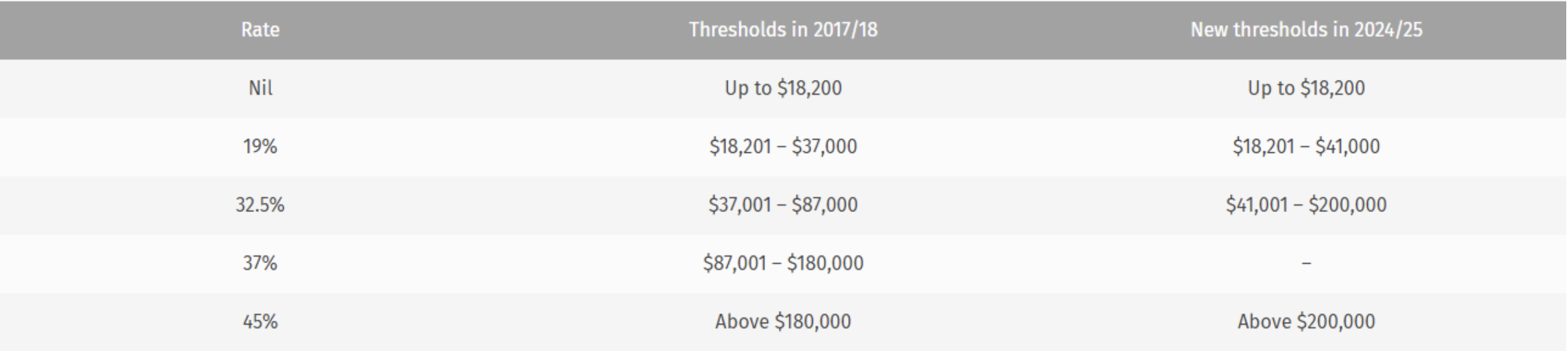
The 37% PIT bracket will be removed from 1 July 2024. From 1 July 2024, the top threshold of the 32.5% PIT bracket will be increased from $120,000 to $200,000. Taxpayers will pay the top marginal tax rate of 45% for taxable incomes exceeding $200,000, and the 32.5% PIT bracket will apply to taxable incomes of $41,001 to $200,000. This is illustrated in the table below.
Source: Budget Paper No 2, pp 33- 34; Treasurer’s media release “Tax relief for working Australians, low and middle income earners first” , 8 May 2018; and Budget 2018- 19 Glossy: Stronger growth to create more jobs, p 11.
Medicare levy – low income thresholds to increase
The Medicare levy low-income thresholds for singles, families, seniors and pensioners will be increased from the 2017 / 18 income year .The threshold for singles will increase to $21, 980 (up from $21,655 in 2016/ 17). The family threshold will increase to $37,089 (up from $36,541 in 2016/ 17). For single seniors and pensioners, the threshold will increase to $34,758 (up from $34,244 in 2016/ 17). The family threshold for seniors and pensioners will increase to $48,385 (up from $47,670 in 2016/ 17). For each dependent child or student, the family income thresholds increase by a further $3, 406 (up from $3,356 in 2016/ 17).
Source: Budget Paper No 2, p 32.
Retaining the Medicare levy at 2%
The 2017/18 Federal Budget measure to increase the Medicare levy from 2% to 2.5% of taxable income from 1 July 2019 will not proceed. Consequential changes to other tax rates that are linked to the top personal income tax rate, such as the fringe benefits tax rate, will also not proceed.
Source: Budget Paper No 2, p 32.
Income tax exemption for certain veteran payments
Supplementary amounts (such as pension supplement, rent assistance and remote area allowance) paid to a veteran, and full payments (including the supplementary component) made to the spouse or partner of a veteran who dies, are exempt from income tax from 1 May 2018.
Source: Budget Paper No 2, pp 31- 32.
Tax Integrity — schemes to license an individual’s fame or image targeted
From 1 July 2019, all remuneration (including payments and non-cash benefits) provided for the commercial exploitation of a person’s fame or image will be included in the assessable income of that individual. This integrity measure will ensure that high profile individuals are no longer able to take advantage of lower tax rates by licensing their fame or image to another entity. High profile individuals (such as sportspeople and actors) can currently license their fame or image to another entity such as a related company or trust. Income for the use of their fame or image goes to the entity that holds the licence. This creates opportunities to take advantage of different tax treatments and facilitates misreporting and incorrect tax outcomes.
Source: Budget Paper No 2 p 45
Funding to A TO for compliance activities targeting individual taxpayers
The ATO will be provided with $130.8m from 1 July 2018 to increase compliance activities targeting individual taxpayers and their tax agents. This measure will continue four income matching programs that would otherwise terminate from 1 July 2018 to allow the ATO to detect incorrect reporting of income, such as foreign source income of high wealth individuals. The measure will also provide funding for new compliance activities, including additional audits and prosecutions, improving education and guidance materials, pre-filling of income tax returns and improving real time messaging to tax agents and individual taxpayers to deter over-claiming of entitlements, such as deductions by higher risk taxpayers and their agents.
Source: Budget Paper No 2, p 31.
INCOME T AX
R&D tax incentive changes
The calculation for entities claiming the R&D tax incentive will change commencing for income years beginning on or after 1 July 2018. Also, a maximum cash refund for “smaller” R&D claimants will be capped at $4m per financial year. A “smaller” R&D claimant is an entity with aggregated annual turnover below $20m. The changes for calculating the R&D tax incentive are based around an “R&D intensity percentage” for each entity. The R&D intensity percentage is based on the amount of R&D related expenditure as a percentage of total company expenditure. The lower the R&D intensity percentage for the entity, the lower the maximum available tax offset. Currently there is a limit on which a company can claim the accelerated rates for the R&D tax incentive. Above this limit, the R&D tax incentive can still be claimed but only at the entity’s corporate tax rate. It is proposed in the budget that the maximum eligible expenditure to get the concessional rates will rise from $100m per entity per year to $150m.
Companies with annual turnover above $20m
Currently: A 38.5% non-refundable tax offset is available with a minimum eligible R&D expenditure of $20,000 pa.
Proposed: Four levels of non-refundable tax offset based on an R&D intensity percentage and the entity’s corporate tax rate.
40% or 42.5% offset if more than 10% of total expenditure relates to R&D
36.5% or 39% offset if R&D intensity percentage is between 5% and 10%
34% or 36.5% offset if R&D intensity percentage is between 2% and 5%
31.5% or 34% offset if R&D intensity percentage is between 0% and 2%.
Companies with annual turnover less than $20m
Currently: A 43.5% refundable tax offset is available with a minimum eligible R&D expenditure of $20,000 pa.
Proposed: A refundable tax offset of 13.5% percentage points above the entity’s corporate tax rate. This will mean no change for some companies as the refundable tax offset will remain 43.5%.
However, “base rate entities” which have a lower corporate tax rate of 27.5% will now have a maximum refundable tax offset of 4 1%. Also, it is proposed that the maximum cash refund available is $4m. Any additional refunds past this amount can be carried forward to later income years.
Source: Budget Paper No 2, p 21.
$20,000 immediate asset write-off extended
Businesses with an aggregated turnover of less than $10m will continue to have access to the $20,000 instant asset write-off for another 12 months. A small business will get an immediate deduction for assets costing less than $20,000, and installed and ready for use before 30 June 2019. The current rules regarding accelerated depreciation for small businesses remain in place. Therefore, assets (including grouped assets purchased as a set) costing more than $20,000 and installed ready for use prior to 30 June 2019 will need to be pooled at an initial r ate of 15% in the first year. Also, small business depreciation pools valued under $20,000 as at 1 July 2018 can be immediately written off in the 2018/ 19 income year .The current “lock out” laws for simplified depreciation rules, which prevent small businesses from re-entering the pooling rules for five years if they opt out, will continue to be suspended until 30 June 2019.
Source: Budget Paper No 2, p 20.
Tax integrity — Div 7A UPE rule strengthened; major reform delayed
Division 7A of IT AA 1936 will be amended to clarify the circumstances in which it applies to unpaid present entitlements (UPEs) — where a related private company becomes entitled to a share of trust income as a beneficiary, but has not been paid that amount. The amendments will apply from 1 July 2019. Division 7A is an integrity rule that requires benefits provided by private companies to related taxpayers to be taxed as dividends unless they are structured as Div 7A complying loans or another exception applies. This measure will ensure the UPE is either required to be repaid to the private company over time as a complying loan or subject to tax as a dividend. The start date of targeted amendments to Div 7A will be deferred from 1 July 2018 to 1 July 2019. Those reforms, announced in the 10- Y ear Enterprise Tax Plan in the 2016/17 Budget, will enable all Div 7A amendments to be progressed as part of a consolidated package.
Source: Budget Paper No 2, p 4 1.
Tax integrity — deductions for vacant land to be denied
From 1 July 2019, tax deductions will not be allowed for expenses associated with holding vacant land. This is an integrity measure to address concerns that deductions are being improperly claimed for expenses, such as interest costs related to holding vacant land where the land is not genuinely held for the purpose of earning assessable income. It will also reduce tax incentives for land banking, which deny the use of land for housing or other development. The measure will apply to land held for residential or commercial purposes. However, the “carrying on a business” test will generally exclude land held for commercial development. Deductions that are denied will not be able to be carried forward for use in later income years. Expenses for denied deductions that would ordinarily be a cost base element (such as borrowing expenses and council rates) may be included in the cost base of the asset for capital gains tax (CGT) purposes when sold. However, deductions denied for expenses that would not ordinarily be a cost base element would not be able to be included in the CGT cost base. The measure will not apply to expenses associated with holding land that are incurred after:
a property has been constructed on the land, it has received approval to be occupied and is available for rent, or
the land is being used by the owner to carry on a business, including a business of primary production.
Source: Budget Paper No 2, p 42.
Tax integrity — no small business CGT concessions for assignment of partnership rights
The small business capital gains tax (CGT) concessions will no longer be available to partners that alienate their income by creating, assigning or otherwise dealing in rights to the future income of a partnership. The small business CGT concessions assist owners of small businesses by providing relief from CGT on the disposal of assets related to their business. However, some taxpayers, including large partnerships, are able to inappropriately access these concessions in relation to their assignment of a right to the future income of a partnership to an entity, without giving that entity any role in the partnership. The measure applies from 7:30pm (AEST) on 8 May 2018 for small business CGT concessions in relation to the assigned rights. However, the small business CGT concessions themselves will not be amended. The concessions will continue to be available to eligible small businesses with an aggregated annual turnover of less than $2m or net assets less than $6m.
Source: Budget Paper No 2, p 43.
Non-compliant payments to employees and contractors no longer deductible
Businesses will no longer be able to claim deductions for payments to their employees where they have not met their PAYG obligations. This includes where the employer is required to withhold PAYG from gross payments, but fails to report or remit it to the ATO. Additionally, the deduction for businesses on certain payments to contractors which have not met PAYG obligations will be removed. Currently, if a contractor does not quote an ABN in a business-to business transaction, the purchaser is required to withhold an amount at the top marginal tax rate and remit this amount to the ATO. Failure to do this correctly will render the entire payment non-deductible. Both of these measures will take effect from 1 July 2019.
Source: Budget Paper No 2, p 24.
Tax Integrity — 50% CGT discount removed for MIT s and attribution MIT s at the trust level
Managed investment trusts (MITs) and attribution MITs (AMITs) will be prevented from applying the 50% capital gains tax (CGT) discount at the trust level. This measure will apply to payments made from 1 July 2019. The measure will prevent beneficiaries that are not entitled to the CGT discount in their own right from getting a benefit from the CGT discount being applied at the trust level. It will ensure that MITs and AMIT s operate as genuine flow through tax vehicles, so that income is taxed in the hands of investors, as if they had invested directly. MIT s and AMIT s that derive a capital gain will still be able to distribute this income as a capital gain that can be discounted in the hands of the beneficiary.
Source: Budget Paper No 2, p 44.
Tax Integrity — anti avoidance rules for circular trust distributions extended to family trusts
A specific anti-avoidance rule that applies to closely held trusts engaging in circular trust distributions will be extended to family trusts. Currently, where family trusts act as beneficiaries of each other in a “round robin” arrangement, a distribution can be ultimately returned to the original trustee — in a way that avoids any tax being paid on that amount. This measure will better enable the ATO to pursue family trusts that engage in these arrangements by extending the specific anti-avoidance rule, imposing tax on such distributions at a rate equal to the top personal tax r ate plus the Medicare levy. The measure will apply from 1 July 2019.
Source: Budget Paper No 2, p 43.
Tax Integrity — testamentary trusts and injected assets
From 1 July 2019, the concessional tax rates available for minors receiving income from testamentary trusts will be limited to income derived from assets that are transferred from the deceased estate, or the proceeds of the disposal or investment of those assets. Currently, income received by minors from testamentary trusts is taxed at normal adult rates rather than the higher tax rates that generally apply to minors. However, some taxpayers are able to inappropriately obtain the benefit of this lower tax rate by injecting assets unrelated to the deceased estate into the testamentary trust. The measure will clarify that minors will be taxed at adult marginal tax rates only in respect of the income a testamentary trust generates from assets of the deceased estate (or the proceeds of the disposal or investment of these assets).
Source: Budget Paper No 2, p 44.
Income tax exemption for International Cricket Council
A five year income tax exemption will be provided to a subsidiary of the International Cricket Council (ICC) for the ICC World Twenty20 to be held in Australia in 2020. The exemption will apply from 1 July 2018 to 30 June 2023. The subsidiary will also be provided an exemption from interest, dividend and royalty withholding tax liabilities for the same period.
Source: Budget Paper No 2, p 27.
SUPERANNUATION
Increased membership of SMSF s and small APRA funds
New and existing self-managed superannuation funds (SMSFs) and small APRA funds will be allowed to have a maximum of six members from 1 July 2019. Currently, the maximum allowable number of members in an SMSF and a small APRA fund is four.
Source: Budget Paper No 2, p 40.
Three-yearly audit cycle for some SMSF s
The annual audit requirement for self-managed superannuation funds (SMSFs) will be changed to a three-yearly requirement for SMSF s with a history of good record keeping and compliance, i.e. for SMSF trustees that have a history of three consecutive years of clear audit reports and timely lodgements of the fund’s annual returns. This measure will commence on 1 July 2019. The government will consult with stakeholders to ensure a smooth implementation of this measure.
Source: Budget Paper No 2, p 4 1.
Preventing inadvertent concessional cap breaches
Individuals whose income exceeds $263,157, and have multiple employers, will be able to nominate that their wages from certain employers are not subject to the superannuation guarantee (SG) from 1 July 2018. The measure is intended to ensure eligible individuals can avoid unintentionally breaching the $25,000 annual concessional contributions cap as a result of multiple compulsory SG contributions. Breaching the cap results in individuals being liable to pay excess contributions tax and a shortfall interest charge. Employees using this measure may receive additional income which will be taxed at marginal tax rates.
Source: Budget Paper No 2, p 40.
Improving integrity of personal contributions deductions
Individual income tax returns will be modified to include a tick box for individuals with personal superannuation contributions to confirm that they have complied with the requirements to submit a “notice of intent” (NOI) where they intend to take a tax deduction for the contributions. The change is intended to improve the integrity of the NOI processes for claiming personal superannuation contribution tax deductions. Where individuals take deductions for their personal superannuation contributions, but do not submit the required “notice of intent”, it results in superannuation funds not applying the 15% tax to their contribution and no tax is paid on it. The ATO will receive additional funding to develop a new compliance model, and to undertake additional compliance and debt collection activities, including denying deductions to individuals who do not comply with the NOI requirements. This measure will commence from 1 July 2018.
Source: Budget Paper No 2, p 39.
Super work test exemption for recent retirees
An exemption from the work test for voluntary contributions to superannuation will be introduced from 1 July 2019 for people aged 65- 7 4 with superannuation balances below $300,000, in the first year that they do not meet the work test requirements. The work test exemption will give recent retirees flexibility to get their financial affairs in order in the transition to retirement. Currently, the work test restricts the ability to make voluntary superannuation contributions for those aged 65- 74, to individuals who self-report as working a minimum of 40 hours in any 30-day period in the financial year.
Source: Budget Paper No 2 p 30
Changes to superannuation insurance arrangements
Insurance within superannuation will move from being a default framework to being offered on an opt-in basis for:
members with low balances — less than $6,000
members under the age of 25 years, and
members whose accounts have not received a contribution in 13 months and are inactive.
The changes will take effect on 1 July 2019 and affected superannuants will have a period of 14 months to decide whether they will opt -in to their existing cover or allow it to switch off.
Source: Budget Paper No 2, p 36.
Superannuation fee protection measures to be introduced
A 3% annual cap will be introduced on passive fees charged by superannuation funds on accounts with balances below $6,000, and exit fees on all superannuation accounts will be banned. The government will also strengthen the ATO’s account consolidation regime by requiring the transfer of all inactive superannuation accounts to the ATO where the balances are below $6,000. The ATO will expand its data matching processes to proactively reunite these inactive superannuation accounts with the member’s active account, where possible. This measure will also include the proactive payment of funds currently held by the ATO. These changes will take effect from 1 July 2019.
Source: Budget Paper No 2, p 35 and Minister for Revenue and Financial Services’ media release,
“Encouraging and Rewarding Australians by Protecting Y our Superannuation”, 8 May 2018.
Financial institutions supervisory levies to be increased
The financial institutions supervisory levies will be increased to raise additional revenue of $31. 9m over four years, from 2018/ 19.This will fully recover the cost of superannuation activities undertaken by the ATO, consistent with the Australian Government Cost Recovery Guidelines.
Source: Budget Paper No 2, p 27.
BLACK ECONOMY MEASURES
Reforms to combat illegal phoenixing and black economy
The government will reform the corporations and tax laws and provide the regulators with additional tools to assist them to deter and disrupt illegal phoenix activity. The package includes reforms to:
introduce new phoenix offences to target those who conduct or facilitate illegal phoenixing
prevent directors improperly backdating resignations to avoid liability or prosecution
limit the ability of directors to resign when this would leave the company with no directors
restrict the ability of related creditors to vote on the appointment, removal or replacement of an external administrator
extend the Director Penalty Regime to GST , luxury car tax and wine equalisation tax, making directors personally liable for the company’s debts, and
expand the ATO’s power to retain refunds where there are outstanding tax lodgements.
Additional funding to the ATO will also be provided over four years to implement new strategies to combat the black economy. The ATO will implement a new and enhanced enforcement strategy that brings together new mobile strike teams and an increased audit presence, a Black Economy Hotline that will allow for the community to report black economy and illegal phoenix activities, improved government data analytics, and educational activities. The government will also consult on and design a new regulatory framework for the Australian Business Number (ABN) system in 2018/19. This measure implements a recommendation of the Black Economy Taskforce — Final Report that the ABN system be strengthened to provide improved confidence in the identity and legitimacy of Australian businesses.
Source: Budget Paper No 2, p 37 and Minister for Revenue and Financial Services’ media release,
“Tackling Illegal Behaviour in the Black Economy”, 8 May 2018.
Taxable payments reporting system to be expanded
The taxable payments reporting system (TPRS) will be expanded to the following industries from 1 July 2019:
security providers and investigation services
road freight transport, and
computer system design and related services.
The TPRS requires businesses to report to the ATO any payments made to contractors during an income year. This additional reporting to the ATO is in the form of an annual report and puts these payments in line with payments in line with payments made for salaries and wages to employees. As the report is a yearly report for years commencing 1 July 2019, the first annual report will be required in August 2020. These reporting requirements are identical to ones already in place for payments to contractors in the building and construction industry, as well as payments in the cleaning and courier industries, commencing 1 July 2018.
Source: Budget Paper No 2, p 22.
Large government contract tenders required to be tax compliant
Businesses seeking to tender for large Australian government contracts will be required to provide information on the status of their tax obligations. Under the proposed arrangements, contracts over $4m (including GST) will be affected. The ATO will receive additional funding to support this measure, which is part of a larger framework of funding for Black Economy Taskforce measures. This measure will commence from 1 July 2019.
Source: Budget Paper No 2, p 181.
Cash receipt limit for businesses to be introduced
Large undocumented cash payments can be used to avoid tax or to launder money from criminal activity. The government will introduce a Black Economy Taskforce recommendation to limit a cash receipt for a business to under $10,000, from 1 July 2019. Transactions with financial institutions or consumer to consumer non-business transactions will not be affected. The Black Economy Taskforce measures include additional funding for the Department of Treasury to enable stakeholder consultation to help with details on the measure. Also, the ATO will receive enhanced funding that will help with enforcement of these proposed measures.
Source: Budget Paper No 2, p 23.
INDIRECT TAXES
GST to be extended to offshore hotel accommodation sellers
Offshore sellers of hotel accommodation in Australia will be required to calculate their GST turnover in the same way as local sellers from 1 July 2019. Currently, unlike GST -registered businesses in Australia, offshore sellers of Australian hotel accommodation are exempt from including sales of hotel accommodation in their GST turnover. This means that they are often not required to register for and charge GST on their mark-up over the wholesale price of the accommodation. Removing the exemption will level the playing field by ensuring the same tax treatment of Australian hotel accommodation, whether booked through a domestic or offshore company. The measure will apply to sales made on or after 1 July 2019. Sales that occur before 1 July 2019 will not be subject to the measure even if the stay at the hotel occurs after this date. This change will require the unanimous agreement of the states and territories prior to the enactment of legislation. This measure follows the extension of GST to digital products and other services from 1 July 2017, and to low value imported goods from 1 July 2018.
Source: Budget Paper No 2, p 29.
Removal of luxury car tax on r e-imported cars following refurbishment overseas
The luxury car tax on cars re-imported into Australia, following a refurbishment overseas, will be removed from 1 January 2019. Currently, cars that are refurbished in Australia are not subject to luxury car tax. However, cars exported from Australia to be refurbished overseas and then re-imported are subject to the tax where the value of the car exceeds the relevant luxury car tax threshold. The inconsistency in tax treatment of refurbished cars will be removed in order to align with Australia’s trade obligations with its foreign trading partners. This measure will ensure the same tax treatment applies, regardless of where the car is refurbished.
Source: Budget Paper No 2, p 38.
Larger refunds and lower rates of excise on alcohol
The alcohol excise refund scheme will be increased from $30,000 per financial year to $100,000 commencing 1 July 2019. The refund will increase for domestic brewers, distillers and producers of draught beer and other fermented beverages such as cider. Domestic brewers of beer will also receive additional relief in the form of a lower excise r ate for smaller kegs. Currently, a lower rate of excise is available for draught beer kegs that are larger than 48 litres. The threshold for this concessional r ate will be lowered to kegs which are 8 litres and above.
Source: Budget Paper No 2, p 19.
Black economy package — combatting illicit tobacco
Measures to target the three main sources of illicit tobacco in Australia (smuggling, leakage from licensed warehouses and domestic production) will be introduced. Collecting tobacco duties and taxes at the border From 1 July 2019, importers of tobacco will be required to pay all duty and tax liabilities upon importation.
This is a change from the current system, where tobacco can be imported and stored in licensed warehouses prior to tax being paid. Transitional arrangements will apply to tobacco products that are held in licensed warehouses at the commencement of the measure on 1 July 2019, allowing eligible affected entities to pay the liability on the warehoused stock within 12 months. Current weekly settlement arrangements will no longer apply to imported tobacco. Although there is currently no licensed commercial tobacco production in Australia, the taxing point for any future domestic manufacture of tobacco will also be changed to be consistent with the new taxing point for tobacco imports.
Creation of the Illicit Tobacco Task Force
From 1 July 2018, a multi-agency Illicit Tobacco Task Force will be formed, comprising members from a number of law enforcement and border security agencies, to combat illicit tobacco smuggling. The new task force will have additional powers and capabilities to enhance intelligence gathering and target, disrupt and prosecute serious and organised crime groups at the centre of the illicit tobacco trade.
Additional resources to combat domestic tobacco crops
From 1 July 2018, the A TO will provide ongoing funding to bolster its capabilities to detect and destroy domestically grown illicit tobacco crops.
Prohibited import control for tobacco
From 1 July 2019, permits will be required for all tobacco imports (except for tobacco imported by travellers within duty free limits).
ATO excise systems upgrade
The A TO will upgrade and modernise its excise and excise equivalent goods payment systems from 2020/21 to replace the paper lodgement system.
Source: Budget Paper No 2, pp 12- 13 and Minister for Revenue and Financial Services’ media release, “Tackling Illegal Behaviour in the Black Economy”, 8 May 2018.
Customs duty on imported placebos and clinical trial kits to be removed
Customs tariffs from placebos and clinical trial kits that are imported into Australia will be removed from 1 July 2018. This measure will simplify the import process for clinical trial kits and placebos, removing the need to differentiate between medicines and placebos, as both will now be subject to a free rate of duty.
Source: Budget Paper No 2, p 13.
Access to Indirect Tax Concession Scheme extended
Access to refunds of indirect tax, including GST, fuel and alcohol taxes under the Indirect Tax Concession Scheme has been extended. New access to refunds will be gr anted to the diplomatic and consular representations of Cote d’Ivoire, Guatemala, Costa Rica and Kazakhstan in Australia. Each of these changes has effect from a time specified by the Minister for Foreign Affairs.
Leenane Templeton Chartered Accountants has been shortlisted as a finalist to win an award in the Boutique Firm of the Year category at the 2018 Australian Accounting Awards, hosted by Accountants Daily.
“This award demonstrates our high standards of professionalism and commitment to providing valuable advice and service to our clients, we believe in placing the clients interests first rather than our own” said Andrew Frith, CEO of Leenane Templeton.
“Leenane Templeton’s recognition for its excellent contribution to the industry reinforces the strength of the brand in connecting with the community and engaging with its clients,” he added.
Now on its fifth year, the Australian Accounting Awards, in partnership with Thomson Reuters, recognises the exceptional contribution of individuals and accounting firms across 31 categories. Winners from the individual categories will automatically be shortlisted for the coveted Accountants Daily Excellence Award.
“On behalf of the team at Accountants Daily, sincere congratulations to all the deserving finalists in this year’s Australian Accounting Awards,” said Accountants Daily managing editor Katarina Taurian.
“It’s great to see such a diverse mix of firms, from micro-businesses right up to nationwide networks.
“We are also pleased to be recognising the broader role accountants play in their locales and in the lives of their clients. Accountants are the backbone of small business in Australia, and the community flow-on effect is enormous.”
The winners will be announced at a black-tie awards dinner on 1 June at the Hyatt Regency Sydney.
Earlier this month, the ATO released Self Managed Superannuation Fund Regulator’s Bulletin SMSFRB 2018/1. It contains some of the most important information available on the use of reserves for SMSFs. However, there is a vital question regarding contribution reserving that SMSFRB 2018/1 gives rise to. The question is not expressly answered; however, in this article I provide what I believe the best answer is.
Background
In SMSFRB 2018/1 the ATO detail that they are less than keen on SMSFs maintaining certain types of reserves. For example, the ATO describe:
an administration reserve as ‘unnecessary for an SMSF’;
an investment reserve as ‘unnecessary in SMSFs’; and
an operational risk reserve as ‘not necessary in SMSFs’.
However, a reserve to hold unallocated contributions (ie, contribution reserving) still appears to be permissible. That being said, the ATO does not consider such an account to be a reserve for superannuation law purposes. Accordingly, the ATO in SMSFR 2018/1 state:
… contributions ‘reserve’ is often used to describe the accounts used to record contributions pending allocation to members. In such cases, these accounts are not reserves for the purposes of the SISA and SISR.
In this article, however, I will use the term ‘contribution reserving.’
How contribution reserving works
Consider the following example from Taxation Determination TD 2013/22. (For completeness, I note that I have updated the financial year to make it more relevant — apart from that, I have quoted TD 2013/22 largely verbatim.)
Harry’s concessional contributions cap for the 2017-18 financial year is $25,000 … Harry makes a personal contribution of $25,000 which is received by his fund on 30 June 2018. The Trustees apply this amount to [a contributions reserve] established in accordance with the governing rules of the fund. On 2 July 2018, the trustees allocate the amount of $25,000 to Harry’s member account in the fund with effect from 2 July 2018 …
The $25,000 contribution is included in the amount of Harry’s concessional contributions for the 2018-19 financial year …
The ATO appear to still accept this. See paragraph 45 of SMSFRB 2018/1.
Accordingly, a contributions reserve appears to allow someone to claim two lots of deductions in financial year 1 (eg, $25,000 x 2 = $50,000), but spread the concessional contributions over two years (and thus there are no excess concessional contributions).
Where the key question arises
The ATO are concerned about uses of reserves that produce positive tax implications under the new laws that commenced from 1 July 2017 (eg, ‘the intentional use of a reserve to reduce a member’s total superannuation balance to enable them to make non-concessional contributions without breaching their non-concessional contributions’ cap’).
To continue the example above, assume that:
if the 30 June 2018 contribution is ignored, Harry would have a total superannuation balance of $1,590,000 as at just before 1 July 2018; however
if the 30 June 2018 contribution is counted, Harry would have a total superannuation balance of $1,615,000 as at just before 1 July 2018.
To put it differently, due to the use of contributions reserving, Harry may be viewed to have a total superannuation balance that is less than the general transfer balance cap for the 2018-19 financial year. Recall that since 1 July 2017, s 292‑85 of the Income Tax Assessment Act 1997 (Cth) provides:
Your non-concessional contributions cap for a financial year is:
(a) unless paragraph (b) applies—[$100,000]; or
(b) if, immediately before the start of the year, your total superannuation balance equals or exceeds [$1,600,000]—nil.
The implications of this are that, due to the use of a contributions reserve, Harry might have a $100,000 non-concessional contributions cap in the 2018-19 financial year. If a contributions reserve were not used, Harry might have had a nil concessional contributions cap in the 2018-19 financial year.
So is a contributions reserve allowed?
In SMSFRB 2018/1 the ATO state that:
We will not apply compliance resources to review arrangements entered into by SMSFs as described in this Bulletin before 1 July 2017 provided that … the facts and circumstances do not indicate that the use of the reserve by the trustee was a means of circumventing the restrictions imposed by the Government’s Superannuation Reform measures announced in the 2016-17 Budget
In light of this, without providing an analysis of the law on point, in a practical sense my view is as follows.
A contribution reserve can be admissible. However, if it provides a benefit in respect of the new laws that took effect from 1 July 2017, either:
do not engage in the contributions reserve; or
first seek prospective ATO input (eg, private binding ruling and/or an SMSF specific advice).
This is a complex area of law. The above is not law and should not be relied upon. Expert advice should be obtained. Naturally, for advisers, the Australian Financial Services Licence under the Corporations Act 2001 (Cth) and tax advice obligations under the Tax Agent Services Act 2009 (Cth) need to be appropriately managed to ensure any advice provided is within the bounds of the law.
For SMSF advice and set up please chat with our SMSF Specialist advisors at Leenane Templeton.
This article was provide with permission and written by Bryce Figot at DBA Lawyers
The end of the FBT year is fast approaching, and it is a good time to reflect on your FBT plans for 2018-19.
Fringe benefits are benefits that you provide to your staff that fall outside the categories of traditional wages and salaries. Examples of common fringe benefits include cars, low interest or interest-free loans and school fees.
Fringe benefits are taxed differently to income, and business owners should be aware of the relevant compliance issues when negotiating salary packages. The benefits are not subject to income tax. However, the employer must pay fringe benefits tax (FBT). Typically, the employer will reduce the employee’s salary by the amount equivalent to the FBT incurred.
The FBT rate is back to 47%. It had been temporarily raised to 49% to prevent high income earners from circumventing the 2% budget repair levy. It returned to the normal rate on 1 April 2017.
It is advisable to seek professional guidance before entering into a new salary packaging agreement with an employee. The reason for this is that the calculations surrounding FBT calculations are extremely complex, and you may end up inadvertently disadvantaging them in the process, thereby defeating the purpose of salary packaging.
Running your own business can be extremely rewarding but there will always be times when it will be quite the opposite. Depending on the business, many factors will determine the success or failure of a small enterprise however the most common is cash flow. Outlined below are a few simple solutions to cash flow problems to help make your business ownership more rewarding.
Without the regular inward flow of cold, hard cash any business will die a natural death. Many small business owners know too well that operating in an uncertain economic environment means customers take more time to pay. Accounting Software Xero’s latest study of their users found that about 60% of invoices are paid late, and more than a third are at least 2 weeks late.
Dun & Bradstreet’s Trade Payments Analysis reports that businesses are waiting on average 45 days to receive payments on invoices– it’s actually at a historic low but that’s still almost seven weeks. When most small businesses set their terms at seven or fourteen days payment, this statistic is not only dangerous to the health of the business, but rising stress is dangerous to the health of the owner.
If you’re finding it hard to get your customers to pay you on time, there are some simple solutions:
1 – Discuss payment terms– Start as you mean to go on with new clients. Getting it sorted upfront sets out the expectations and reduces any confusion
2 – Pay upfront. Of course, the easiest way is to get full payment upfront, but this can be difficult for most service providers, particularly with new customers. Instead, ask for a part-payment, which could be 50%-70%, prior to the full service being delivered. This not only establishes a mutual commitment by both parties but also creates a more regular flow of cash into your business.
3 – Use an automatic payment service. This can be done for one-off or ongoing payments and assures you that you will be paid because the payment has already been scheduled from your customer’s bank account. Here’s another tip – where possible set up the deduction from a bank account instead of a credit card. It’s much harder to cancel the former and credit cards regularly expire. There are many reliable services available in Australia and the cost is surprisingly low. Type “direct debit payment services Australia” into your search engine, do some research and find the one that suits you best. Once set up, you’ll wonder why you didn’t do it earlier.
4 – Provide an incentive. Encourage your customers to pay before the due date by offering a small discount. Utility companies and councils have done this for decades and although it could reduce your profit a little, you’ll save by not having to chase late payers. The opposite of discounting is late-payment penalties or adding interest to overdue payments. Be careful with this practice because it can create more animosity when the original invoiced amount blows out of context. And it does nothing for ongoing customer relationships
5 – Invoice as soon as possible – As a small business operator managing many areas of the business can result in delays in invoicing. Make sure you invoice as soon as possible and use technology like accounting software to create professional recurring invoices or to invoice from your phone on the go
On the flipside, if your customers are dragging the chain, you could be having difficulty paying your bills. Knowing what it feels like, take the upper hand and explain the position to your creditors. Most will be happy to work out a payment schedule so that everyone wins.
For help with your small business speak with your advisor at Leenane Templeton Chartered Accountants and Business Advisors. Call (02) 4926 2300 or contact us.
As a hard-working small business owner you’ve spent years building your own livelihood and now, for whatever reason, you’ve decided the time has come to sell or close down your enterprise.
To assist you, the Australian Tax Office has a handy checklist on its website to enable you to tick off important legal and taxation matters you will need to address. You can find it here.
Many of the items listed are fairly straightforward so I have focused on clarifying those that could cause confusion.
Goods and services tax
Disposing of capital assets
If you are registered for GST, disposing of capital assets is a taxable sale and you are required to account for GST.
Margin scheme
If you are selling real property, the margin scheme calculates the GST as being 1/11th of the difference between the sale price and the purchase price or approved valuation.
Sale of a going concern
A business sold as a going concern is generally exempt from GST however the ATO recommends you obtain a private ruling relating to your particular circumstances.
Capital gains tax
The sale of your business’ assets may incur CGT if you sell them for more than their cost base.
Small business concessions
If you satisfy the definition of ‘small business’ for CGT purposes (currently net assets of $6 million or less) you may be eligible for:
CGT exemption on assets owned continuously for at least 15 years;
50% capital gain reduction on active assets or total relief if you are retiring; and
deferred capital gains for two years, or longer if you acquire a replacement asset.
Earnouts
If a price can’t be agreed at sale time an ‘earnout agreement’ allows payment of an initial lump sum with subsequent payments made based on the business’ performance after sale. These payments are considered received in the year the sale occurred, often requiring the amendment of prior year tax returns.
Event K6
If you own pre-CGT shares and the market value of your company’s post-CGT assets are at least 75% of the net value of the company, the ATO may deem your shares to be post-CGT assets.
Buy/Sell agreement
An agreement whereby the surviving business partners will buy out your interest in the business should you die, become disabled or retire. If the payout from a life insurance policy is used, the proceeds will be exempt from CGT.
Cap election
Should you satisfy the ‘small business’ net asset threshold and the 15-year ownership CGT exemption you may be eligible to make a non-concessional contribution of your business sale proceeds into superannuation without affecting your non-concessional cap. A lifetime limit of $500,000 applies.
Rollover statement
You must provide certain information to a super fund when rolling over an ETP consisting of a CGT-exempt component.
Division 7A
If your business forgives all or part of a debt owed by you as a shareholder or shareholder’s associate, the debt may be treated as dividends under Division 7A. You can seek the Tax Commissioner’s discretion in this area.
Demergers
If selling your company as a number of separate entities your demerger may have CGT consequences.
Winding up a company
If your company pays a distribution to shareholders of money or property that has been derived from income and not paid up share capital, that distribution may be deemed to be dividends.
CGT provisions can be triggered when a company makes a final or interim distribution where the distribution is not deemed to be dividends.
If a liquidator has been appointed, it has an obligation to collect any debts owed to the ATO.
Finalising employee or independent contractor obligations
If your business has employees, including independent contractors, you will need to finalise matters relating to FBT, PAYG, superannuation and eligible termination payments for those employees.
The checklist is an excellent guide, but you should always seek professional advice regarding the legal and taxation matters involved and above all, retain all related documentation and records. Please call our team at Leenane Templeton on (02) 4926 2300 or contact us.
Margaret was 21 when she married Graham. She was working as a sales assistant in a large department store when they decided to start a family.
As her pregnancy advanced Margaret gave up work and Graham, a warehouse fork-lift driver, took a second job to make up the shortfall in their income. He was a hard worker and fast learner which prompted his boss to promote Graham to Warehouse Manager a few months later.
In the years after their first son was born, two more babies arrived – another boy and a girl. Once the children were settled at school, Margaret returned to part-time work.
Soon after they’d married, Graham engaged David a financial planner to structure an insurance and savings strategy. With David’s ongoing guidance, the young couple was able to afford annual holidays, private school fees and put aside cash for unexpected events.
Years passed and the children grew up and left home. Graham was now a partner in the warehousing business and earning a good income. So when Margaret turned 50, she decided to take early retirement.
They were living comfortably on Graham’s salary when he suffered a heart-attack. He was rushed to hospital but died shortly after.
Margaret knew that Graham had insurance policies and that there were investments and superannuation, but other than relying on their bank account balance to pay household bills, she’d had little other involvement; happily leaving that to Graham and David.
Over the years, their financial planner had become a family friend, and it was to David that Margaret now turned.
David took care of the insurance claims and organised for Graham’s superannuation to be paid out. He recommended Margaret pay off the remainder of the mortgage.
After considering insurances, superannuation and the investment portfolio, Margaret discovered that she’d been well provided for but she had no idea what to do with her money. She didn’t know what the tax implications would be and was worried about having a regular income.
David’s next task was to define Margaret’s needs and level of risk tolerance. He addressed Margaret’s tax situation and structured a portfolio to provide an income stream for her to live off.
When Margaret turned 55, David advised that her own superannuation was accessible. He reviewed her investments to maximise Margaret’s income potential and minimise her tax liability.
Margaret and Graham had dreamed of retiring at the beach so she sold the family home and bought a comfortable beachside apartment. Downsizing freed additional cash so Margaret, now 65 and financially secure, asked David to open investment accounts for each of her four grandchildren.
To celebrate Margaret’s 70th birthday, she decided to take a cruise with a dear friend. David arranged a partial redemption from the most appropriate of her investments so she was able to holiday in style.
Although Margaret had been widowed unexpectedly, early planning and good advice enabled her to maintain an enjoyable lifestyle in retirement. Graham would definitely be resting in peace.
For a full financial plan feel free to call our team to discuss your needs and the steps we take to help achieve the right plan for you. Contact Leenane Templeton today.
An important part of the wedding vows is “for richer or poorer” and we’d all prefer the former! But after the euphoria of the wedding day passes, many couples leave their financial management to chance with money often becoming a bone of contention if each has different goals and attitudes.
It’s unlikely that anyone would vow on their wedding day “I will love and honour you, keep only one credit card and pay it off every month”, but seriously, couples need to develop their own financial vows. It’s not very romantic however this five-step guide could save a lot of heartache.
Step 1 – Prioritise
Agree on what is most important to you both. You could spend big on lifestyle. Or save to afford a house, children, or some other goal such as further education. Once you’ve agreed on your goals, give your plan a name (get creative!), put it on paper (an App is too easy to forget about) and post it on the fridge where you see it every day to keep you focused.
Step 2 – Know where your money goes
If you can’t measure it, you can’t manage it. As boring as it may seem, you need to look at your spending and decide if it is consistent with your priorities. This can be done by checking your bank and card statements every month. Most online banking programs offer this reporting feature making this step very easy.
Step 3 – Don’t eat your money
Most spending goes on food, so if you ever wondered where your money goes, you probably ate it! Reduce impulsive food buying by eating before you shop so you’re not hungry and shopping only once per week. One weekly trip to the supermarket will also cut petrol costs.
Step 4 – Shop wisely
When you are spending on larger items, think before you buy. Do you need the big brand name? Maybe yes on electrical goods but maybe not on new clothing. Comparison-shopping does make a difference and there are many websites to help you find the best deals (be aware that a lot of comparison sites only show those providers who have paid for a listing so the reviews can be skewed).
Step 5 – Keep talking
Having a plan is no good unless you review it regularly. This is a time to leave the boxing gloves off because you will both make mistakes and maybe even cheat on your agreements. Your priorities will change over time and your Money Plan will change too. It’s important to agree on your goals, maintain good communication and, above all, keep your sense of humour.
Whilst these steps were written for newlyweds, they are just as appropriate for any couple, families, empty nesters and retirees… it’s never too late to start.
For help with your financial planning please call our financial advisors for an appointment. Call (02) 4926 2300 or email our team
For those who are interested in purchasing their first residential premises, the First Home Super Saver (‘FHSS’) Scheme may be an option worth exploring. We consider the questions below regarding the FHSS Scheme introduced by the Treasury Laws Amendment (Reducing Pressure On Housing Affordability Measures No. 1) Act 2017 (Cth) (that received royal assent on 13 December 2017):
How does the FHSS Scheme work?
What are some tips and traps for SMSFs and their members regarding this?
How does the FHSS Scheme work?
There are four broad steps that need to be taken if a member wants to take advantage of the FHSS Scheme.
Step 1: Eligibility
The first step the member needs to take is to confirm that they are eligible to participate in the FHSS Scheme. Broadly, the member must:
have never held any freehold interest in land in Australia (including any long-term leasehold interest of 50 plus years). This is either in their individual capacity or through a controlled foreign company title interest;
be 18 years or older; and
have not previously received any payment under the FHSS Scheme.
A member may still be eligible for the FHSS Scheme if they have previously owned property in Australia if they have suffered financial hardship subject to them satisfying further conditions. This measure was provided to assist individuals who have suffered financial setbacks, like relationship breakdowns, to exit the rental market and start over again. Supplemental regulations will specify the relevant circumstances the ATO will consider to make such a determination.
A member should check whether their fund accepts FHSS contributions. The FHSS Scheme precludes defined benefit funds and constitutionally protected funds from participating which may result in many public sector employees having to find alternative funds for their FHSS contributions.
SMSFs members should ensure their SMSF deed authorises and provides the relevant mechanics to deal with the FHSS Scheme including releasing FHSS amounts to the ATO.
Step 2: Contributions
Once a member has determined that they are eligible to participate in the FHSS Scheme and their fund can accept FHSS contributions, the member can begin making eligible contributions to their super fund. Broadly, an eligible contribution is:
a concessional or non-concessional contribution that is not a mandated employer contribution. Thus, contributions that are made to cover an employer’s minimum superannuation guarantee requirement are excluded from the FHSS Scheme;
eligible insofar as it does not result in the member exceeding their concessional and non-concessional contributions caps; and
eligible insofar as it does not exceed the $15,000 FHSS contribution limit in any financial year (‘FY’), commencing from 1 July 2017.
The maximum amount of contributions that may be eligible to be released under the FHSS Scheme is $30,000. When an eligible contribution is made, the relevant super fund is required to allocate the contribution accordingly and inform the ATO. The member will, in due course, be able to check their FHSS contribution balance with the ATO from time to time.
Step 3: Determination and Release
Once the member has accumulated a certain amount in their FHSS allocations, they can request a FHSS Scheme determination from the ATO. The ATO will then provide the member with an estimate of the member’s FHSS Scheme maximum release amount, which includes:
concessional and non-concessional FHSS contributions;
associated earnings as calculated by the ATO — shortfall interest charge rate X [FHSS contributions + sum of earlier daily proxy amounts]; and
less PAYG withholding tax
After considering the amount in the FHSS determination, the member can then request a release authority from the ATO. The ATO will then generate a release authority and provide confirmation to both the member and their respective superannuation fund. Once the super fund receives the release authority, it releases the relevant amount to the ATO. The ATO receives the amount from the fund and deducts the PAYG withholding tax. After any tax is deducted, the ATO makes the net payment to the member. The member must include the FHSS amount received in their income tax return for that FY. The member is entitled to a 30% non-refundable tax offset of the FHSS amount received that FY.
Thus, if a member is on a 45% tax rate, they will only pay 15% on released amounts plus applicable levies.
Step 4: Purchase, Recontribution and Tax
Within 12 months after the release of the FHSS released amount, the member can either:
purchase or construct a residential premises;
recontribute the amount; or
request another extension for up to 12 months.
If the member enters into a contract to purchase or construct residential premises, the member is required to notify the ATO within 28 days after the member enters into such a contract.
If the member decides to recontribute the FHSS released amount (eg, they do not purchase or construct within a 12 month period), they are required to inform the ATO shortly after the release of the FHSS released amount.
The recontributed amount will count towards the member’s non-concessional caps for the FY the amount was recontributed and the member cannot claim a deduction in respect of these amounts.
A member can request that the ATO extend the period for entering into a contract by up to 12 months. Thus, the scheme generally provides a maximum period of up to 24 months from when the relevant amount is released to enter into a contract to purchase or construct a residential premises.
Alternatively, if the member retains an FHSS amount beyond the relevant 12 month, or if an extension is granted, beyond a 24 month period, they pay FHSS tax of 20% plus applicable levies on the FHSS released amount.
What are some tips and traps for SMSFs and their members?
Ideally the SMSF deed should provide express wording to enable the SMSF to receive FHSS eligible contributions and allow the SMSF, upon receipt of a release authority, to release these contributions directly to the ATO, rather than the member. Another thing that the SMSF trustee will need to do is regularly notify the ATO when a member makes an eligible contribution.
For SMSF members, it should be noted that for couples, both can participate in the FHSS Scheme to purchase their first family home. This means a couple can access up to $60,000 from their super to go towards purchasing their first home.
For individuals in higher tax brackets, there may be tax advantages in participating in the FHSS Scheme, even if they do not end up purchasing a home.
The FHSS Scheme Estimator at www.budget.gov.au/estimator/ is a tool that individuals can use to estimate how much they can gain through the FHSS Scheme by salary sacrificing their income into their super. The estimator compares outcomes of saving using pre-tax contributions to superannuation relative to saving the same amount in a standard deposit account outside the superannuation environment.
For example, if an SMSF member on a $100,000 salary contributes $13,000 a year into super, the estimator shows that in three years this can be converted into a $25,121 deposit under the FHSS Scheme. That’s $6,438 more than saving this in a standard deposit account. If this can be doubled in the case of a couple (with the same salary level), this can create savings of $50,242, however this will require both members to implement the same salary sacrifice strategy.
* * *
This article is for general information only and should not be relied upon without first seeking advice from an appropriately qualified professional.
Please feel free to call our SMSF specialists on (02) 4926 2300.
Written by and provided with permission of Christian Pakpahan,Lawyer and Daniel Butler, Director DBA Lawyers