


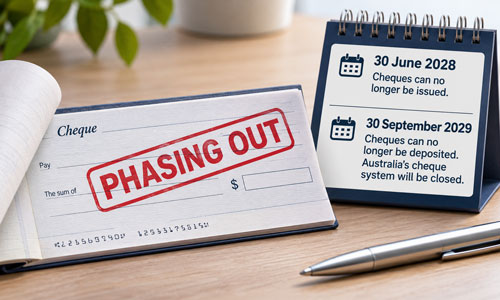
After decades of use, cheque payments are coming to an end in Australia. Whether you’re a business owner, an individual or someone who still occasionally uses bank cheques, there are some important changes ahead.
The Australian Government has confirmed that cheques will be phased out as part of its plan to modernise Australia’s payment system.
While cheques can still be used through participating financial institutions, the transition is already underway, with some banks and organisations reducing or withdrawing their cheque services.
For individuals and businesses that continue to rely on cheques, now is a good time to understand the changes and prepare for alternative payment methods.
When will cheques be phased out?
There are two important dates to be aware of:
30 June 2028 – Cheque issuance ends
Personal, business, government and bank cheques will no longer be issued after this date. Cheques written after 30 June 2028 will not be accepted for payment.
30 September 2029 – Australia’s cheque system closes
Banks and financial institutions will stop accepting cheques for payment, and cheques will no longer be able to be deposited.
Cheques issued before the June 2028 deadline may continue to be deposited until the September 2029 closure date, subject to their validity and the services offered by the relevant financial institution.
Importantly, some banks and organisations may withdraw cheque services earlier, so it’s worth checking with your financial institution.
Why is Australia moving away from cheques?
Quite simply, Australians are using cheques far less frequently than they once did.
According to the Reserve Bank of Australia’s Consumer Payment Behaviour in Australia report, published in May 2026, cheques accounted for just 0.02% of consumer payments recorded in its 2025 survey.
With electronic payments now widely used, maintaining the cheque system is becoming increasingly costly and inefficient.
The transition is part of the Australian Government’s broader strategy to modernise the payments system while allowing time for individuals and businesses to adjust.
What does this mean for businesses?
Although cheque payments are now relatively uncommon, some businesses still use them to pay suppliers, receive customer payments or manage particular financial transactions.
If your business continues to use cheques, the changes may affect your payment arrangements, accounting procedures and cash flow management.
We recommend reviewing the following areas:
- Supplier payments: Identify any suppliers you currently pay by cheque and arrange suitable alternatives.
- Customer payments: If customers pay you by cheque, begin communicating alternative payment options.
- Accounting and bookkeeping: Review your existing payment and reconciliation procedures to ensure they accommodate electronic transactions.
- Outstanding cheques: Review cheques that have been issued but not presented, and follow up on any that remain outstanding.
- Internal payment approvals: If your business relies on cheque signatures or paper-based payment authorisations, consider how equivalent approval controls will operate with electronic payments.
Making these changes progressively will help avoid unnecessary disruption as the deadlines approach.
What are the alternatives to cheques?
There are several established payment methods available, depending on your banking arrangements and the type of transaction.
Electronic funds transfer (EFT)
Payments can be made directly between bank accounts using internet or business banking.
PayID
PayID enables payments to participating accounts using identifiers such as a mobile number, email address or ABN, where supported by the financial institution.
BPAY
BPAY allows payments to participating businesses and organisations through internet or mobile banking using their biller code and customer reference number.
Debit and credit cards
Cards offer another payment option for everyday purchases and payments to businesses that accept them.
Direct debit
For recurring payments, direct debit arrangements may provide a convenient alternative to issuing individual cheques.
Before changing payment arrangements, always verify the recipient’s banking details using a trusted contact method, particularly when suppliers or other organisations notify you of changes to their account details.
What about individuals who still use cheques?
The changes will also affect individuals who use personal or bank cheques for occasional payments.
This may include people who prefer traditional banking methods or those who are less comfortable using electronic payment services.
The Australian Government and banking industry have acknowledged the need to support customers through the transition.
If you currently rely on cheques, speak with your bank about the alternatives available and what assistance it can provide.
You don’t need to wait until 2028 to start exploring your options.
How Leenane Templeton can help
At Leenane Templeton, we work with individuals and businesses across Newcastle, the Hunter and beyond, helping them manage their accounting, taxation and financial affairs.
For our business clients, moving away from cheques may also be an opportunity to review existing accounting processes, payment procedures and systems.
If you’re unsure how these changes may affect your business’s financial administration, our team can help you review your accounting processes and prepare for the transition.
The message is simple: cheques aren’t disappearing overnight, but their days are numbered. Preparing early will make the transition much easier.
For further information about Australia’s cheque phase-out, visit the official Cheques Transition website.
Comments are closed.